Sunday, January 31, 2010
Reruns Below
Given the recent earthquake in Haiti, many of us are contemplating issues of charity and donation right now. So I've rerun three entries on the topic, below.


Selfishness and Generosity
It's easy to spot selfish people. They're the ones who worry about how they're always giving too much.
Similarly, generous people are the ones who worry about how they're never giving enough.
Selfish people think of themselves as overly generous. Generous people think of themselves as overly selfish.
Similarly, generous people are the ones who worry about how they're never giving enough.
Selfish people think of themselves as overly generous. Generous people think of themselves as overly selfish.
Donation as Consumption
There's a standard do-gooder's conundrum, which I can illustrate via a real world example.
I viewed this YouTube video:
....of a superb high school orchestra from Ohio playing Tchaikovsky with tons of heart-breaking soul in a national competition (they tied for runner-up). I read the NY Times story about how these are mostly poor kids, and how the concertmaster (i.e. top violinist), a brilliant teenager, is living on her own and being forced by circumstance to abandon her dreams. The orchestra's teetering; the school system offers little support, doesn't provide instruments, and kids must actually pay-to-play - a $55 fee for the school year which some can't afford. And this is one of the lucky cases; many schools these days have no music program at all. (Before you read on, please give that Times article a read. It's well-written and touching.)
I get caught up in stories like this...and want to help. I could afford to endow a couple of kids into the orchestra who can't afford the $55, or maybe donate a couple of used violas.
But here's where the conundrum arises. There are myriad similar situations in schools all over the country. And there are myriad brilliant kids who've been forced to abandon their dreams. And there are more important problems in the world than this (e.g. starvation). So it would be very easy to haplessly throw up my arms and decline to help, given the enormity of it all. Sort of the way tourists in India quickly learn to stop giving coins to the multitudes of beggars carrying starving babies. Hey, you can't help them all!
Here's the trick to getting through that: just help what you bump into. I didn't happen to get emotionally involved in the story of some other school. It was this one that caught my attention. And today I happen not to have hunger or disease on my mind; it's Tchaikovsky. This problem, in other words, is one I noticed, cared about, and can help solve...a little.
As for not being able to "help them all", true. But every bit of help helps someone. So it's irrational to surrender to feelings of futility and do nothing. Why forego assistance we can provide just because there's much we can't? Behind this feeling of futility is the fear that one could easily drain one's coffers aiming to help each and every problem out there. First of all, that simply won't happen (except in our overblown fantasies of sainthood). Second, that fear stems from pure selfishness. The mark of a selfish person is a fear of being overly generous.
There's nothing wrong with budgeting in hard limits, as we do with other expenditures. After all, we don't throw up our hands and refuse to buy books or movies because we "can't buy them all" (and might easily drain our coffers in so trying). We simply budget our consumption. And donations ought to be viewed as consumption. Paying money to buy improvement to a given situation is what consumerism is all about. Most purchases are intended to solve problems of various sorts, and there's a satisfaction in that. And the interesting thing is that buying solutions to problems which happen to be external to us feels equally satisfying.
It's no different, in other words, from any other sort of shopping. I might buy milk, eggs, a few magazines, and a small problem or two solved. Every once in a while I'll buy a car, computer, or bigger problem solved. Smaller budgets solve smaller problems, but at any scale (above the level of struggling to pay rent and feed kids), the same principles apply. Helping someone else's kids doesn't feel any more like "throwing money away" than helping mine.
I don't feel compelled to buy every car...or to fix every problem. I don't bring home every Trader Joe's product; I pick, choose, and budget. If something that I need captures my attention, and I can afford it, I buy it. It's the same with donating to issues capturing my attention. I don't fight the impulse, nor do I deflect it by zooming the camera out to the futile enormity of it all. I donate precisely as I consume (and, with SIGA having tripled this year, I'm happy to budget higher!)
So...I'll help two anonymous strangers in Ohio play in their high school orchestra next year, for about the cost of a fancy dinner for two. A good purchase!
Finally, while it's easy to sit back and help problems that funnel to me via mainstream channels like the NY Times, more acute, less publicized problems can be discovered via active investigation. And that's where one can put one's intrepid chowhounding skills to work. Again, donating is consuming. And what is chowhounding, but extra-skillful consumption?
I viewed this YouTube video:
....of a superb high school orchestra from Ohio playing Tchaikovsky with tons of heart-breaking soul in a national competition (they tied for runner-up). I read the NY Times story about how these are mostly poor kids, and how the concertmaster (i.e. top violinist), a brilliant teenager, is living on her own and being forced by circumstance to abandon her dreams. The orchestra's teetering; the school system offers little support, doesn't provide instruments, and kids must actually pay-to-play - a $55 fee for the school year which some can't afford. And this is one of the lucky cases; many schools these days have no music program at all. (Before you read on, please give that Times article a read. It's well-written and touching.)
I get caught up in stories like this...and want to help. I could afford to endow a couple of kids into the orchestra who can't afford the $55, or maybe donate a couple of used violas.
But here's where the conundrum arises. There are myriad similar situations in schools all over the country. And there are myriad brilliant kids who've been forced to abandon their dreams. And there are more important problems in the world than this (e.g. starvation). So it would be very easy to haplessly throw up my arms and decline to help, given the enormity of it all. Sort of the way tourists in India quickly learn to stop giving coins to the multitudes of beggars carrying starving babies. Hey, you can't help them all!
Here's the trick to getting through that: just help what you bump into. I didn't happen to get emotionally involved in the story of some other school. It was this one that caught my attention. And today I happen not to have hunger or disease on my mind; it's Tchaikovsky. This problem, in other words, is one I noticed, cared about, and can help solve...a little.
As for not being able to "help them all", true. But every bit of help helps someone. So it's irrational to surrender to feelings of futility and do nothing. Why forego assistance we can provide just because there's much we can't? Behind this feeling of futility is the fear that one could easily drain one's coffers aiming to help each and every problem out there. First of all, that simply won't happen (except in our overblown fantasies of sainthood). Second, that fear stems from pure selfishness. The mark of a selfish person is a fear of being overly generous.
There's nothing wrong with budgeting in hard limits, as we do with other expenditures. After all, we don't throw up our hands and refuse to buy books or movies because we "can't buy them all" (and might easily drain our coffers in so trying). We simply budget our consumption. And donations ought to be viewed as consumption. Paying money to buy improvement to a given situation is what consumerism is all about. Most purchases are intended to solve problems of various sorts, and there's a satisfaction in that. And the interesting thing is that buying solutions to problems which happen to be external to us feels equally satisfying.
It's no different, in other words, from any other sort of shopping. I might buy milk, eggs, a few magazines, and a small problem or two solved. Every once in a while I'll buy a car, computer, or bigger problem solved. Smaller budgets solve smaller problems, but at any scale (above the level of struggling to pay rent and feed kids), the same principles apply. Helping someone else's kids doesn't feel any more like "throwing money away" than helping mine.
I don't feel compelled to buy every car...or to fix every problem. I don't bring home every Trader Joe's product; I pick, choose, and budget. If something that I need captures my attention, and I can afford it, I buy it. It's the same with donating to issues capturing my attention. I don't fight the impulse, nor do I deflect it by zooming the camera out to the futile enormity of it all. I donate precisely as I consume (and, with SIGA having tripled this year, I'm happy to budget higher!)
So...I'll help two anonymous strangers in Ohio play in their high school orchestra next year, for about the cost of a fancy dinner for two. A good purchase!
Finally, while it's easy to sit back and help problems that funnel to me via mainstream channels like the NY Times, more acute, less publicized problems can be discovered via active investigation. And that's where one can put one's intrepid chowhounding skills to work. Again, donating is consuming. And what is chowhounding, but extra-skillful consumption?
A Trick for Donating More Skillfully
The middle of a recession may seem an inappropriate time to discuss charitable donations, but non-profits really need help at times like these. And now, more than ever, it's essential to try to get the best bang-for-buck with any funds we do manage to scrape together for good causes.
Many people vet non-profits by researching them on Charity Navigator. You can learn, for example, how efficiently donations are applied - i.e. what percentage of your contribution serves the actual cause, rather than the organization's salary, infrastructure, and marketing.
That's good, but not it's not good enough. Better: before giving money, volunteer for a while. Chip in time or talent, and, by working with the organization, you'll soon have a clear idea of what they're made of. You'll find out whether they're truly as earnest and dynamic as their brochure paints them! You'll also learn how competent the people are - significant because screwed-up organizations, however well-intentioned, won't do much good with your money.
A big bonus is that you'll be helping with more than just your bank account. And that feels a lot better than just coldly opening your checkbook!
I've gone this route with a number of organizations over the years, all of which looked great on paper. I've found that the view from the inside is often very different. This method has helped me dodge some bullets, and donate far more wisely. And I suspect my efforts (editing copy, helping with branding, etc.) have helped at least as much as my donations.
This only works for smaller charities, however. Volunteers at large non-profits rarely see the workings above middle management level, and it's hard to judge operations via a manager or two.
Many people vet non-profits by researching them on Charity Navigator. You can learn, for example, how efficiently donations are applied - i.e. what percentage of your contribution serves the actual cause, rather than the organization's salary, infrastructure, and marketing.
That's good, but not it's not good enough. Better: before giving money, volunteer for a while. Chip in time or talent, and, by working with the organization, you'll soon have a clear idea of what they're made of. You'll find out whether they're truly as earnest and dynamic as their brochure paints them! You'll also learn how competent the people are - significant because screwed-up organizations, however well-intentioned, won't do much good with your money.
A big bonus is that you'll be helping with more than just your bank account. And that feels a lot better than just coldly opening your checkbook!
I've gone this route with a number of organizations over the years, all of which looked great on paper. I've found that the view from the inside is often very different. This method has helped me dodge some bullets, and donate far more wisely. And I suspect my efforts (editing copy, helping with branding, etc.) have helped at least as much as my donations.
This only works for smaller charities, however. Volunteers at large non-profits rarely see the workings above middle management level, and it's hard to judge operations via a manager or two.
Saturday, January 30, 2010
What Apple's iPad is Good For
Last week, Apple announced their new iPad. Longtime Mac geeks like me were disappointed; the thing's nothing more than an oversized iPod Touch! We were hoping for live video conferencing, but there's no camera. Wild and innovative new "gesturing" capability? Nope. There was a rumor about controlling stuff via fingers sweeping the back of the device, but...nuh-uh. There's no breakthrough tech here, just a great screen, super fast operation (due to a customized processor), and an intimate computing experience. Feh.
But then I thought about it. My mom has always been, and will always be, baffled by the desktop metaphor of modern computers. She just wants to surf web, check email, and play Scrabble, and, to her, all the menus and options and flexibilities of a full computer are a fearsome thicket of woe. She sits with her laptop poised precariously on her knees, craning her neck to stare into the screen as if it were a foreign object. If she could comfortably hold an iPad in her hands, and use its stripped-down operating system to perform the simple tasks she's interested in (iPhone's OS is famously navigable by young and old alike), the experience would be vastly more intimate, and stripped of all the scary potential for failure. No more calling me in a state of flustered agitation because "a message just came up on the screen". The iPad is the perfect for-your-parents solution.
But that's not all. I used to create thick daily packets of stapled print-outs, because, like most people, I hate reading on a computer display. But since I got my iPhone, I can't remember the last time I fired up my printer (I use Instapaper to swiftly aggregate interesting online text for later iPhone reading). That's a huge change, and one no one had anticipated at the iPhone's launch. Yet, while it's better for reading than a computer monitor, the small iPhone screen is still not quite right. But an iPad would be perfect. It would also be the perfect device for most of the web browsing I do at home. I currently do a lot of that browsing - which mostly, after all, entails reading - on my iPhone. The faster and larger iPad would be optimal.
So I've delegated 75% of what I used to do via computer (and computer printer) to my iPhone. When I'm on the run, that's still the right tool for the job. But many tasks I perform on my iPhone would work better on an iPad. And of the remaining tasks I still need my computer for, many may at some point be covered via iPad apps.
The third thing going for the iPad is that the "Cloud" is increasingly where we do our computing, and the power there has been increasing at an impressive clip. Since the early 1990's, computer people have forecasted an era of "dumb terminals" which allow you to run online applications. They wouldn't require much processing, as all computation would be done at the other end. And the iPad makes for a pretty intelligent dumb terminal. While pundits have been saying the iPad will reach fruition once the zillions of iPhone developers produce apps for it, I think that, over the next year or two, this may also come to be seen as an ideal device for cloud computing. And that's something the iPhone can't touch.
So I acknowledge my urge to run away from my computer - even my nicely portable Macbook Pro - whenever I need to read, immerse, or be entertained. A computer plays sound files, for instance, but I don't drag the laptop around with me to listen to music! I ran to iPod for that, and, later, found myself running to iPhone for much of the rest. But the iPad's a superior device to run to. It can better accommodate much of what we currently do, uncomfortably, on our computers. Different people (e.g. me and my mom) have different comfort zones, but we are all overdue for off-loading many tasks we used to deem "computing" but which are now, really, nothing more than lifestyle and entertainment activities.
I may eventually be weaned entirely off my laptop, but not soon. I still feel the need for a "real" computer. I see, in the desktop metaphor - in the menus and file system and options and preferences - lots of juicy power and potential. And I will continue to nurse this preference even as the iPad improves over its next few generations. But that's mostly just because I'm a creature of the last century.
Saturday, January 23, 2010
Riceball Pizza
Here is the missing from from the "Extreme Long Island Pizza" photo essay two below. Thanks to Paul Trapani, here, finally, is the famed Riceball Pie:


Thursday, January 21, 2010
Travel Deal: Pay-Ahead Hotel Discounts
It's been a long time since travel sites offered rates that could beat a hotel's own site. The budget/discount sites often actually cost a bit more. But a new trend makes it extra smart to consult an individual hotel site's reservation engine before booking.
More and more hotels are offering serious discounts for those willing to pay up, non-refundably, upon booking. In many cases, paying in advance at a luxury hotel will snag you a rate that's competitive with local budget hotels. The discounts are especially deep on fancy hotels in Mexico, where the tourism economy was ravaged by the flu scare last year.
These deals are never trumpeted; you have to actually get into the nitty gritty of the reservations process to see them. And these rates are often Internet-only.
Tuesday, January 19, 2010
Extreme Long Island Pizzas
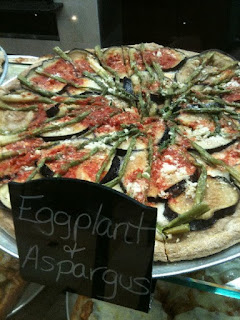
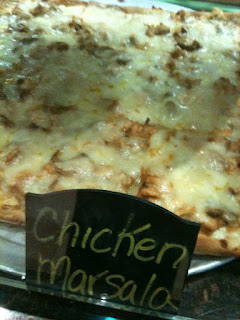
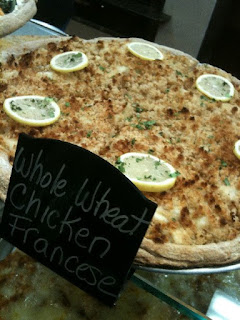
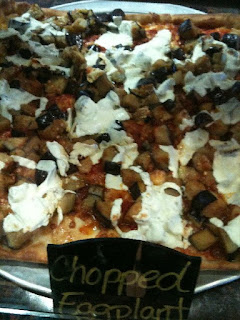
Long Island is getting more and more extreme in its pizzas, and at the leading edge is Monte Pizzeria (728 Old Bethpage Rd, Old Bethpage, NY; 516-752-8554). Unfortunately, the day I went there were none of their signature "ravioli chicken Alfredo" slices - or, for that matter, any rice ball slices. They seem to like to "mix it up". Not that we were hurting for choices:



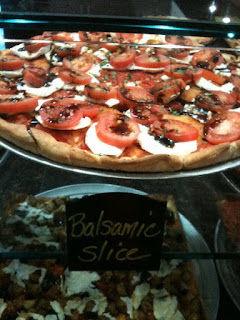

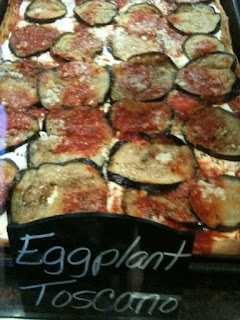
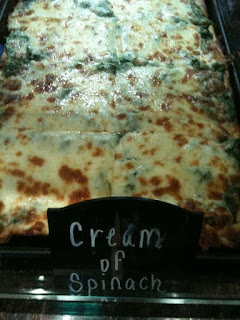
Detail on the chicken marsala slice:

Detail on the chicken marsala slice:
Detail on the whole wheat chicken francese slice:


Courtesy of Paul Trapani, this is the elusive ravioli chicken Alfredo slice:
Monday, January 18, 2010
A Birthday Well Worth Celebrating
Apropos of the holiday, here are a couple of wonderful MLK quotes I hadn't heard before (and which I scarfed from Andrew Tobias' blog):
Re: that last one, I'd go further and suggest that the street sweeper might subtly change the world via his loving, masterful work. And maybe I'm naive, but I believe it's possible.
“We are all tied together in a single garment of destiny... An inescapable network of mutuality... I can never be what I ought to be until you are allowed to be what you ought to be.” – Martin Luther King, Jr.
“If a man is called to be a street sweeper, he should sweep streets even as Michelangelo painted or Beethoven composed music or Shakespeare wrote poetry. He should sweep streets so well that all the hosts of heaven and earth will pause to say, ‘Here lived a great street sweeper who did his job well.’” – Martin Luther King, Jr.
Re: that last one, I'd go further and suggest that the street sweeper might subtly change the world via his loving, masterful work. And maybe I'm naive, but I believe it's possible.
Sunday, January 17, 2010
Super Cool Weekend Bag
 This, the Korchmar Adventure Collection Expandable Duffel, is the hippest, most perfectly shaped and configured weekend bag ever. It's not really a duffel; what a silly name for such a cool bag! The photo makes it look really wide, but it's just 22" (expandable). Good selection and placement of internal pockets. Awesome.
It's on sale here for $221 with free shipping. Expensive, yes, but it will last forever...making it a better value than a succession of ugly, poor-quality $75 bags. Also, I like that it looks classy without being show-off-ish. You can take it literally anywhere.
Subscribe to:
Posts (Atom)