Monday, August 27, 2012

Some Beers to Try

This isn't a list of "the best" beers. Just some beers you may or may not know about, and which I happen to be particularly fond of right now.


König Pilsener (German Pilsener 4.9%) should be bought only in cans, not in bottles. Cans are good now. They don't affect flavor. And they block light and other environmental nasties which harm most beers - especially delicate Pilseners, which are extra light and subtle. So König Pilsener offers a rare unblemished taste of excellent classic German Pilsener. And you can buy a four pack of tall 500 ml cans for under $6, which is considerably cheaper than Pabst Blue Ribbon. I don't understand it. But I like it.

I always have a bunch of these in my fridge. It's my house beer. I rejoice in the opportunity to drink German Pilsener in the wrong hemisphere and still have it taste just the way it should really taste, with all subtleties intact. Plus: cheap!


Before I found König Pilsener, my two house beers were:

Victory "Prima Pils" (German Pilsener 5.3%), is a very good German Pilsener made here in Pennsylviania. It comes only in bottles, so be sure not to buy ones sitting in light (in grocery displays, always reach back to grab a bottle from the middle of the pack (this is the way to buy all beer), or, even better, try to snatch bottles from a sealed case.

and...

Victory "HopDevil Ale" (American IPA 6.7%) is a good choice when you crave a nice bracing hit of bitter hops but are looking for drinkability above all (plus easy availability and low price).

Boulevard Brewing "Tank 7 Farmhouse Ale", 8%) from Missouri, is something you don't see everyday: a refreshing Belgian-style beer. Belgians aim for art with their beers, which makes most of them ill-suited to more casual consumption.

If I lived in Massachusettes (the nearest authorized state; it's not available in New York yet, though I hear Whole Foods may be working on it), and if money were no object (this isn't cheap beer), I'd make Tank 7 my house beer.

Buy it in regular-sized bottles, not the 22 ouncers; the larger ones are more for shared special occasions, but the smalls better suit the beer's casual spirit.

Uinta "Dubhe Imperial Black IPA" (American Black Ale 9.2%).
Uinta is a new-ish brewery from Utah that's just begun large-scale distribution. Darker, stronger beers are their specialty, and their Black IPA is one of the best examples of the style, which is dark as stout, but less creamy and chocolatey. It's hopped like an IPA, but be careful, as this is an extra strong IPA ("Imperial") at 9.2%.

Weihenstephaner "Vitus" (Weizenbock 7.7%) is the wheat beer for people who don't like wheat beers. Not terribly clovey/banana-y. Unlike most wheat beers, this one's got backbone. And it's way stronger than it tastes, so take care. It's full of rich German brewing character. I consider this one of the most under-recognized, under-appreciated beers currently available.
Weihenstephaner "Korbinian" (Doppelbock 7.4%), also from Weihenstephaner. Doppelbocks are concentrated, strong, sweet-ish, toffee-like affairs, and this is no exception. But the big difference here (aside from the mere 7.4% strength, very low for a doppelbock) is the finish, which is curiously, magically dry. This makes it very drinkable - and "drinkable" is definitely not a descriptor you'd apply to other dopplebocks.

De Ranke "Guldenberg" (Tripel, 8.5%).
I've been seriously considering selling off all my possessions, buying an RV, and driving around to bars tapping kegs of Guldenberg. Sightings are rare, so it would be much more involved than simply hopping between, say, Grateful Dead shows.

Describe it? Are you serious? How would one describe "love" to someone who's never experienced it?
De Ranke "XX Bitter" (Belgian IPA, 6.2%) is De Ranke's second best beer, and more widely known. As with Guldenberg, there's so much personality here that it's hard to pin down a description, or even a stylistic label. It's a sudsy world unto itself, mashing up (pun intended) flavor signatures from multiple beer styles. At least nominally, it's another Belgian IPA (i.e. Belgian ale zinged up with hops - in this case, grassy/British ones). It's quite bitter, in keeping with its name, but it's the furthest thing from some of the more astringent, tongue-scraping hoppy beers you may have experienced. You've just got to try it.

By the way, both XX Bitter and Guldenberg are good (though expensive) in bottles, too. But better on tap. Or [tears of imagined joy] cask.


Green Flash "Le Freak" (Belgian IPA, 9.2%) is a household name among beer geeks, because it was the first American beer in a style that's become an instant, much-imitated classic: Belgian IPA. Belgian IPAs are a hybrid, joining the full-bodied yeast and malting of Belgian ales with bitter, aromatic American hops.

Le Freak is yet another beer that's stronger than it tastes, and it's expensive (usually over $10 for a 22 oz bottle). But if you like complex flavors exquisitely balanced to the point where nothing sticks out and the elegant whole is far greater than the parts, this one's for you.

Sierra Nevada "Ruthless Rye" (American IPA, 6.6%) is not the best rye beer, but it's definitely the most widely-distributed. You can find this practically everywhere...and it's quite good.


Founders "Red's Rye" (Rye Beer, 6.6%) is a better rye beer, but hard to find.

Also great from Founders: KBS (Kentucky Breakfast Stout) (American Double / Imperial Stout 11.2%), Super strong (really for winter), and....

CBS (Canadian Breakfast Stout) (American Double / Imperial Stout 10.6%)
Powerful, jam-packed with flavor.

Thornbridge used to be my favorite British Brewer. Their ales are lovingly made, with the cheeky twist of New Zealand hops in the mix. New Zealand hops are eccentric, with wild, tropical flavors recalling things like mango and passionfruit. Thornbridge is still quite good (if you can find it), but not quite as good since the original brewer quit and went to work for...


Buxton Brewery in Bakewell, England.

How good is Buxton's beer? I spent a king's ransom to attend a hyper high-end beer tasting this summer where a stupefying quantity of the world's best beers were not only present, but poured by their actual brewers, all of whom had flown in specially. I should have been making rounds, tasting as much as possible. But I spent over an hour filling and refilling my tasting glass at the Buxton booth. I lacked for nothing.

Their beer is consistently great across the entire range. And, like Thornbridge (and unusual for Brits), they taste fully dimensional and alive even in bottles.

I don't believe Buxton's available in the US yet, but watch for it.

Finally, an enigma.


Courage "Russian Imperial Stout" (Russian Imperial Stout 10%), first brewed in the 18th century, is one of the most-loved classic beers of all time. It's always been brewed infrequently, and people have swooned over it when it's appeared, cellaring cases for years or decades, and spurring brisk trade on eBay. When Courage stopped making the beer in 1993, people wept (well, I did, anyway).

This stuff is huge, tangy, frothy, creamy, deep, luscious, spicy, fruity, chocolatey/coffee. I once forced a wine expert friend (who frequently poured '29 Bordeaux and '59 Vintage Port for friends, and insisted he had no taste for beer) to taste it, and he went cuckoo-for-cocoa-puffs, ecstatically kissing the cheek of everyone in the room. It's that good.

When Courage stopped brewing it, and rebuffed inquiries about its future, one importer went to the length of cloning the recipe and selling it under a new brand. It wasn't as good, though. Nothing is as good.

And now, guess what? It's back! And it's still great (and will be even greater after a few years in a cool, dark cellar)! Yet I've not heard a word about it. No excitement whatsoever. Just me! I don't get it....


A few web resources:

Beer Advocate offers good (but extremely geeky) beer reviews

Beer Menus tells you where to find a given beer (in stores or bars), and offers current beer lists from bars. Not all data is reliably fresh, though, so be sure to check dates. And they only cover a few geographic areas.

The New York City Beer Guide is the grandaddy of beer web sites, predating Chowhound by two full years.

Sunday, August 26, 2012

Explaining Armstrong

"Doing inspired work in order to get famous is like eating a great dinner in order to take a shit." -- Banksy

The best way to understand Neil Armstrong's aloof relationship with press and public is to consider the life of his hero, Charles Lindbergh. This well-written profile of Lindbergh's daughter, Reeve, reveals that what appeared, from outside, as baffling reclusiveness was just someone trying to live a normal life.

Having worked to accomplish something noteworthy, you must choose whether to circle around to inhabit your own contrail of noteworthiness, or to blithely continue the doing. Your choice reveals your motivation for having done the work in the first place.

Doing good work is infinitely satisfying in and of itself. Inhabiting the acclaim is as satisfying as sniffing one's own farts.

Saturday, August 25, 2012

Dead Malls

A photo essay by Ned Hepburn capturing the hulking carcasses of abandoned shopping malls has been making the Internet rounds. Here are just four of 84 Pictures of Dead Malls.


So here's my idea. Recruit a guerilla team to re-inhabit one of these abandoned malls for an afternoon or a weekend, and do post-apocalyptic, post-capitalist things there. Extraordinarily non-commercial things!

E.g.:
  • Set up a storefront where people sing tenderly to you.

  • ...and another where they decoratively paint your money and then give it back to you.

  • Repurpose a toy store as a place where kids invent games for other kids to play.

  • Ban smart phones and other devices from a video game store, install comfortable chairs, and make it a place where strangers talk to each other. Or read books.

  • In the food court, offer delicious campfire cooking. Pay for your food with art you've created at an abandoned H.R. Block.

  • Have people dress as security guards who will stop and question anyone who seems troubled or unhappy.

I'm actually seriously considering this (I've done similarly ambitious pranks before, but those are stories for another day). It'd certainly be timely, with the much-awaited launch of "Revolution" TV series coming up in a few weeks:
"Revolution takes place in a post-apocalyptic future. Fifteen years earlier, an unknown phenomenon permanently disabled all advanced technology on the planet, ranging from computers and electronics to car engines, jet engines, and batteries. People were forced to adapt to a world without technology..."

Wednesday, August 22, 2012

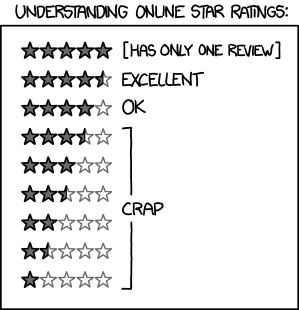
Understanding Online Star Ratings

This particularly good xkcd comic is up right now:


The simplicity is what makes it effective, but being as how this is a Slog rather than a comic, I'll fuss it up some for my own version:

5 stars: Has only one review
4.5 stars: Excellent (the 4 star reviews come from people who never rate anything 5 stars)
4 stars: Either excellent or crap, with uncomprehending idiots either over or underrating
1.5 to 3.5 stars: Crap
1 star: Has only one review

("OK" ratings can't be meaningfully demarcated via online rating systems)

This, by the way, is one reason why we never instituted star ratings on Chowhound.

Oh, and if you like this sort of thing, you may enjoy my "Eating by the Numbers" system, which is a surprisingly non-ditzy way to rate food (and other things) on a 1-to-10 scale.

Tuesday, August 21, 2012

The Infinite Potential of Slow Learners

Yesterday I described how painfully slow and stupid I am in areas like home decorating. It's not a question of ignorance; I could spend years hobnobbing with designers and learning everything there is to know about upholstery and track lighting, but the practical application will always feel like alien territory. I'm not a natural. I'm slow. Slow enough to drive you batshit crazy.

And yet, although it took three years of painstaking work to outfit a house a few years ago....
"in the end, the place had the magical power to make anyone stepping into it feel absolutely comfortable and relaxed. It didn't make much of a visual impression; there was no particular design "impact". But neither did it look sloppy or mismatched. What hit you was the Vibe. I'd nailed it!"
That's not my only weak spot. I'm also slow at learning physical moves. I've driven several yoga teachers to near breakdowns with my thick-headed sluggishness. "Do this," they'd instruct the class, and I'd stare in dumbfounded confusion while the others simply did the move. They'd talk slooooowly to me and raise their volume, assuming me to be an idiot. But my mind isn't the problem. It just takes a while for my body to absorb new instructions.

At this point, I've practiced yoga for 35 years, and can do some really hard poses. I'd "impress" those same teachers if they saw me! And because it took decades, rather than months, to, say, plant my palms on the floor in a forward bend, I've learned an awful lot. Every millimeter of progress produced a tiny jewel of insight. If you watch me bend forward, you'll feel like something's happening. That's not true of naturally bendy people. They just bend!

I've tried over the years to take Salsa dance classes, because I love the music so much. But dance teachers are the sort of people who learn dance moves quickly, so it's impossible for them to relate to a below-average student who needs to practice each step dozens of times. Once a step sinks in, I can perform it with good feel (maybe more so than "naturals" can!). But it's tough to find a teacher with sufficient patience.

These are areas where I learn slowly, and that's just how it is. They will not get faster. But the important thing is that my potential in these realms is as high as anyone's. In fact, maybe a tad higher, because in taking my time and pondering minutiae, I go deeper.

In other areas, I'm super fast. I think fast and talk fast. I can leap from thought to connected thought with ease. It comes naturally. But when I grew up, there were kids in my class labeled as "slow". These kids were inferior; you couldn't expect much of value to pop out of their minds, because they are, after all, "slow". I always took that as a euphemism. They were damaged goods with hard limits.

Boy, was I wrong. I went on to meet many people whose intellects absorb facts and ideas with syrupy slowness. If you tell them something new, they'll need to mull it over. But sometimes they'll digest it all into conclusions so novel, so rich, so damned brilliant that I'll realize that I, with my fast, jumpy mind, miss all sorts of intellectual goodness.

There are lots of consequences to all this. They could fill a book - a book that should be written, because this is all so little recognized. But here are a few points, in dense shorthand:

1. Slow learners are limited only in velocity, not in potential mastery.

2. Slow learning often yields richer results.

3. We're all slow learners in some realm.....but having been discouraged from using our slowest, richest faculties, those faculties usually remain stillborn, which is why many people never uncover their genius (everyone has genius).

4. The custom of leading with strengths and burying weaknesses creates great societal problems:
  • 4a. Educational systems favor fast learners and discourage slow learners.
    Consider my dance and yoga teachers. Or, for that matter, school gym teachers who, being fast-learning jocks, give up on slow-learning kids. This has had huge impact on national health and obesity. Athletics aren't just for the naturally athletic!
  • 4b. We lack empathy for slow learners in realms where we're fast.
    I've explored my slow areas, finding that slowness actually confers a certain edge. It's all been so destigmatized for me that I can relate to slow learners even in realms where I'm a natural. But most of us spend our lives recoiling from from our slow sides, which helps perpetuate the ignorantly condescending attitude I outgrew. Again: slow learners are limited only in velocity, not in potential mastery! Say it loud: I'm slow and I'm proud!
  • 4c. We group people by their fortes.
    This makes sense; everyone offers society the cream of their ability. But to segregate by natural forte is to make the wrong distinction. If I'd followed that momentum, I'd have quit yoga, dance, and sports. Instead, those are the realms where I'm happiest (if this article reads well, I'll feel satisfied. But the ultimate success of that house gave me way more satisfaction than my writing - which comes easily - ever could!).

Monday, August 20, 2012

Home Decor for the Visually Incompetent

I'm very un-visual. I key into the world more via other senses. So I'm poor at anything involving design. Tasks like picking out drapes or choosing a car color or deciding where to place a coffee table leave me yearning to simply roll dice.

So, a few years ago, when I decided to live, for the first time in my adult life, in a house, I felt a rush of terror as I contemplated empty rooms and bare walls. One option would have been to simply dump in all the chintzy second-hand and Ikea-bought furnishings I'd carried around to countless apartments since college, but I was feeling too old for that. Where to begin? It was paralyzing. So I asked someone for suggestions, and he offered some of the best advice I've ever received:
"Don't be in a rush. Add one thing at a time, and be completely sure it feels (not "looks"...feels) absolutely right and comfortable. Don't worry about the look. Don't have an overall plan. Just start adding details, one at a time, with great care."
It took nearly three years to furnish the house, but I lavished great care, and, in the end, the place had the magical power to make anyone stepping into it feel absolutely comfortable and relaxed. The place didn't make a grand impression; there was no particular design "impact". But neither did things look sloppy or mismatched. What hit you was the Vibe. I'd nailed it!

Of course, few people could handle a three year process. But those who'd go mad living in a partially-decorated house are the sort who are good at this stuff! They don't require a low-and-slow approach; they have the skill to pick out everything en masse and whip it all more or less neatly and stylishly into place!

But as quick and competent and "natural" as such people are, I'm not sure many of them could create as deeply alluring a vibe as I, in my glacial thick-headedness, managed to achieve (thanks to my friend's great advice!).

More re: the benefits of slow-learning.

Sunday, August 19, 2012

"The Poor"

In my previous entry, I made frequent reference to "the poor". And that's a term I actually hate (I just didn't have any other way to phrase it!). I think it's a false construct saddled with wrong assumptions.

Growing up as a sheltered middle-class suburbanite, the word summoned visions of grimy unpleasant unhappiness. "The Poor" was a vaguely-understood scary "Other". But then, as I gained life experience, I noticed a few things:

1. "Poor" is relative
It doesn't matter how much money you have; browse real estate prices in Manhattan. Or contemplate sending kids to college without loans...or paying for business class, to avoid the indignities of coach. Even if you can somehow afford such things, they will not feel smoothly, affably attainable.

Those aren't Mr. Howell-isms ("Butlers are nearly unaffordable these days!"). Some people truly need to live in Manhattan, e.g. for work. Or have kids who can't afford loans. Or have long legs. So even "rich" people get the same trembly stomach I once felt when forced to take a toll bridge, replace a failing appliance, or pay for antibiotics. And, in keeping with the relativism, bear in mind that there are millions who'd take even those trifling last three as loathsomely Mr. Howell-ish ("la-di-da, such a burden for you to buck up for fancy medicine while my malnourished children and I fend off tsetse flies!").

The adjective "poorer" has meaning. The noun form "poor", much less so. Money limitations scale infinitely up and down. There's no point at which they're transcended. "Poor" is wherever your head bumps the bar.

2. You are in the 1%...globally
The poorest American is unthinkably rich compared to 99% of historic humanity. Consider these questions: How many of your siblings died due to lack of medical care? How much taller would you be if you hadn't been malnourished as a child? Do you have sufficient free time to get depressed or neurotic? Will you perform back-breaking labor til the day you die?

When an American feels poor - i.e. fosters resentment toward those with even bigger apartments and even nicer cars - billions scoff.

3. Less Stuff Doesn't Make You Less Happy
I was taught (by everything from Dickens novels to Jimmy Breslin) to envision The Poor as miserable. But after spending time in the Third World (and some sketchy portions of the First World), I've learned that's completely wrong. Here's how the mistake comes about:

Americans equate pain with suffering. We do so because pain is so unfamiliar to us that we can't help but respond with anguish. People with real problems learn to draw subtler distinctions. They can endure painful circumstance without triggering an adolescent grimace because they never expected everything to go just so in the first place. As a result, they display qualities seldom seen in America, like equanimity and empathy. It's easier to dance and love with a full heart when you're not stuck in your head nursing neurotic fixations re: the various peas lurking beneath your mattresses. An essential truth is understood: that happiness stems from wanting what you get, rather than getting what you want.

If you don't believe it, read a fantastic book by a writer who spent years visiting small, third world villages and discovering that such places, with little material bounty, appear to be the only places where humans feel - and act - fully human: "A World of Villages", by Brian M. Schwartz, is available used from Amazon.com for next to nothing. It would have been a best-seller if the book market wasn't glutted at the time of its publication with titles (none as profound or as readable) from backpacking world travelers.

Or, just as effective: start watching people who are wealthier than you (in real life, not in movies), and try to gauge how many seem happier than you. That's a gigantic "tell", yet one of the most oft-missed truisms of the human experience.

A Campaign of Two Half-Libertarians

Here is even stronger confirmation that Paul Ryan, per my previous article, is only a half-Libertarian. As Chris Hayes explains,
"Long before he became one of the right’s most vocal critics of the idea that government spending could help boost the flagging economy, Rep. Paul Ryan offered a forceful, full-throated defense of stimulus spending — when then-President George W. Bush wanted it in 2002."
Libertarians: I was once one of you, though I'm not anymore. And you've just got to face the fact that current Republicans (outside of the Paul family) are just dabbling in Libertarian rhetoric when it suits them - i.e. when it stands to further enrich their corporate and military/industrial patrons, and when it appeases the Tea Party which terrified them in the midterm elections. The Tea Party movement itself may have launched with a few foggy Libertarian impulses, but it's now been co-opted as a subsidiary of Fox News/Limbaugh/Karl Rove. Staunchly hawkish and meddlesomely socially conservative. The same old stuff. That's not Libertarianism, it's just another sort of Big Government. And my point is that, for most Libertarians, the current Republican agenda represents the worse of two "big government" evils.

If you're not going to get a seriously Libertarian administration (and believe me, you're not; it's as unlikely, post-McGovern, as a truly liberal one), then you must choose between half Libertarians.

I'd suggest choosing the half that won't attack Iran unless absolutely necessary, that will defend women and gay civil rights, maintain balance in the Supreme Court, and retain (and hopefully try to reform) our inefficient, fiscally non-viable safety net at least until there's a viable alternative aside from "I've got mine, Jack." Paul Ryan and his half-Libertarian brethren have shown opportunistic fervor for slashing poverty programs, but what about the massive private philanthropy that's supposed to arise to replace the safety net? Do you see those guys talking much about that? I don't. Aside from eagerness to nuke the poor's vital (for now) programs, all I see from them is low-income voter disenfranchisement and increasing agitation for actually charging them income tax.

Or you can choose the half Libertarians who will swell (and use) our military even more, deliberately disenfranchise student, minority, and poor voters, and who believe defaulting on our debt is a good idea (the Republican move which pushed them beyond my pale) and who show no devotion whatsoever to personal or social liberty...all while cynically mouthing Libertarian platitudes.

Both will inflate government. Ronald Reagan greatly inflated government. The "small government"/"government is not the answer" credo from Republicans is a banner they drape themselves in while cutting off poor people, who don't vote for them anyway, while directing the same public spigots to Halliburton, The Pentagon, and other favored factions and institutions (generously subsidizing, for example, all those rabidly anti-government western ranchers).

I don't believe in Libertarianism. But I recognize that true Libertarians aren't hard-hearted jerks who want to see the poor starve and for the 1% to absorb virtually all wealth. They have theories about how it all will go down more equitably and viably than that. But, for god's sake, don't vote for people who want to swap corporate welfare for poverty programs, to slash Medicare to inflate the military, to cut taxes for the superrich and increase them for the poor, and generally pull some of the greediest Libertarian moves without the slightest nod toward the principled civic-mindedness and commitment to freedom which make Libertarianism a political philosophy rather than a cynical ticket to baldfaced piracy.

If you're a staunch Republican, and believe the jazz about Job Creators and trickling down, well, god bless you. I don't think you're jerks, either! But the above wasn't for you.

Thursday, August 16, 2012

Job Creators

The antidote to big lies is clear, eloquent common sense. And there are a lot of big lies out there now (though, alas, scant eloquent common sense). One of the biggest is that we need to tax the rich less so they have extra money to create jobs.

Consider: The rich were taxed upwards of 90% in the 1950s and 1960s, the time of fantastic growth and full employment. And for the past few decades, the rich have been taxed unprecedentedly lightly, yet employment has fallen.

And consider: Business owners never hire because they have extra money lying around. They hire when they need more hands on deck to meet increasing demand. And demand is fueled by a large and prosperous middle class. The middle class - the engine of the economy - spurs job creation.
"We've had it backwards for the last 30 years. Rich people don't create jobs. Jobs are a consequence of an eco-systemic feedback loop between customers and businesses. And when the middle class thrives, businesses grow and hire, and owners profit. That's why taxing the rich to pay for investments that benefit all is such a fantastic idea for the middle class and the rich."
Duh. That's not class warfare talk (the talker - a TED talker, to be specific - is uber capitalist/zillionaire Nick Hanauer). It's not liberal propaganda. It's just simple, eloquent truth.

(Please pass that link around; Hanauer's six minute video is over in a flash, and every word is the essence of pure common sense. I've never seen this explained better. In fact, I'm not sure why I'm typing this or why you're reading this. Go watch his video, instead!)

Another great point from Hanauer:
"Anyone who's ever run a business knows that hiring more people is a course of last resort for capitalists. It's what we do if - and only if - rising consumer demand requires it."
Yep. Payroll is an expense, and expenses are resisted in business. You only hire when demand forces it. And demand doesn't come from rich people. Rich people don't consume in direct proportion to their income disparity. As Hanauer says, he doesn't own 3000 cars.

It's obvious to any Economics 101 student that the brightest future for the 1% involves a thriving middle class and a solid public infrastructure. Those elements are the fuel for any business or investment. Dismantling the safety net is bad for them. Propagating poverty is bad for them. Paying 5-10% more taxes - i.e. returning to the level of taxation in the 1990's when those guys were doing mind-bogglingly well, so we can shore up crumbling infrastructure - would, in the end, be the best possible thing for them. No one proposes a return to 90% rates. Just bring Buffett to parity with his secretary. Isn't that the most reasonable, common sensical proposal ever?

[Note: the 90% tax rate figure is misleading. See Noah's comment, below, for an explanation. However, my point stands: taxes were vastly higher before, when the nation experienced unparalleled growth, and, anyway, no one's advocating for a return to Eisenhower's rabid Communism]

Wednesday, August 15, 2012

Apple to Set a Precedent of Non-Indispensableness

Apple is about to announce a mini-iPad, according to Bloomberg and the Wall Street Journal. John Gruber just wrote a long piece trying to piece together exactly what Apple's got up its sleeve. It's rumored Apple will announce this product alongside the new iPhone on September 12.

I've had an instinctive feeling of unease with this product which has been hard to articulate, but I think I've finally got it. It's a marketing issue - one I don't see anyone else pointing out.

First was iPod. Updating from that to iPhone (or iPod Touch) was a no-brainer, since the latter two encompassed the former. If you loved your iPod, you traded up to iPhone or Touch for even greater lovability. Owning both a Mac and an iPhone/Touch made terrific sense; each had its role, and they worked together beautifully. They were an environment, a whole better than the parts.

Then came iPad, which lots of people viewed, at first, as a superfluous blown-up iPhone (not me; I was uncharacteristically right about iPad from the beginning). I did, however, feel a bit over-deviced for a while. Walking away from my computer, checking email on my iPhone as I strolled out to the yard and settled in to view a video on my iPad felt like a bit much. But I adjusted. Unlike Mac and iPhone, iPad was ideal for reading and web surfing, both of which are essential to me. I stopped printing things out (I can't remember the last time I bought copy paper). I cut my computer time by more than half. I feel freed. Yes, juggling three devices feels a bit embarrassing, plus there's the expense, but I can't deny they've given me back my money's worth.

But now there's this. I'm certainly not buying a mini iPad, too. It required some persuasion to get me to reluctantly add an iPad, but no marketing can entice me to add this fourth device. I doubt Apple will even make a case for the indispensableness of mini iPad. This one is, for the first time, strictly optional.

The sense of momentum - that each new device improves our information ecosystem in essential and inevitable ways - will be lost. If I'd lost that sense of momentum two years ago, I'd never have sprung for iPad. But I will now be a much tougher sell for any sort of future iDevices. I'll be asking myself whether I really need to buy, rather than whether I can make the sacrifice of not buying.

The mini iPad will be a hit among those who don't already own all devices. But those of us who do - Apple's faithful - will lose our sense of indispensableness. New products will be more soberly analyzed, and more easily turned down. And while "Prove I need it!" sounds like a sensible approach - it's how consumers weigh products from any other company - Apple's different. Or, at least, was.

Blog Archive