Thursday, October 31, 2013

Peaks

The following is a graph of all-time traffic statistics to this Slog (courtesy of Blogger, our host):


The big crazy peak was the eerie, highly impersonal moment last month when my "How I Outgrew Libertarianism" article exploded in a brief mayhem of confirmation bias and snark. The smaller peak was the Newtown shooting, when I tried to work out my feelings here, not realizing I'd be publishing the first-ever online reference to the killer's mom, casting me into the midst of the sensationalism. Good times. Of course, I lived through a different sort of traffic peak from 1997 to 2005, and that wasn't much fun, either.

I've occasionally played prominent music gigs with famous people. The experiences were rarely satisfying, but they made my family and friends deeply happy (in much the same way, come to think of it, as my weight loss does). By contrast, if I report spending a deeply satisfying evening playing in an obscure black bar near the airport, eyes glaze. I can seriously impress anyone in their late 20's by telling them I played the crazed jungle bone solos on the cartoon "Rocko's Modern Life"...but that gig meant nothing to me.*

Peaks of mass attention are only pleasant for extreme narcissists. Real people get the heebie-jeebies, at best. Yet most of us think you'd have to be completely bonkers to eschew the spotlight, ala Salinger. If one isn't angling to do the thing one does in front of the largest possible crowd, one seems not to be doing anything at all. A well-meaning friend who faithfully reads the Slog asked me the other day whether I've been doing any writing lately. God bless America!

Looking at that graph, I recall happily giving life to ideas that would have otherwise forever vaguely flitted around in my head. I remember reveling in the freedom to broach difficult and obscure concepts without worrying about losing readers, and the joy of not having to persuade square editors to publish my work. Most of all: the blessed relief from the professional obligation to untangle and pre-chew every concept for effortless swallowing. And, speaking of swallowing, I've discussed food here with a frequency proportional to the topic's actual (non-predominant) priority in my life.

And, emerging from it all is a result that makes me blink in disbelief: I seem to have unwittingly assembled an accessible, highly-interconnected model of my (for better or worse) unique way of viewing things - a Web of my mind disguised as a blog. Sometimes I read myself here to understand who I am and how I think. For so many years I had no idea.

As I view the modest traffic curve, I intuit that among the few hundred steady readers some have been with me from the beginning, since long before Chowhound, and perhaps even dating back to my NY Press days. We've survived the Chowhound deluge and here we are, dry and safe, and still together.

That's what I feel when I look at the graph. Then I notice those two peaks, and I cringe.


* - Trombonist Garnett Brown has the converse problem: I've heard that his all-time favorite recorded solo is on the "Deep Throat" soundtrack, and, of course, absolutely nobody cares.

Wednesday, October 30, 2013

Technical Difficulties

Technical difficulties caused yesterday's entry ("Surprising Behavior Breaks Things") to be cut off, and then removed, and then restored as an older draft, and only just right now brought to its final intended form.

Ironically, I was trying to edit and publish via a different method. Which broke things.

If you read it previously, you might want to give it another look.

Tuesday, October 29, 2013

Surprising Behavior Breaks Things

An exploration of Groucho Marx, computer hackers, beta testers, Banksy, and Kali the Goddess of Death


Most channels of action in this world are established with the expectation that they'll be used in certain prescribed ways. Builders anticipate the potential range of actions, and they build to accommodate them. They also try to anticipate "edge cases" - the surprising and unconventional behavior of a small portion of the public. Of course, no one can anticipate all edge cases. Surprisingness, by its nature, is hard to anticipate.

If you do surprising things, you will tend to break things, because things are not made to withstand (much less accommodate) surprising behavior. If you rename your computer's innermost system kernel file to "I Love You", your computer will probably behave erratically. If you attach scramjet engines to your Dodge Dart and accelerate it to 5000 mph, the airbag system is likely to cause more harm than good. And so on.

Most people are not creative, so stuff doesn't break for them as often. Things generally work in a diverse society because most people are surprisingly unsurprising, and so most behavior is anticipatable...by engineers, lawmakers, and other architects and managers.

Being creative, breaking stuff comes naturally to me, and that's made me a very good beta tester. It's the task of a beta tester to push a given piece of technology past its breaking point so builders can make their work as impervious as possible to edge-case usage. Beta testing has been a cherished hobby of mine for many years; it's the only legitimate arena these days for the inquisitive, explorative type of person who proudly identified ourselves as "hackers" before the term became laden with shame.

[A hacker, in the original sense of the word, is someone who finds surprising ways to use technology never anticipated by its builders. Yes, this includes abusive actions such as vandalizing home pages, stealing credit card numbers, and disseminating viruses, but that's just the inevitable asshole side of a broad realm. At its heart, hacking is very similar to "tinkering"; it's about pushing beyond limits and intentions, a pursuit that's innately immoral only for those who equate morality with blind, trudging conformity.]

But while the clever misuse of systems represents a joyful expression of freedom and creativity (I must again link to Banksy as the current champion of that sort of thing), a distinction must be made between that and the random and heedless misuse of systems.

There is risk in making yourself an edge case. Parking lots, for example, are designed for slow driving. Those who navigate them at high speed will tend to have drivers crash into them, because anticipating really fast cars while backing out of parking spaces requires more violent neck-craning than most people apply. Again, surprising behavior breaks things. So it's important to consider the stakes.

But, either way, some level of breakage is always involved. So, from the perspective of those bound by blind, trudging conformity, creativity is indistinguishable from destructiveness. That's why creative people are feared. To Margaret Dumont (the stout, stuck-up lady who was forever trying to throw fabulous fancy parties and sing regal cantatas in the Marx Brothers movies) Groucho and his brothers were evil destructive forces, barging in with their wisecracks and their disrespectful behavior and ruining everything. And it's key to remember that the world is pretty much entirely composed of Margaret Dumonts.

I'm a big fan of Mayor Bloomberg, but I wasn't surprised in the least by his reaction to Bansky's recent New York escapades:
"There are some places for art and there are some places [not for] art. And running up to somebody's property or public property and defacing it is not my definition of art.... it’s a sign of decay and loss of control
There it is! People prefer control over surprise, so it's the mission of those in charge to defend the former from the latter. Or at least try to, with the grim acknowledgement that entropy always wins in the end.

The Dumontian resistance to surprise is what gave rise to the Hindu goddess Kali being known as the goddess of destruction (remember those depraved cultists in "Indiana Jones and the Temple of Doom"?). Like the hackers, she gets a bad rap. What she actually is is the goddess of creativity. But to those who tenaciously cling to status quo, her bottomless thirst for change and the immense energy she wields in empowering the world's ceaseless churning represent all that is destructive, dangerous, and deathly. She's the very root of all our fears because, being infinitely surprising, over time she breaks absolutely everything.


Sunday, October 27, 2013

Banksy's Grumpy Truck

Banksy expresses in nine words an observation to which I've devoted thousands:


The truck's owner, no fool, has put the vehicle up for sale.


Previous Slog mentions of Banksy:
The Quandary of Unacclaimed Genius
Explaining Armstrong
The Shallow and Self-Defeating Illusion of Competition (same quote, making a different point)


Snowden: Greater Threat to Whistle-Blowing than to the Government

Per this troubling news story, Snowden has some really heavy information. He insists it's encrypted and stored wisely, and that he'll reveal it only selectively and judiciously.
'"I carefully evaluated every single document I disclosed to ensure that each was legitimately in the public interest," he told the Guardian newspaper. "There are all sorts of documents that would have made a big impact that I didn’t turn over, because harming people isn’t my goal. Transparency is."'
I'm sympathetic to the goal of transparency. But I'm not sure I want an Edward Snowden determining what's harmful. Nor do I want an Edward Snowden assuming responsibility for encrypting and storing these documents. In a feat of power jujitsu, the whistle-blower has taken on the responsibilities of the institution, and while I lack confidence in the wisdom and competence of institutions, I have exponentially less confidence in the wisdom and competence of a Snowden.

Even if Snowden's completely sincere and his actions are immaculate, he'll still have done great harm to the future of whistle-blowing by bringing to light - for those of us predisposed to applaud whistle-blowers - conflicting moral issues not previously clearly seen. Many of us hearken to the image of a moral individual taking a stand against an immoral institution. That image is baked into the American psyche as an indisputable good. Those Nazi soldiers "just following orders" were morally obligated to disobey those orders, no?

The problem is that different people have differing notions of morality, and if every institution required the consent and approval of each individual, nothing would ever function (consider our Congress). Whistle-blowing should be reserved for only extreme evil, corruption, and immorality, but that's difficult to gauge when one's dander is up (and someone's dander always is). It's only clear in retrospect.

Many of us - at least those who don't run large institutions - have maintained an innate sense that whistle-blowers are good, and should never be thwarted. But along with the baby comes torrents of bathwater. Should one minor, unproven individual have the power to blow up an institution? And, furthermore, do we want individuals - even those as principled and judicious as Snowden claims to be - taking upon themselves the full brunt of that institution's power?

These are questions I'd never previously asked myself. But now whistle-blowing seems a much more nuanced scenario. Edward Snowden, by pushing these boundaries, has raised such questions even among those inclined to sympathize. In so doing, he's enduringly harmed the cherished institution of whistle-blowing. This episode has been an enormous boon for those who seek to hinder that sort of thing for all the wrong reasons.

Monday, October 21, 2013

Vast Realms of Human Craziness

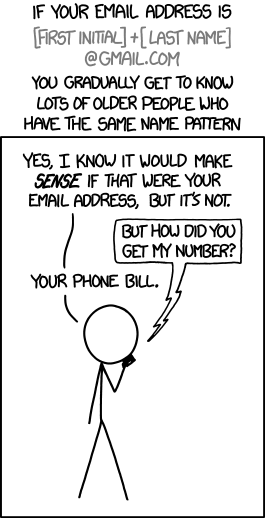
Sometimes XKCD comics can be a bit obscure, and this one made me ponder for a minute:


The point is that many people, believe it or not, assume they have a pre-assigned email address waiting for them at terrygoldberg@gmail.com or margaretsopolosky@yahoo.com. It's crazy just on the face of it, but misunderstanding technology is one thing, and assuming you're the special Bob Jefferson who gets that address is nuttier still. And yet many people, asked for their email address, really do just make one up. They enter on forms - or pass on to friends - addresses they've never actually signed up for, ala UncleLarry@gmail.com.

Breathe. Don't forget to breathe.

The comic left me perplexed yesterday, as I pondered it all, but it's even worse than that. For about the hundredth time, I just typed in a URL I'd found on a restaurant takeout menu and found that there's no such site. I'd always assumed this happened because someone made the mistake of publicizing the address before the site went live. But now I realize...it's the same phenomenon. They're just making it up.

Homeland and Other TV Stuff

If you've been watching Homeland, you've seen the wheels come off the cart in various ways over the past two seasons, as capably documented by the great Alan Sepinwall.

But there's a seldom-linked resource I just stumbled into, where The New Republic discusses each week's episode with a real-life CIA case officer. Great stuff. Analysis of last night's episode is due up at any moment, but, meanwhile, here are the previous installments.

I'm still finding the series worth watching, but among the current crop I'm more into (in no particular order) Masters of Sex (Showtime), Key & Peele (Comedy Central....catch the 10/16 episode if you can); Veep (HBO), The Bridge (FX), Hannibal (NBC), Orange is the New Black (Netflix), Louie (FX), The Americans (FX, which I wrote about here), Game of Thrones (HBO), and, while downhill, still possibly the greatest TV series ever (even if you don't love cars): Top Gear (British version only, on BBC America).

Also, I should point out that I was recommending Breaking Bad way before it became popular, back in 2009!.

Saturday, October 19, 2013

Spain, Morocco, London, Part 4: Sunday Dinner in the Faux Countryside

Part 1: I Eagerly Kiss Your Cheeks
Part 2: A Paella By Any Other Name...
Part 3: Scoring Some Coca


As in many Mediterranean cultures, Catalan families enjoy the tradition of a Sunday drive in the country, highlighted by a simple, rustic meal. But Barcelona has sprawled so heavily that much of what was previously "country" now lies within city limits. So if you simply drive over Tibidabo mountain, which hovers over the north end of town, you can feel as if you're a hundred miles away.

Photo of Tibidabo snarfed, with permission, from here


The far side of Tibidabo boasts a number of eateries. All are filled to capacity on Sundays, though otherwise sleepy. And they make urbanites pay dearly for their laziness. If you drive an hour or two into actual countryside (e.g. the place where I had calçots a few years ago), you'll pay a fraction of the price.


But drummer Pablo Posa has made a rare score, discovering the one Tibidabo place with reasonable prices. We enjoyed a very typical Catalan Sunday dinner at Can Jané, which, for extra bucolic-ness, boasts a small menagerie of animals such as emus and ponys.


Tourists never know what to do with the big pile of toast.


Naturally, you rub tomato all over it! (Pa amb Tomàquet)


Setas (Oyster Mushrooms)


Mongetes Secas i Panceta (White Beans With Pancetta)


Not uniquely Catalan, but I know many of you come here for the spuds.


Mel i Mató (A Catalan fresh curd cheese similar to ricotta, served with honey).
So simple but so delicious.


I didn't get photos of the grilled meats. They were very good, though not up the level of La Llar De L'all I Oli.


What's more traditional than chocolate ice cream?


Martina, our master of ceremonies, shows us how it's done


I need to explain why I'm showing you this rather unflashy meal.

The term "Catalan Cuisine" has become associated with sexy shiny high-end cooking, but that's all made up. It's artificial. It's a contrived, stylized fashion plate for selling food magazines and cookbooks, and it has as much to do with real Catalan food as "jazz dance" has to do with jazz.

To be sure, at this point you'll find shiny places here trying to sing that tune. But they're merely copping the style; cashing in on a foreign trend that is Catalan in name only.

Dowdy cabins like this - where kids meander around the floor and moms and dads slump at tables nibbling distractedly on great big loaves of toast with tomato - are where you taste actual Catalan cuisine. The House of Garlic Mayonnaise...that's Catalan cuisine. The calçots I had last time in a similar rustic venue...that's Catalan cuisine. David's arroz...that's Catalan cuisine. Forget the contrived lacquered nibbles you see on TV and in the high-end food porn magazines. If you take away one thing from everything I've shown you, make it this: Catalan food is not sexy. It's soulful.

Martina (see final photo) may one day grow up to wear slinky cocktail dresses and flirt poutily with Eurotrash socialites in shiny trendy Barcelona cafes. She may run into that alien trend. But in her heart of hearts, the phrase "catalan cuisine" will always evoke meals like this. This is ground zero, though it's nothing you'd ever see on the Food Network.

Thursday, October 17, 2013

Less Delighting, More Prodding

The best-loved advertisements of my lifetime, the "I can't believe I ate the whole thing" commercials for...wait, was it Pepto Bismol? Rolaids? Ah, here, I found it: Alka Seltzer!


I just proved the point I was about to make: the commercials flopped. I understand they did nothing to increase sales.

Great ads, though! Before that, commercials were inane and mind-numbing. After that, they became relentlessly ABC - i.e. they'd always be closing:


You know those subscription card inserts in magazines that fall out and annoy the bejesus out of you? Publishers hate to annoy the bejesus out of you, but the problem is that those cards work really really well. Better than just about anything.

Advertising and marketing are rewarded not for pleasing us, but for successfully manipulating us. In an ideal world, the two would be one and the same. But they, alas, are not.

Wednesday, October 16, 2013

Spain, Morocco, London, Part 3: Scoring Some Coca

Part 1: I Eagerly Kiss Your Cheeks
Part 2: A Paella By Any Other Name...


After the paella rice, we strolled into the center of David's village, l’Estany, where the annual celebration of Catalan independence was underway. It seems, for some reason, to involve lots of drag queen karaoke performed in the civic auditorium by otherwise straight, uptight villagers (per my previous Barcelona report, when staid Catalans let their hair down it's like how in Star Trek Vulcans get totally emotional every seven years) and a profusion of the special holiday bread called "coca", eaten with a bit of llanganissa, one of the many local sausages.


Then it was back to Barcelona, where I discovered a sublime new artisanal beer bar called La Bona Pinta (The Good Pint). Tiny and intimate, the owners curate a hand-picked selection of only really good stuff. Bars boasting hundreds of beers are 95% crap (reality check: Stella Artois is like fancy-looking, smartly-marketed Schlitz). Give me a place like this, with a few dozen stellar bottles - some so rare and obscure that I couldn't stop giggling maniacally while perusing the shelves - plus three glorious tap beers. I heard about two other new beer bars (Ale & Hop and La Resitencia), but I felt way too loyal to La Bona Pinta to check them out.

I had my first-ever taste here of London's Kernal Brewery, totally unknown in America but starting to build a tremendous following in England. Also: beers from one of my all-time faves (also unknown in America), Buxton.

And, of course, some esoteric Catalan beers. I loved the Amber Pale Ale from Cerveses Almogàver and Lupulus from Montseny. Spain's not yet Italy (which is the new Belgium), but it's getting there. And, for now, the best brewing is being done in Catalonia.

I made another pilgrimage to Italian/Spanish guitarist/electrician/chef Andrea Grimaldi's mini-hacienda an hour north of Barcelona. This time, he whipped up pizzas in his handmade wood oven. Behold some of the best pizza I've ever eaten:


Squash Flowers


Tuna and Onion


Ceps


For the Kids


Go to part 4

Blog Archive