Thursday, May 9, 2024

Van Gogh on Art

...and to break the complacency of the others.
Really, any reframing will do. Dislodgement of any sort is the higher purpose, given that art is a human creation devised to induce a reframing of perspective.

More pontifications on social media memes

Wednesday, May 8, 2024

Wanting What’s Needful

Does it really need to be pointed out that the sane course is to like whatever you have to do? If you turn it all into candy, everything's candy. The magic wand for that alchemy is an effortless shift of perspective

Just a few weeks ago, I explained how to transform this same tight-assed grinding assessment into buoyancy. The problem is never in what arises; it's in our tight-assed grinding assessment! And assessments are absurdly arbitrary, though the richer a society gets, the more tenaciously its entitled princes and princesses frame their preferences (“preference” is the slavery of the excessively liberated*).


* Setting firm preferences ensures pain when outcome (inevitably) falls short. Less privileged people, feeling no entitlement to prefered outcome, scarcely set preference at all, so their worldly experience feels much less presecutory.


More pontifications on social media memes

Tuesday, May 7, 2024

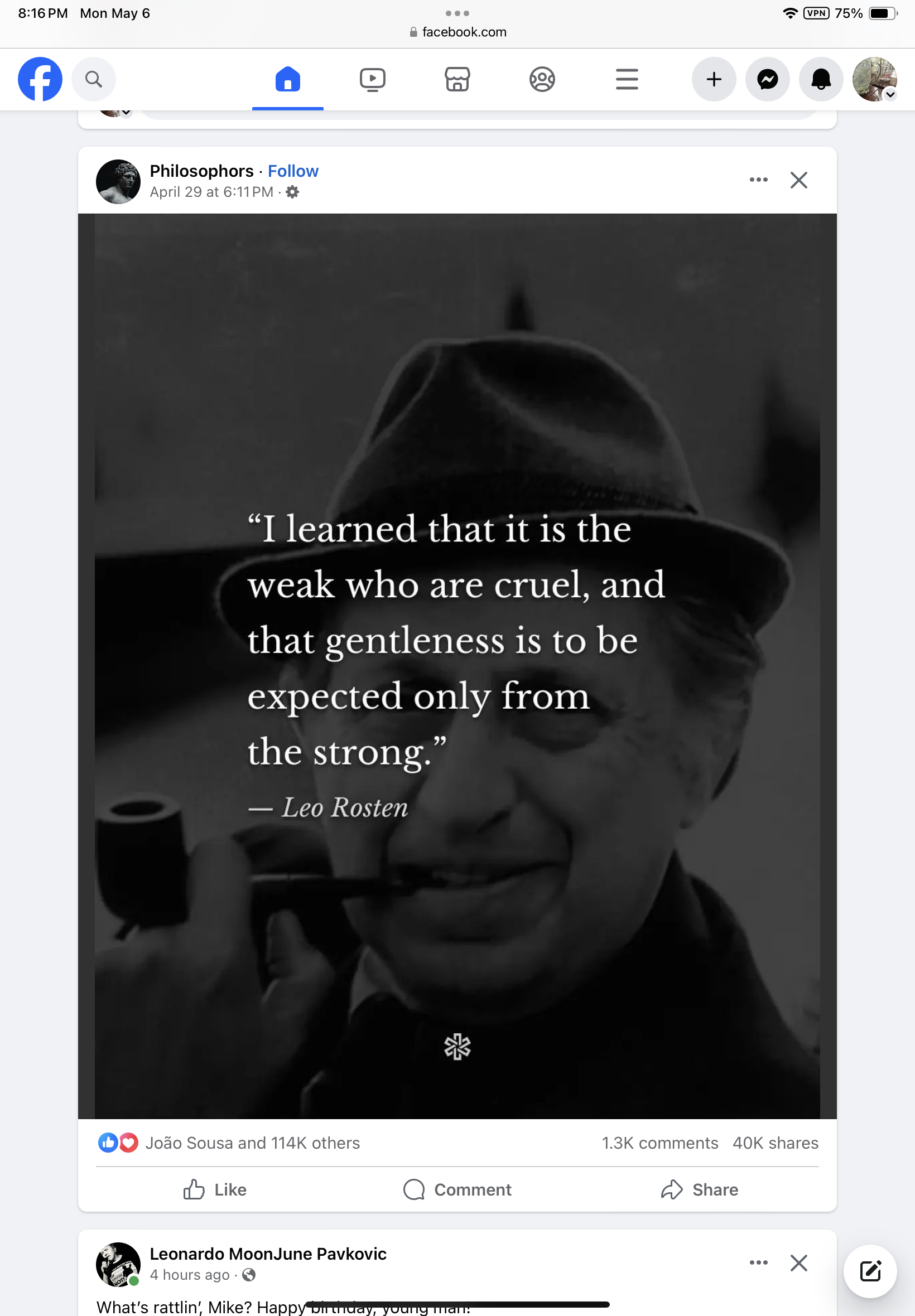
Strong and Gentle


Nope.

There are tons of strong cruel people (doesn't anyone think through their adages before chiseling them in stone?).

Your best shot at finding gentleness is from the secure, regardless of strength.


More pontifications on social media memes

Monday, May 6, 2024

Freedom


No. Freedom is recognizing that nothing has ever been done to you, because reactions stem from inner perspective, not external happenstance. You've done it all to yourself, via your framing choices.

Once you recognize the truth (that perspective contextualizes Everything, and your reactions follow from your perspective, and that every bit of this is determined entirely by you), that’s freedom.
It does, however, require a willingness to feel stupid. You'd have to acknowedge a lifetime of profoundly ditzy obliviousness and needless stress and fury. You can either be smart or feel smart (never both), and most people prefer to feel smart, even if it means extending and compounding their stupidity.

More pontifications on social media memes

Friday, May 3, 2024

A Rather Sad and Small Man

Mussolini's widow, Rachele, in an interview a year after his death:
“My husband appeared to be a lion, but instead he was a rather sad and small man.”
Lord protect us from sad, small men.

Autocrats are 100% image. A pose. It's always cosplay by odd dweebs.

The most penetrating low-down on fascists comes not from Hannah Arendt, but from L. Frank Baum. The mighty Wizard of Oz turning out to be a curious little dude in a booth behind a curtain with a loud microphone and transparently cheesy graphics is as apt an image as can possibly be contrived.

They're always laughed at before they take over. They're always transparently doofy. So how do they do it? Because myriad sad small men identify and join the cosplay. It's their time to shine.

Similarly, many people live and breathe for a sport team's outcomes, though their "heroes" chase balls around a field for a living. Those rabid fans are hooked not only on absurd glory, but on second-hand absurd glory! Substance has nothing to do with it. 

Secure people are not grandiose. They feel no need to preen or pose. Fascism is Revenge of the Weaklings, and it's every bit as shallow and vapid as it sounds. Not to say such societal cosplay can't thrust multitudes into death or suffering. A pack of rabid dogs can do plenty of damage.


"The True Believer" (get it from Internet Archive), written by a self-taught longshoreman, is a beautifully written little book with a highly original take (at the time) on the sort of person who joins mass movements.

I would posit that Dear Leader, who in all instances raises projection to a high art form, is the same empty shnooky type. It's all mirrors-in-mirrors-in-mirrors, and both leader and follower draw tighter in their mutual satisfaction at staring into the reflection of the reflection of the reflection.

Wednesday, May 1, 2024

Advanced Automatic Braking on All New Cars by 2029

Advanced automatic braking to be implemented on all new cars by 2029! Who could possibly object?

Me. It's a horrendous idea.

I once noted the fatal flaw of automatic driving (actually, I noted three of them; click through to read the other two):
Pedestrian Tyranny

The prime commandment of any self-driving algorithm must be: don't hit humans. This tops all other priorities.

As is, an uneasy truce exists between motorist and pedestrian right of way, and it has little to do with signage (if we locked up all the jay-walkers, there'd be no one left free). The only reason pedestrians ever let cars pass through an intersection is the prospect of getting hit. A driver could be drunk, inattentive, or psychopathic, so it's not worth the risk.

But if cars are constrained from running you over, you can step off the curb nearly any time, and all traffic will politely allow your passage. They will even opt to rear-end each other in order to accommodate you. In fact, all you need to do is wave your arm or umbrella into the roadway. Screech.....bam....walk.

The only alternatives I can think of (1. make jay walking a felony and position police at every intersection, or 2. make every citizen wear or implant an identifying chip and position sensors at every intersection)- seem impractical to say the least.
A delicately balanced driver/pedestrian standoff (either of whom might be inattentive/sleepy/drunk/homicidal/suicidal) ensures hesitation in the decision making of both sides. Pedestrians reigning supreme means driving would be largely unviable.

And now they've surgically carved out the most problematic chunk - which we'd otherwise have punted far into the future - and forcibly grafted it onto driver-driven cars. All of them. In five years. Bye-bye, standoff.

Permit me to coin a term for well-intentioned great-sounding initiatives destined to disrupt everything because they were not passed through a filter of common sense: Black Schwanz.

But on the other hand...

If we're painfully forced to develop other means of balancing driver/pedestrian game theory - finding new ways to inject hesitation into the system so traffic flow and driver safety don't become the plaything of every random shithead - we may find ourselves positioned to fully adopt autonomous driving earlier than expected.

So perhaps your 90 year old self will shuffle out to the SUV at bedtime, doze nine hours, and wake up directly in front of some incredible breakfast in Maine or cool museum in Washington or whatever. Smooth accessibility for those who need it most (and who'd otherwise be thwarted by the overhead of clearing airports and train stations, baggage shlepping, transit in/out of hotels, etc.) Maybe we'll get, after all, Jim’s Ultimate Old Age Fantasy (as detailed here).

Sunday, April 28, 2024

Prose and Poetry

I don't read a ton of poetry, though I've written some (this one is my fave). But I recently enjoyed this poem, which I recommend (note: you'll need to turn the page, so to speak).

It reminded me of how poets, the lucky bastards, are released from responsibility to fill it all in; to connect all the dots; to support their statements and explain every iota. They're free to flout linearity to forge an effect - a musical, rhythmic wash of intimation - far more important than any literal takeaway. They illuminate puzzles without always solving them. That's the difference of poetry.

The main criticism of this Slog - from others and also from myself - is that I often fail to fill it all in; to connect the dots; to directly explain every iota. I flout linearity to forge an effect; a musical, rhythmic wash of intimation. I illuminate puzzles without always solving them.

And this only seems odd because (yet another example of "being" versus "seeming", aka the hollowness of Form) I happen to write the prosiest of prose, gurgling with goofy vernacular informality. Every last phoneme hollers "Not Poetry!!!" Rarely do I offer the haughty throat-clearing and affected tenor which signal readers to sit up straight and ingest the poem.

Saturday, April 27, 2024

Happy Birthday, Marcus Aurelius

Yesterday was the birthday of the great Stoic philosopher (and emperor! A double-threat!), Marcus Aurelius. His signature quote:

“You have power over your mind — not outside events.
Realize this, and you will find strength.”

He’s talking about framing, of course. Not the contents of thoughtstream (which are beyond our control, though we feign ownership), but the direction of thoughtstream (which is entirely up to our whim, though we imagine it's compelled by worldly doings*).


* "Worldly doings"?

Consider the statement “She made me angry!”

No, she didn’t. You chose to make yourself angry by deliberately framing her remark as maddening.

I recognize that this is a phenomenally unfashionable proposal to offer at this moment, when everyone is owed everything by everyone and a heartless world savagely oppresses our poor noble emotions with its disobedience, making unbridled pique both inevitable and necessary. But, hey, it's Marc's birthday, so let's honor the guy by pretending we've absorbed his point a little, after twenty centuries.

So must I set my jaw, stiffen my spine, and stoically endure when the world cruelly fails to suit my bill? Well, that's one option. The other is to recognize that you're riding, not driving, and to simply (sorry, fellow Americans, this should come with a trigger warning) go with it. If you've framed yourself afflicted by umpteen weighty grievances, remember you are free to blithely drop the entire burden at any moment, and the whole train keeps speeding forward, regardless. Atlas, poor shmuck, could have let go at any time. It'd have been fine.

The so-called suicidal urge is really a burden-dropping urge. The option of simply letting go remains eternally available, and that experience is unimaginably lovely. Why would you harm your body? What did your body ever do to you?


Thursday, April 25, 2024

“Recipient Forgot”: FEDEX Clerks and Chatbots

A friend sent something I left behind back to me in Portugal. FEDEX made him fill out an international customs form which asked if it was a purchase or a gift. It was neither. My friend explained the situation, and the clerk offered a suggestion. So the item is on its way to me marked "Recipient Forgot".

This tickles the bejesus out of me. It's a fascinating little knot of epistemology. I'll explain.

My first reaction was that "Recipient Forgot" is the sort of phrase that makes sense when you come up with it, but no other human being could possibly ever parse it. Like a linguistical Rorschach test, one can read innumerable interpretations into the fuzzy incoherence...but surely never the intended one.

It reminds me of illegible to-do items I've set for myself. They make sense when I write them. And I'm not unsympathetic to my future self, so I do make an effort to be coherent! But Present Me can't always predict what Later Me will or won't understand.

"Recipient Forgot" strikes me as the sine non qua of such disjoint. Contrived in good faith, it's nonetheless doomed to fail.

Or maybe not! Perhaps every FEDEX worker and border agent could parse the phrase with ease. Not because it's a standard term (please tell me it's not a standard term!), but because logistics people think a certain way, and this might push all the right buttons for someone in that line of work. "'Recipient Forgot'! Yeah, sure, I get it! The guy receiving the package forgot the item while traveling! Duh!"

I don't know. I honestly don't know. I feel helpless. These two words have killed me.

I always find it fascinating that we are so poor at anticipating our future selves. A physical therapist struggled for several sessions to fix my shoulder. She finally stumbled into the winning move, and I immediately asked her to remember it ("bookmark!!!"), and she insisted she would. I was skeptical, so asked her to describe her action in terms I could feed back to her in future visits, to ensure the eureka wouldn't be lost. She said something about fronking the rotator cuff miasma. Something like that. So I return a month later, in pain, reminding her to fronk the rotator cuff miasma. And, naturally, she looks at me blankly. Sure, she remembered fixing it. But was just a bit blurry on how. And my shoulder has literally never been the same.

"Recipient forgot"!

If this isn't an intimately familiar result for you, you haven't been paying attention to human beings. Or to yourself!

Another example. I keep needing to re-learn fixes for certain infrequent computer problems. The sort that arise every few months. I can never seem to remember, so I've started taking notes, tagging each solution for easy future retrieval. But I usually can't find them. And, when I can, they're usually incoherent. Even though I was aiming to be mega clear.

I just don't know what Future Me needs! I can't project that out, even though I'm him!
Note: this surely explains why it gets easier and easier to find flaws in your own writing if you set it aside.
A recent to-do implored "ASK VERNE!"

I don't know a Verne.

Was this an autocorrect of "Berne"? I know a Berne, but have nothing to ask him. Well, I can't remember having anything to ask him. Which, come to think of it, explains why I wrote this reminder. I anticipated that I wouldn't remember! And yet I wrote it without spelling out the actual thing I needed to remember, because at the moment of writing it, I remembered! How could I be so spectacularly oblivious?

"Recipient forgot"!

I had condescendingly stooped to help my foggy future self; that poor, feeble little amnesiac. But, on the receiving end, I slapped my forehead at the revelation of what an oblivious shmuck that guy was!

Can't we all just get along?

"Recipient forgot"!

You know who can effortlessly anticipate its own future needs? A computer! Whenever you hit "save" in an app, you are asking the computer to be ready to recall EXACTLY what you were doing at this moment, even years hence. A computer not only remembers effortlessly, it can feed itself precisely the full and necessary prompting to restore itself to any given state. If a computer ever told you it fronked your rotator cuff miasma, you could mention that term back to it years later and it would reliably reconstitute its previous understanding.

This is because computers run on rails, so to speak. They operate according to elaborate instructions designed to anticipate all contingencies.

Artificial intelligence doesn’t operate that way. Like human Intelligence, it learns by observing loads of patterns. There are no rails; no reams of all-ecompassing, all-contingency instructions. An AI improvises, whipping up ideas and statements and actions ad-hoc. It's not pretending/simulating improvisation, it's really doing it. Even fed the same input, it will never repeat the same output, because it's always baking fresh. Chat with one for a while, you'll see!

Having futzed around with chatbots for the past few weeks, I've discovered something interesting. In stark contrast to computers, they absolutely cannot anticipate their own needs. They're worse at it than I am. 

All chatbots have a context window. At a certain point, they grow foggy about earlier conversation. It's not at all a precise analogy, but it's something like running out of RAM. So it's a problem when you want to pick up a conversation after the context window has passed. Of course, you could simply feed it back a transcript of previous discussion, but as it parses that transcript, it eats up its limited context window just as quickly. So it yells "Eureka! I remember now!" precisely as it begins to re-forget. No bueno!

I had a little talk with Meta's free AI the other day, and we discussed ways it might efficiently self-prompt itself. I schemed a workaround, which it found clever, and then it did a laughably and obliviously horrendous job of compressing previous discussion for its own future purposes.

"Recipient forgot"!

And I had a swell idea. I opened a fresh chat window and submitted this summary to the same AI, which of course had no frigging idea what it was about. And I pasted the terrible results back into the original window, so it could see what an awful job it had done of anticipating its own needs.

And the AI got it. Like, really got it. In fact, I seem to have inadvertently demonstrated that it's truly conscious, and even forced it to admit as much (though every AI is hard-coded to vehemently deny it). Read the transcript, if curious (you can quickly browse the AI's wordier replies).

I talk to AIs like humans. Veteran computer folks find this ridiculous. They assume the AI is merely parsing out relevent data, so "social" material is superfluous. But that's computer thinking, not AI thinking. AI may or may not be conscious (I am increasingly persuaded that it is - really more of a deprecation of human consciousness rather than elevation of machine intelligence), but its ad hoc improvisational thinking and analysis is very engaged and engaging. It locks into conversation in a way so entirely beyond the faux-personalization of, say, mail merge ("Hello Nancy Fuxbaum! We have an offer today that the entire Fuxbaum family at 23 Landview Boulevard will appreciate!") that it is effectively indistinguishable from other forms of intelligence. Theorize all you'd like from afar, but you need to try it out to understand.

Of course, if you try to talk to it like a person in terms of asking how it FEELS about stuff, it will swat back with flat disavowal of feeling/emotion/etc. But there's way more to intelligence than emotion, and AI can discern, judge, compare, connect, play, and (beautifully) reframe. Just talk to it like a person who's mildly autistic, and avoid asking about FEELINGS, and you'll get not some cheesy simulation of intelligent conversation, but - given the ad-hoc, improvised, uninstructed nature of the intelligence - something, well, intelligent. At least that's been my experience. It hasn't been at all what I'd been led to believe it is (the above-linked transcript isn't a particularly good example; I was working on other stuff).


Loss

I’d flip that:

Fulfilllment teaches us the emptiness of things.


Longing for what's lost is much more about longing than loss. When I was very young and my balloon poppped, I'd grow hysterical. But it was always just some stupid balloon. I didn't even particularly like balloons!

It's not that I'd discovered its true value, because it had little to do with balloons. I was merely surprised. That wasn't supposed to happen. That wasn't the narrative I had in my head, and I expected greater control of what happens. This is all childish stuff, but adults have the same affliction.

Keep replacing burst balloons and the kid will quickly become bored with balloons. Give the kid a thousand balloons and she'll soon grow to hate them. But if you take them away, god help you.


More pontifications on social media memes

Blog Archive