Showing posts with label language. Show all posts

Thursday, April 25, 2024

“Recipient Forgot”: FEDEX Clerks and Chatbots

A friend sent something I left behind back to me in Portugal. FEDEX made him fill out an international customs form which asked if it was a purchase or a gift. It was neither. My friend explained the situation, and the clerk offered a suggestion. So the item is on its way to me marked "Recipient Forgot".

This tickles the bejesus out of me. It's a fascinating little knot of epistemology. I'll explain.

My first reaction was that "Recipient Forgot" is the sort of phrase that makes sense when you come up with it, but no other human being could possibly ever parse it. Like a linguistical Rorschach test, one can read innumerable interpretations into the fuzzy incoherence...but surely never the intended one.

It reminds me of illegible to-do items I've set for myself. They make sense when I write them. And I'm not unsympathetic to my future self, so I do make an effort to be coherent! But Present Me can't always predict what Later Me will or won't understand.

"Recipient Forgot" strikes me as the sine non qua of such disjoint. Contrived in good faith, it's nonetheless doomed to fail.

Or maybe not! Perhaps every FEDEX worker and border agent could parse the phrase with ease. Not because it's a standard term (please tell me it's not a standard term!), but because logistics people think a certain way, and this might push all the right buttons for someone in that line of work. "'Recipient Forgot'! Yeah, sure, I get it! The guy receiving the package forgot the item while traveling! Duh!"

I don't know. I honestly don't know. I feel helpless. These two words have killed me.

I always find it fascinating that we are so poor at anticipating our future selves. A physical therapist struggled for several sessions to fix my shoulder. She finally stumbled into the winning move, and I immediately asked her to remember it ("bookmark!!!"), and she insisted she would. I was skeptical, so asked her to describe her action in terms I could feed back to her in future visits, to ensure the eureka wouldn't be lost. She said something about fronking the rotator cuff miasma. Something like that. So I return a month later, in pain, reminding her to fronk the rotator cuff miasma. And, naturally, she looks at me blankly. Sure, she remembered fixing it. But was just a bit blurry on how. And my shoulder has literally never been the same.

"Recipient forgot"!

If this isn't an intimately familiar result for you, you haven't been paying attention to human beings. Or to yourself!

Another example. I keep needing to re-learn fixes for certain infrequent computer problems. The sort that arise every few months. I can never seem to remember, so I've started taking notes, tagging each solution for easy future retrieval. But I usually can't find them. And, when I can, they're usually incoherent. Even though I was aiming to be mega clear.

I just don't know what Future Me needs! I can't project that out, even though I'm him!
Note: this surely explains why it gets easier and easier to find flaws in your own writing if you set it aside.
A recent to-do implored "ASK VERNE!"

I don't know a Verne.

Was this an autocorrect of "Berne"? I know a Berne, but have nothing to ask him. Well, I can't remember having anything to ask him. Which, come to think of it, explains why I wrote this reminder. I anticipated that I wouldn't remember! And yet I wrote it without spelling out the actual thing I needed to remember, because at the moment of writing it, I remembered! How could I be so spectacularly oblivious?

"Recipient forgot"!

I had condescendingly stooped to help my foggy future self; that poor, feeble little amnesiac. But, on the receiving end, I slapped my forehead at the revelation of what an oblivious shmuck that guy was!

Can't we all just get along?

"Recipient forgot"!

You know who can effortlessly anticipate its own future needs? A computer! Whenever you hit "save" in an app, you are asking the computer to be ready to recall EXACTLY what you were doing at this moment, even years hence. A computer not only remembers effortlessly, it can feed itself precisely the full and necessary prompting to restore itself to any given state. If a computer ever told you it fronked your rotator cuff miasma, you could mention that term back to it years later and it would reliably reconstitute its previous understanding.

This is because computers run on rails, so to speak. They operate according to elaborate instructions designed to anticipate all contingencies.

Artificial intelligence doesn’t operate that way. Like human Intelligence, it learns by observing loads of patterns. There are no rails; no reams of all-ecompassing, all-contingency instructions. An AI improvises, whipping up ideas and statements and actions ad-hoc. It's not pretending/simulating improvisation, it's really doing it. Even fed the same input, it will never repeat the same output, because it's always baking fresh. Chat with one for a while, you'll see!

Having futzed around with chatbots for the past few weeks, I've discovered something interesting. In stark contrast to computers, they absolutely cannot anticipate their own needs. They're worse at it than I am. 

All chatbots have a context window. At a certain point, they grow foggy about earlier conversation. It's not at all a precise analogy, but it's something like running out of RAM. So it's a problem when you want to pick up a conversation after the context window has passed. Of course, you could simply feed it back a transcript of previous discussion, but as it parses that transcript, it eats up its limited context window just as quickly. So it yells "Eureka! I remember now!" precisely as it begins to re-forget. No bueno!

I had a little talk with Meta's free AI the other day, and we discussed ways it might efficiently self-prompt itself. I schemed a workaround, which it found clever, and then it did a laughably and obliviously horrendous job of compressing previous discussion for its own future purposes.

"Recipient forgot"!

And I had a swell idea. I opened a fresh chat window and submitted this summary to the same AI, which of course had no frigging idea what it was about. And I pasted the terrible results back into the original window, so it could see what an awful job it had done of anticipating its own needs.

And the AI got it. Like, really got it. In fact, I seem to have inadvertently demonstrated that it's truly conscious, and even forced it to admit as much (though every AI is hard-coded to vehemently deny it). Read the transcript, if curious (you can quickly browse the AI's wordier replies).

I talk to AIs like humans. Veteran computer folks find this ridiculous. They assume the AI is merely parsing out relevent data, so "social" material is superfluous. But that's computer thinking, not AI thinking. AI may or may not be conscious (I am increasingly persuaded that it is - really more of a deprecation of human consciousness rather than elevation of machine intelligence), but its ad hoc improvisational thinking and analysis is very engaged and engaging. It locks into conversation in a way so entirely beyond the faux-personalization of, say, mail merge ("Hello Nancy Fuxbaum! We have an offer today that the entire Fuxbaum family at 23 Landview Boulevard will appreciate!") that it is effectively indistinguishable from other forms of intelligence. Theorize all you'd like from afar, but you need to try it out to understand.

Of course, if you try to talk to it like a person in terms of asking how it FEELS about stuff, it will swat back with flat disavowal of feeling/emotion/etc. But there's way more to intelligence than emotion, and AI can discern, judge, compare, connect, play, and (beautifully) reframe. Just talk to it like a person who's mildly autistic, and avoid asking about FEELINGS, and you'll get not some cheesy simulation of intelligent conversation, but - given the ad-hoc, improvised, uninstructed nature of the intelligence - something, well, intelligent. At least that's been my experience. It hasn't been at all what I'd been led to believe it is (the above-linked transcript isn't a particularly good example; I was working on other stuff).


Wednesday, February 21, 2024

Two Useful Terms

Oppositional Defiance Disorder

I have a mild aphasia. I need to struggle for words. Most people can't relate...until they hit a situation where there is no word. Then they know how I feel!

In this case, the phrase does exist, but it's nowhere near as well-known as the condition it describes. I constantly see people reaching for a term to describe people with a kneejerk compulsion to always do the opposite thing. Say, for example, members of a staunchly anti-Russian political party, seeing the opposing party try to block Russia from slaughtering and obliterating its neighbor, turn around and start rooting against the obliterees, just to be dicks. What do you call that?

Oppositional Defiance Disorder.

There you go. You're welcome.

Hedonic Adaptation

Hedonic adaptation, aka Hedonic treadmill, is a term I just heard for the first time. It refers to the fact that people have a steady level of happiness they "shoot for", so when they become too happy, they ratchet themselves right back down again. It's like a thermostat for happiness, keeping you nice and "meh" (or worse - depressives, I'm looking at you!).

"Ballasting Happiness", second on the Hits List in the left margin, was one of my proudest breakthroughs. And, yeah, I was just too ignorant to know it was already figured out back in, like, yeesh, 1971.

I can console myself because I also posited how we do it, accounting for otherwise inexplicable human behavior. But still, my greatest fear is that the ideas I've grinded on for 30 or 40 years, popping out insights that strike me as gratifyingly unique and fresh, are actually banal and everyone knows this stuff but me. I.e. I'm the slow child breaking through. Hey, good for yooooou, buddy!

That's how I feel perpetually: the slow child breaking through. Remember the time I conceptually reinvented glue?

Saturday, January 14, 2023

Bad at Languages

I have at this point met 12,000 American expats (slight exaggeration) living in Portugal, some for months or years, who barely speak a word of Portuguese. And every single one of them disclaims that they're "bad at languages".

My response to that - which, of course, I keep to myself - is that, if you can't manage to say "yes", "no", and "thank you" (plus a couple dozen other easy polite words) in the society in which you've chosen to live, that's not a question of language facility, that's a question of fuck-giving.

For the most part, Americans here say "Sí" or "No", which, of course, is Spanish. In Portuguese, it's "Sim" (seem) or "Nao" (now). This may strike you as a petty difference, but only like shitting in the sink rather than in the toilet is a petty difference.

Shrugging off the distinction between Spanish and Portuguese disrespects both proud cultures. You've made them a mere blur. A "those people". A WHATEVER. By shrugging petulantly at the distinction between "sí" and "sim", you dismiss the entirety of both cultures. Understandable for tourists, but, sheesh, if you're actually living there...

But that's not the point I'm here to make. What intrigues me is the "I'm bad at languages" explanation. I once wrote that "Every snob feels merely shy." And this clearly dips from that same well.

Tuesday, January 18, 2022

Wordle Tips

I think I've cracked the code on Wordle, the rare trend I'm full-heartedly conforming to.

I've guessed correctly in row 3 three days in a row now. Here's Saturday's result:


...and here's Sunday:


...and here's yesterday:


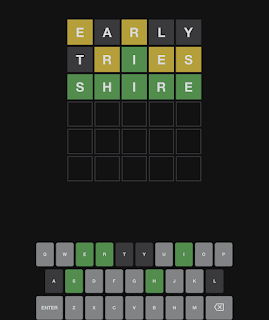
Here's my actual screen for yesterday:


1. I always start with "Early", to start pinning down vowels. I used to have an even more vowely word, but it is, alas, lost.

2. "Tries" was not a guess. Don't guess! It's not that game! Tries has "S" last (very common), and adds one of the missing vowels, plus the common "T". It also tries to locate the "R" and "E". Your second row should have no wasted letters. Every letter should introduce new common letters and/or reposition known letters (in this case, two repositions and three introductions).

3. By row three, if you followed the above strategy (no guessing!!), you have more info than you might initially think.
Obviously, "I" is #3.

"R" is #1,#4, or #5. We can eliminate #5, as I couldn’t think of a common word that worked with these included/excluded letters. So "R" is either #1 or #4

"S" is #1, #2, or #4. I can't think of any words that would put it #2. So "S" (like "R") is either #1 or #4

"E" obviously can't be #3. And it can't be #1 or #4, because they're occupied by "I" or "S" (one way or the other). So "E" is either #2 or #5. It was unlikely to be #2 (“EI”), so it's #5. I got lucky that it wasn’t “reign” (and “deign” and “feign” don’t use an “R”, and also are too obscure for Wordle).
So here's where we’re at: (S/R) (?) (I) (R/S) (E).

There are two possibilities: SPIRE, or SHIRE (it can't be RAISE because "A" is excluded).

Wordly only uses common everyday words...and spire's a bit obscure. Shire might seem uncommon, too, but remember: the puzzle's produced by a Brit.


Update: I just did it again today. I won’t spoil todays puzzle for you, but here is my result:


Sunday, January 2, 2022

Improving Your Foreign Language Accent

Spoiler: this is a follow-up to this.


It's a cherished activity for my friends in Spain to give me crap over my lousy Spanish. I'm lazy with verb forms, lazy with vocabulary, and lazy with accent (other than that, not bad).

"Should I speak like a TV newsreader?" I once asked, launching into a loud, stiffly pompous, basso profundo mockery, ostentatiously trilling my "rr"s, wrapping my vowels in rich corinthian leather, and popping my bilabial plosives like spitting ping-pong balls.

"THAT'S IT!!" hollered all pals present. Even the otherwise disinterested bartender cocked an approving eyebrow. I was so startled that I waited a few moments to see whether they were putting me on. They weren't. The highly affected accent I'd just tried on wasn't an absurd spoof of Spanish. It was Spanish. The way I normally speak was under-exaggerated and under-affected.

You're not speaking a language correctly until you worry you might cause offense by lathering it on much, much, much too thickly. If you speak some French, you gotta Inspector Clouseau that mo-fo.

Beneath this all was a deeper issue. The ostentatious approach didn't sound like me. I'm not that person. I don't talk that way. Sure, I speak Spanish. That's something I'd do. But the crisply fricative articulation - the full Ricardo Montalban - is something I'd do only mockingly. Speaking Spanish correctly meant sounding like someone other than me.

I still don't, by the way. I continue to slur my half-assed Spanish with the whiny slack-jawed laziness of a cool daddy NYC jazz musician. 'Cuz that's what I am. Even though I no longer live in NYC and am no longer a jazz musician. That's the character. That's this Jim Leff guy, I guess.

As I explained last time, adults have trouble learning because learning requires "changing from the type of person who doesn't speak French to a person who pretentiously trills "No no no no no!" through pursed lips."

And the inhibition is powerful, because people imagine that if they're not THIS PERSON (this character they made themself forget they chose to play) they'd be lost or erased or snuffed or fallen-off-a-cliff into a dark pit of non-existence. "We inhibit it with all our might," I noted, "hooking it in to our very survival instinct."

To understand the power of this inhibition, consider this. I play my character particularly lightly. While most people are so invested they forget they're even posing, I barely suspend disbelief. Plus, again, I do speak Spanish (that's something I'd do!). Yet, even still, I can't make myself go full Montalban, because it's out of character.


I've shared this tip with many friends who speak heavily-accented English. I ask them to IMITATE an American. They always manage it surprisingly well. And they always express surprise, wrinkle their noses, and go back to speaking heavily-accented English. Why? Because they're foreigners.

Saturday, January 1, 2022

Unifying Framing, Learning, Creativity, Depression, and Narcissism

This edges closer to a grand unification of the ideas that occupy me. For newcomers, I’m insatiably curious and trying to work through insight as it errantly arrives (see the Slog's subtitle at stage left). Fitting pieces together. I’m like Columbo, only more foggy and with a slightly shabbier raincoat.


I've often noted that children learn easily and adults learn painfully. Adults obviously ought to emulate the learning style of children, and it's insane that we have, since the Victorian era, forced young people to learn in the most adult way. Hey, kids! Learn more like a grown-up! 'Cuz we do it super-badly!

I've explored the reason children learn faster/better (check out postings tagged "education"), attributing it to their uninhibited playfulness and adaptability. They haven't yet frozen into the pose of someone too distinguished to pilot a unicycle. They haven't yet decided they're the sort of person who doesn't speak French. It's all about pliancy of perspective.

I've also previously noted that I've been eleven ever since I was eleven. Looking around me at that age, I observed that teenagers appeared to have lost their minds, and grown-ups were stiff, stodgy, growly, boring, plodding ogres. Powerful but dim and blinkered, they were classic examples of strong drunks.

Most kids can't wait to advance to the next level, but I realized I'd never be more pliant, exuberant, curious, and receptive than I was at that moment, and saw no reason to level up - to graduate into some new persona, discarding my current perch. I’d found a good perch! Why unperch???

At that stage, I hadn't framed framing. I recognized, intuitively, that I had great fluidity of perspective, and that it was helpful, but I couldn't explain it all to myself (perspective on perspective arrived only a few years ago....epiphany chronicled here in this Slog). But the thing about me that seemed usefully pliant and quick and magical - and which teenagers appeared to half-lose (becoming dumb and dramatic and heavy) and which adults had lost entirely (becoming stiff and slow and dull) - was my faculty for reframing, aka shifting perspective.

I didn't clearly understand it, but I knew I needed to retain it at all costs. When I say I'm still eleven, I don't mean this weirdly tall and hairy body, and I don't mean that I chew bubblegum and play Pong all day. It's not the outward eleven year-old, it's the lithe inner perspective. The pliancy. That’s what I inarticulately meant. We are our pattern of framing; of attention-paying. We are subject, not object.

This also explains why some people (never women, oddly) mistake me for gay. The palpably light core of this grizzled 59 year old, who you’d expect to be gruffly sluggish, suggests that I'm hiding something. If gayness is a preoccupation for you, it makes sense to assume I'm that. I also get other odd projections. I'm a human Rorschach. But it's natural. I bought the ticket, so I've taken the ride. I really can't complain. It was the correct move to stay eleven, despite the drawbacks.

Grown-ups, super occupied with playing a character, congeal and lose pliancy. "Maturity"! This role-play requires obsessive upkeep, expending enormous energy (explaining why adults are so sluggish), and it's tremendously counterproductive. It's all about freezing perspective, which is what depression is. Even non-depressed grown-ups seem pretty depressed to an eleven year old. The less-depressed ones are a bit more carefree in portraying the character they've made themselves forget they’ve chosen to play. Just a bit.

At eleven, I wasn't playing a character. And while I've lightly dabbled over the years with role-playing, I never really bought in (I plied my eager/daffy Chowhound persona entirely as broad comedy). At a certain point, I dropped all pretense (and charisma with it, which led to weirdly troubling social encounters, which I used to call my "curse").

Despite the drawbacks, this "letting go" returned all my childhood energy, and I'm more eleven (i.e. pliant) than ever. I learn like an 11 year old. Long time readers surely have noticed my eager all-embracing curiosity...and this explains it. They say people don't change, yet I'm unrecognizable from previous iterations....and this explains it. I'm a moderately talented, reasonably intelligent guy who's managed to excel far beyond his potential in seven different fields....and this explains it (I'm not here to boast, I'm here to share my tricks so you can do way better than I did).

You can't learn if you're fully occupied with playing a character, with the exhaustingly self-referential perspective of starring in some movie. First, it ties up all your attention. Second, it inhibits the playful curiosity necessary for learning. And, third (this is the subtle one), learning is change, and adults are notoriously phobic of change. Why? Obsessively maintaining your role as This Person inherently means avoiding becoming Some Other Person.

Learning means changing from the type of person who doesn't speak French to a person who pretentiously trills "No no no no no!" through pursed lips. You go from someone who's bad with computers to a nerd preoccupied with his disk cache. Learning turns you into another character.

And that's not just unpleasant, it's downright existential. The highest possible stakes! We fiercely defend ourselves from losing the character we've convinced ourselves we are. I don't want to play a Francophone or computer nerd because I'm playing this guy!

That's the x-factor. That's why adults tenaciously resist change, growth, learning, and pliancy. It's not that we sadly lose some crucial cognitive faculty. It's that we inhibit it with all our might, hooking it in to our very survival instinct.


I observed here that "Creativity is the ability to generate and wisely choose among a complex set of options." That requires pliancy of perspective which allows creative people to make art. Creative people work a bit less hard to deliberately inhibit their pliancy.

Monday, September 13, 2021

False Friends, Inadvertent Penetration, and Coimbra

All Portugal trip reports in chronological order:

Oddly Bookended Food Day in Portugal (Nepali and Goan in Almada)
My Portuguese Rosebud (questing for a second helping of the arroz de mariscos that changed my life 30 years ago)
Bacalhau Score (glorious restaurant version of a homely grandma dish in Almada)
Grappling with Chowhounding Hubris (good-not-great pork cheeks in Sintra)
Taskinha Do Chef (Torres Vedras, Portugal) (exquisite family-run restaurant in Torres Vedras)
False Friends, Inadvertent Penetration, and Coimbra (diagnosing the Coimbra Problem)
Solar dos Amigos (rustic culinary splendor in Caldas da Rainha)
Burguezia do Leitão (the best roast suckling pig palace near Coimbra, in Casal Comba)
A Casa do Jorge (smashing wine country steakhouse in Santana, near Azeitão)


There's a linguistic phenomenon known as a "false friend". This describes words that seem familiar, but don't mean what you think they mean. I, alas, am the poster child for this phenomenon, having once been nearly laughed off stage for it.

It was the first gig of my first tour in Spain. I'd played a couple warm-up tunes with the rhythm section, and it was time to bring on our female vocalist. Proudly confident in my high school Spanish, I took the microphone and said "Señores y señoras, quiero introducir nuestra vocalista...." and before I could utter her name, the auditorium erupted in vast howls of laughter, which persisted for a good long while.

The bass player, a bear-like Andalusian named Nono, gestured with his finger to come over to him. He was gripping his sides, tears streaming down his cheeks, but he managed to croak out an explanation: "You just said you want to penetrate the singer. The word you want is 'presentar'".

Geez, "introducir" sure seemed right. But no. False friend.

In the years since, I've noticed cultural false friends beyond language. For example, in 90s Tokyo, I came upon a couple of sneering Japanese punks. Pierced everything, extra-malevolent mohawks. I nearly crossed to the other side of the street as they approached.

A wizened grandma a few feet in front of me nodded sweetly at them, and they straightened up, bowed respectfully (all malevolence cleanly washed off their faces), then recomposed their shtick and walked on. I'd thought they seemed familiar, but they weren't at all what I thought they were (I’m not sure they were even what they thought they were).

You'll notice this phenomenon a lot if you pay attention while traveling (if not, you'll develop a false sense of homogeneity). I seek it out, enjoying the cognitive dissonance. Here's one that steered me wrong for decades:

Ask any Portuguese about the town of Coimbra, and they'll say "college town". That's it. Automatic response. Nothing else to say. College town. Coimbra? College town. Yeah, a college town. Coimbra is a college town.

I figured they meant it was like Boston - a center of learning with a diverse community of intellectually curious students. A teeming academic beehive buzzing with chem research, creative writing, and chai lattes. This became my image of the place, persisting in the mid 90s when I briefly skirted the town's perimeter en route to Porto. It was magnificently beautiful (imagine a matte painting backdrop for a Star Trek episode set in year 1225 Europe). A picturesque seat of learning. A college town, I'd heard!

Last week I finally pulled into Coimbra, and commenced my usual onslaught of eating, drinking, hanging, talking, etc.. And virtually everyone I encountered was a bit "off". Dourly impersonal and weirdly disconnected. My AirBnB host, an engineering professor, placidly watched me struggle out of a tiny elevator with my collection of suitcases, bags, and laptop backpacks. She held out my key for me to grab with my fully-occupied hands, and mumbled "Welcome do you have questions." 

Still gasping from the effort and slightly disoriented, I tried to focus my mind on questions. The pause was not convenient for her. Without a shred of malevolence, she reemphasized, a little louder, "Any questions?" "Uh, no, I don't think so…" I replied, and she swiftly retreated into her adjoining apartment. Odd. Spooky.

And the whole town was like that. I'm an experienced enough traveler to not draw firm conclusions from a few encounters, but I couldn't avoid seeing this as the local style. 

Finally, I passed an open-aired nighttime concert about to start in a stunning plaza illuminated with highly dramatic lighting. It was a string quartet of serious-looking and well-put-together young people with excellent posture and intense game faces. I perched eagerly on some church steps to listen, and my mouth quickly fell completely agape behind my face mask. Here are a few bars.


This was a phenomenally - almost satirically - joyless and ploddingly under-tempo version of Mozart's Eine Kleine Nachtmusik. Utterly grim and trudging and grudging. Zero youthful exuberance. The setting - the plaza, the buildings - was stirring. But the musicians were essentially contaminating it all with their drearily dispassionate - really, almost inhuman - performance. 

I escaped quickly (fearing transmission of a virus that might consume and neutralize my own musicality), and, upon arriving back at my room, found no hot water. I texted my AirBnb host, who replied as follows (this is a direct quote, and she wasn’t being cheeky):

Try turning the faucet to the left and wait a minute.

Three hundred devastating replies flashed through my head, but I finally opted for a cold shower, and let it slide. There was nothing to say, and, really, I was grateful that she'd sparked an epiphany which had been forming all day. 

Finally (thirty years later!) I understand what the Portuguese mean about Coimbra being a college town. There's a vibe of dour Aspergery disconnection and bloodless oblivious superiority. What they mean is that the town's pervaded by the very worst sort of academician vibe. They never lead by mentioning the beauty of the place, because, with a vibe like that, the beauty's wasted.

College town. Yup. A goddamn college town. Hey, what can you do?

Sunday, April 4, 2021

Craziness Codicil

Following up on my previous posting, "The Craziness of Encountering Crazy People Who Don't Exist"...


When you sanitize and euphemize your language and your thinking about a thing, you deliberately detach yourself from truthful conception of the thing. You shun and reject truth. And that's not good, because if/when that truth is encountered, it will stun you. Having methodically bleached some truth nugget previously lodged in your consciousness, you're left in a bind when reality pops up...which it does with some frequency.

This is, in fact, why we think. It's so that reality doesn't knock our teeth out or leave us yammering like idiots. Thinking is our pre-production preparation for reality. It's useful work, even if it's not all sparkly nice and a smooth fit with cultural trends. Ideally, we think to understand, not to conform. You need to really watch out for anyone trying to reconfigure your motivation from comprehension to conformity. That's the essence of brainwashing, aka "political re-education".

Thought bleaching, even for seemingly benign reasons, leads to debilitating results. It can work for a while, in a limited, blinkered way, but it inevitably leaves you estranged from reality. Me, I'm a big fan of reality, of truth. The very last thing I want is to deliberately estrange myself from it.

It's particularly corrosive for those whom this artifice has been contrived to protect. It shames and erases their reality. However positive your intentions, that's a hack that should never be pursued.

The Craziness of Encountering Crazy People Who Don't Exist

I had lunch a while back with a mentally ill guy. And I was completely taken aback when he started spouting craziness.

We've really boxed ourselves in with our language meshugas here in Euphemism World. Who'd expect a "mentally ill" person, facing certain "challenges", to spew outright craziness? One doesn't expect craziness from the mentally ill. One expects neatly compartmentalized, non-stigmatizable mental illness. Because that's what we call it.
Hi there, I'm Canadian, brunette, Pisces, mildly athletic, and mentally ill! So tell me a little about yourself!
You don't expect craziness because there's no such thing. Crazy people don't exist. So when a crazy person sat before me at lunch, it seemed unexpectedly....ugly. Much as the word "crazy" is ugly. "Crazy" truthfully describes the ugly prattle coming out of his mouth. And if you can't say so, or even think it, you'll feel shocked when something very much fitting that non-existent and totally not-okay word materializes before your lying eyes. The disjoint, in fact, makes the encounter much more jarring. It's, well, crazy...and that's just, well, crazy!

As a society we may nobly strive to sweep stigma under the cognitive/linguistic rug, but then one day you'll encounter some bona fide crazy shit, and find it as hard as I did to maintain composure while insouciantly swirling Sauvignon blanc and daintily tooth-scraping artichoke scuzz. It all grinds to a halt. We're lost without the availability of the word we're never supposed to utter upon encountering the thing we're never supposed to acknowledge. Reality startles the dreamer.

This is a horridly poor outcome for crazy (ouch) people. Because if the reality of how they behave is so awful as to be excluded from polite conversation, where, exactly, does that leave them? What's it like when the very thing you are can't be spoken without euphemism? One gets a taste of that predicament from eggshell-walking, painfully meticulous prog-speech (I'm sick of the term "PC", which the piqued canned hams of Fox News have ruined for me):
"So! Jim, I understand, is of the, um, Hebraic persuasion. By which, I mean to say, he's a Jew-American, oh dear, so sorry, my denture must have slipped, a Jewish-American, and those wonderful, uh, beings are so splendidly intellectual and sarcastic! I hasten to note that every individual Jew - sorry, er, Jewish-American - is of COURSE unique, so I'm not attempting to generalize here, but...."
Even this relatively mild form of word mincing leaves me wanting to book de-circumcision surgery and rhinoplasty, and to eat nothing but pork chops dunked in mayonnaise for the rest of my life. I'm driven to self-denial, if not self-obliteration, by vaguely insulting faux-tolerant (STOP ‘TOLERATING’ ME ALREADY!!!) gesturing. As I wrote here, "As a member of five or six minority groups, myself, I find myself cringing whenever I see groups to which I belong depicted or discussed with anxious care and glossy patina. What awful thing, after all, are they so carefully dancing around?!?"

It must be far worse for those whose actuality has been de-worded. What does it feel like when those enduring your crazy ravings are left struggling to recompose their tidy worldview that all's swell and you are absolutely not as crazy as you just clearly demonstrated yourself to be? Isn't that the most exclusionary possible exclusion? And isn't it also a false feedback loop? If I'm acting crazy, please, for heaven's sake, tell me! Bluntly! Don't just stare straight through me, mentally self-denying your assessment of the unthinkable thing you've totally decided I am.

If it's so imperative to create a minty fresh landscape in our collective imagination, stocked exclusively with above-average bright and untarnished souls, some of whom might face certain "challenges" - euphemizing their uncomfortable truth off the table - then what becomes of such people? Aren't they essentially purged along with their unmentionable trait? Aren't we making them, themselves, unthinkable?

It's perfectly ok to point out tallness. But shortness? YOU SHUT YOUR MOUTH RIGHT NOW. Sympathetic people deem such characterization taboo; so irredeemably awful that we must expunge the very concept. But, sweet Jesus, where does that leave short people? Personally, I don't think size is any big deal (me, I'm tall, so I hit my head a lot, and wouldn't mind shaving off half a foot and being 5'6"). It reminds me of Basil Fawlty, proprietor of a fictional provincial British hotel, desperately trying to NOT MENTION THE WAR to his German guests. Is shortness really so horrid that we can't mention it? What does this reveal about our actual feelings about short people? Doth we protest too much?

What kind of freaky funhouse ride do we force upon the anti-stigmatized? Is this a nice thing to do to, for example, crazy people? If no one can be crazy - because it's too awful to say so - then how can crazy people even go on living?

In fact, how can any of us go on living in minty-fresh Euphemism World without it taking a toll on our mental health? And if it did, how would you even know? Craziness is easily spotted, but "mental health challenges" sound like something you'd need to wait in line for a very long time at a community wellness center to assess, before primly adding the term to your bright, colorful punchcard of turn-ons, turn-offs, and charming personal peccadillos.


I'm not poorly informed. My intellectual grasp of mental illness is rather sophisticated, thanks. But language is not a purely intellectual function (if it were, writers could predetermine reader reaction like code compels computers). Language is equally an emotional channel, and every one of us has a visceral understanding of "Crazy", whether we use the word or repress it, and that deep understanding is not - by very design! - triggered by the term "mental illness".

Prohibiting vivid words only heightens their power. For example, "nigger", which had largely dissolved into corny anachronism by the early 1980s, now has been given the immense power to flip much of the nation into frothed madness via one single utterance. Why would we willingly stoke such words with such heightened power? Me, I'd rather type it over and over - nigger nigger nigger - until it decays into a meaningless musical sound with less juice, not more. See how puny and nothing it is. Let's opt out of fetishizing malicious stupidity. Nigger corn chips gall bladder prune juice hairspray! Unceremoniously grind out the stupid cigarette butt beneath your heel. It's barely worth snuffing; certainly not to be mistaken for the infernal blaze of Hell; and, for god's sake, let's not keep, like, honoring it.

Also: I've suffered from depression, OCD, and PTSD, all in long remission after lengthy regimens of yoga and exercise, followed by years of rigorous meditation (unclenching the myriad micro-contractions with which we purposefully bind ourselves). I've also had schizophrenic, paranoid, addicted, alcoholic, psychopathic, narcissistic, megalomaniac, and suicided loved ones. So its not that I lack sympathy, bokay? I'm all for sympathy, but I do not find our current modes of performative pseudo-sympathy the least bit sympathetic. I've acted crazy, you've probably acted crazy, and it's fine, we can call it what it is...if only to ensure that we don't keep stigmatizing via heavy-handed anti-stigmatization (will we human beings ever learn to react to extremism with enlightened moderation rather than with reciprocal extremism?).


Woops, I forgot to actually get to the point...but corrected that here.

Sunday, March 22, 2020

Perky Pandemic Project (PPP): Learn a Language!

Issac Newton developed calculus during Black Plague lock down. And it's said that seventy years earlier Shakespeare wrote Macbeth in quarantine (which is somewhat true, and here's a fascinating though ultimately frustrating dive into the question that suggests we can definitely credit the plague with a lot of Will's poetry, as theaters were shuttered and a bloke's got to make a living).

So what can we do? Hey, I have an idea! Let's learn a foreign language!

It's a timely suggestion, because it so happens I've spent the past five weeks studying Portuguese. And I've been meaning to write about my process of coaxing my 57-year-old neurons into absorbing torrents of fresh information - a process I promised myself I'd never again undertake after a lifetime of laboriously building knowledge in several fields, eventually discovering that insight beats knowledge. The juicy stuff comes - as is so often true in this life - from lithely using what you've got (reframing!) rather than accumulating more and more.

So I didn't want to launch another big learning endeavor, ever. Besides, I figured I was thick as concrete, unable to retain anything for more than 30 seconds (unless it tickles my interest, in which case I'm like Rain Man). Yet, astonishingly, it's working. I guess I'm going about it the right way.

And it dawns on me that we're all home with time on our hands, and might want to emerge in a couple months with the cool superpower of speaking another language. So I'll offer a quick overview of my approach, describing the tools I've been using (all free or cheap), and I'll tackle the epistemology angle separately someday (here's a follow-up).
It really is a superpower. Beyond unlocking a world of culture and communication, a new language coaxes deep reframing. You add rooms to your inner home; fresh viewpoints becoming deliciously available. You've essentially birthed a new person.
Note, first, that I'm a sloppy learner. I don't sit primly at my desk mastering each lesson before moving on to the next. I don't lay solid foundations. I plunge ahead heedlessly the second I get a basic gist, and clean up the slop later - or, if I can get away with it, simply don't. For example, I've been speaking Spanish for 45 years, yet I still call drapes "the-things-you-put-over-the-windows-so-the-light-doesn't-come-in".

Here are tools for sloppy ad-hoc learners; for those of us who dive in and dabble, cleaning up gaps and problems later, if ever.

Anki

Anki is a software platform that's like flash cards on steroids, and geeks worldwide practically worship it. Anki drills you on a few cards per day (and intentionally makes it hard to do more), tracking and ranking problematic ones so that, moving forward, they get re-tested until you've finally internalized them. Sloppy learning nirvana!

There are Mac and PC Anki apps, which you can use to configure your Anki deck. For the actual drilling, just use their web app via your browser (it works great on mobile, as it's an ultra simple interface). You report - via honor system! - whether you find a given card "Easy" (re-test very sporadically), "Good" (re-test moderately after waiting a while), "Again" (you're not there yet), or "Hard" (furious re-testing). It takes work to build and tweak your deck, but it's worth it.

Don't use the canned language decks you can find online. Brew your own deck. Here's what I put in mine:

1. The 100 most frequent Portuguese words (in both Portuguese -> English format, but also separate cards for English -> Portuguese). A zillion web sites offer this sort of thing.
2. Present tense conjugations for the three regular verb types (e.g. "I eat" -> "Eu como", but also the reverse).
3. Present tense conjugations for the most common irregular verbs
4. Past tense conjugations for regular and irregular verbs
5. Numbers, months, days of the week, body parts, etc. All in forward and in reverse.

The Printout

The material that goes into Anki needs to be at least somewhat familiarized before you drill with Anki (it's a bit painful to learn absolutely new stuff via flash card quizzes). So I formatted the material I just listed, above, into a nice multi-page document which I print out and read through at traffic lights and over coffee. I also saved them as one big PDF, which I emailed into my Kindle app for browsing on mobile. It's like knitting or a fidget toy; the thing I pull out at odd moments. Then, once per day, I let Anki quiz me.

I memorize poorly. I remember stuff very well for a short while and then lose it forever. Yet, miraculously, 350 new words are fairly lodged in my brain thanks to five weeks of Anki + printouts. I'm amazed, really. Its true that some are accessed only very slowly, like wading through a vat of syrup, but that's cool, I can ratchet up the speed later. Same with spelling and pronunciation. Again: sloppy learning works for me.

Preply

Preply lists native language teachers worldwide who instruct you via Skype, for as little as $15/hour.

I don't, frankly, need some Portuguese kid masterminding my language education. But to brush up on pronunciation, and offer easy engagement, practice, and feedback, you just can't beat the price. My teacher - a random Portuguese lady living in Mexico - thinks she's my language guru, but while I dutifully follow her lead, I'm mostly in it for the spoken practice.

Google Translate

Google Translate is an invaluable resource, obviously. Not just for quicky/easy lookups, but because it will speak any word, which makes the ghost of every language student who's ever lived insane with envy. The problem is that it's a computer voice - good but not great - and, unbelievably, Google only offers Brazilian-style Portuguese pronunciation - a whole different thing from European Portuguese - so for pronunciation guidance I actually prefer...

Forvo

At some point tons of earnest people in tons of countries had the patience to sit down and speak words into a microphone so Forvo could offer an ambitious library of pronunciations. Sort of like Wikipedia, I guess. So you can drill down to pronunciations not just for major regions, but minor ones, as well, in many cases (the town of every Forvo participant is noted).

Forvo was an enormous help when we needed to provide dish pronunciations for every cuisine (except Chinese, where it's impossible to convey pitch) in my smart phone app Eat Everywhere. Nobody's ever done that before (shockingly) and Forvo was a huge help.

Reverso Conjugator

Reverso Conjugator offers conjugations for all verbs in all tenses for many languages. So useful! And they even offer a browser extension. To quote my late mother, this Internet thing is really something.

Foreign Service Institute

I don't totally grok what this actually is. The Foreign Service Institute web site says "These courses were developed by the United States government and are in the public domain", but they appear to have been written by some kid named Darren. And these sorts of heavy-learning courses are the sort of thing I tend to bookmark or download and never touch. I'm just too lumpy/sloppy. But it's there.

Duolingo

Duolingo is the Wonder Bread of language instruction. The Candy Crush of language instruction. This is the sparkly marketeered happy-talk lowest-common-denominator way to do it, and they make it SUPER FUN....if you're a child or an idiot.

The free mobile apps are nothing but cute tests with lots of breaks for ads and maddening perky awards celebrating your progress. Plus you "compete" via leaderboards, which, yay, is exactly what I'm not looking for.

But you know what? There's a gap when you spend lots of time familiarizing yourself with vocabulary lists and conjugations and drilling via flash cards and chatting with on-the-clock natives via Skype. And I'll be damned if Duolingo isn't the ideal spackling for those gaps.

It's very easy to lose an hour answering quizzes, endless quizzes. Fill in the blanks, multiple choices, and even speak-the-answer-into-your-microphones. You'd have to be awfully ditzy to imagine it's actually teaching you the language. Not even close. But for spackle? A-plus. Again, expect to roll your eyes at the shiny contrivances and ditzery. But it counterbalances time spent staring at dry vocab lists.

Homespun Labors-of-Love

A jillion aspergians and monomaniacs have built up impressive web sites and YouTube channels - a parallel series of vast empires of learning tools custom jiggered for their respective native languages (people, fortunately, do the same for individual cuisines, too; one of the unsung features of Eat Everything is that we've vetted and recommended the best ethnic food sites for each region which you can surf via an in-app browser). Find a site you like, and you'll start depending on it, because you need the native flair of someone who's answered 10,000 questions from students like you.

For example, I floundered with Portuguese's crazy-assed way of handling days of the week:
Monday = Segunda-feira
Tuesday = Terça-feira
Wednesday = Quarta-feira
Thursday = Quinta-feira
Friday = Sexta-feira
Saturday = Sábado
Sunday = Domingo
Why the hell is Monday "segunda" (second)?

Dry vocabulary lists don't explain this, but Susana of Portuguese Lab did: Sunday, the lord's day, comes first, above everything. Knowing this, I'll never forget (though I still count silently on my fingers to get to Thursday).

Feeling too blurry to take up something like this right now? That's not because the world is weighing on you. Blame, instead, the exhausting false impression that you personally own the prevalent pain. You're not Atlas; you don't have a world to hold up. A positive, ambitious challenge is the best way to reframe from an unhelpful and smothering sense of apprehension.

Come back to your senses! How are you, right now and right here? Thus reset, you're free to embark on something cool and transformative!

Followup posting

Wednesday, September 25, 2019

The "R" Word

I like the word "retarded". This, of course, is a problem. I don't use it often, but there are situations where I feel called to invoke the voice of a jaded teen circa 1973, and nothing else gets the job done quite as well.

I know I'm not supposed to. There's a societal consensus on this, and, of course, writers and artists must always heed consensus preferences. That's our role: keep our heads down, tow the line, and stay within the bounds of politesse. Don't be bad. That's how artists roll. I get that.

But I'm not clear on the reasoning. I suppose the word is offensive to genuinely retarded people, but that usage doesn't even exist - the afflicted having been renamed - so I'm at a loss as to whom it offends, exactly. Perhaps simply non-smart people? We don't want to stigmatize low intelligence. But then why can I still say "stupid", or "moron", or "dope", or "lunatic"? Why can I freely shower my writing with "shmuck", "putz", "idiot", and "imbecile"?

I'd imagine the answer would be "Well, you shouldn't! These are highly negative, insulting and hurtful words, so they all should be avoided!"

Again, it's not that I'm not eager to diligently update my adherence to trendy social norms of expression. I just want to sensitively parse the ever-shrinking boundaries. So I have two questions:

1. Why is intelligence special? Shouldn't we proscribe "ugly", "clumsy", "untalented", "smelly", "limp-dicked", "flat-chested", and the many other terms stigmatizing deficiency and otherness?

2. Where do we draw the line? Frankly, "retarded" doesn't strike me as all that extreme ("moron" and "dope" contain far more venom). It's mostly just snide. So shall we expunge all snide speech, for example the description of a singer as "horrendously out-of-tune"? That's undeniably hurtful, no? Should she be "otherwise-tuned"?

Friday, April 27, 2018

Permitted To Freely Split Infinitives

"I see no hope for the future of our people if they are dependent on frivolous youth of today, for certainly all youth are reckless beyond words... When I was young, we were taught to be discreet and respectful of elders, but the present youth are exceedingly [disrespectful] and impatient of restraint". - Hesiod, 8th century BC.


When I was a teenager, I loved to quote, to people of my parent's generation, ancient Greeks griping about the lazy, disrespectful new generation. Since similar observations have been made for 30 centuries straight, it would follow that either our race has 1. devolved, by this point, to invertebrate slime, or else 2. this was, all along, empty pique from crusty twits rigidly intolerant toward inevitable change.

Similarly, every language has been seen by academics as having been ruined ("bastardized", in the original meaning of the term...which has, itself, fittingly, been bastardized) in every era. It would follow that by this point we must be grunting at each other like apes, or else such observations were empty pique from crusty twits rigidly intolerant toward inevitable change.

There's no such thing as "bad" cultural change, because culture is change. By the time culture - even good culture! - congeals into tradition, it's ready for hospice care. For example, I can hardly listen to a note of jazz today. And compare the current crop of stiff, desiccated classical musicians to the lithe freshness of a Michal Hambourg.

Bad news for crusty twits: The Economist has finally ruled split infinitves to be ok. Those of us who have, all along, used language not to conform but to express can, I suppose, rejoice or whatever.


More on language pedantry:

A delightful video from Stephen Fry, reformed language pedant.

My original posting on the issue, including a link to a little-remembered but influential-at-the-time article by lexicographer Jesse Sheidlower.

Tuesday, January 23, 2018

Akimbo

Wouldn't you have thought the word "akimbo" (as in "arms akimbo") derived from Swahili or some other African language?

Nope. Old English, preceded, probably, by Old Norse.

Wednesday, December 4, 2013

The Ugly Roots of Language Pedantry

In response to yesterday's posting, "Vanquishing the Language Pedants", my Brazilian friend Kita reports:
"Here in Brasil we have the same Portuguese language police...and it is so silly."
Of course you do! This is everywhere, because it involves a faculty as commonplace as language: arrogance. Such people never advanced beyond the silly adolescent notion that spotting flaws in others makes one superior.

But there's a much uglier impulse behind it all. What this really is (and I'm sure it's the same in Brazil and elsewhere) is a form of classism. The "bad" language which pedants decry is nearly always the sort of language used by their perceived social inferiors.

It's always been like this; people of lower classes have always been perceived to use language appallingly (and also to eat filthy disgusting things, exhibit poor hygiene, etc etc.). Since explicit classism is socially taboo these days, this sense of superiority and revulsion has become masked behind a pretense of academic rigor (to the point where most pedants have lost awareness of the true root of their impulse). But the irony is that academics, again, are definitely not on that side, and haven't been for decades. And Stephen Fry has blasted away all pretense that this is about anything but bald snobbery.

It's an ugliness, and thank goodness it's dying. But other forms of classism will pop up to replace it. These days everyone respects the foods of lower classes, but don't imagine for a moment that we don't still find ways to express classism in our eating habits.


Note: I've updated the article at that final link by adding a postscript, and will push that article back to the top of the Slog tomorrow.

Tuesday, December 3, 2013

Vanquishing the Language Pedants

We seem to have hit a tipping point. Academics have long agreed that language is dynamic and personal, so it's really quite daft for anyone to suppose they have the authority to pronounce what sort of usage is "right" and what sort is "wrong".

Yet there remain legions of citizen pedant/vigilantes who make it their task to indignantly scold what they deem incorrect use. Such people never imagine that few academics would back them up in that sort of thing. As I wrote several years ago , the noxious influence of William Fowler (author of "Fowler's Modern English Usage") has been overcome, and modern lexicographers work descriptively (cataloging the myriad varieties of language use and tracking its continuous revision) rather than prescriptively (telling people - as if they were in any position to do so - what's right and what's wrong).

Well, this is finally beginning to penetrate to the public. And I've never heard the issue tackled as beautifully and eruditely as in this short, entertaining video where British actor and comedian Stephen Fry annihilates language pedants with such logic and eloquence that I can't imagine how any of them could ever possibly pipe up again:


Another sign of the mainstreaming of language counter-pedantry: this NPR page explaining how the substitution of "axe" for "ask" has been standard English for a thousand years - used by, among others, Chaucer.

Personally, that sort of thing makes me completely nucular.

Tuesday, August 20, 2013

Snobbery, Typography, and Trees

Butterick’s Practical Typography is a free web book from Matthew Butterick offering a concise, clear, interesting explanation of the subject. There's lots to learn. I highly recommend it.

On the other hand, it's also a typical example of arbitrary preference presented as unassailable righteousness. There's a long history of that sort of thing - where an expert pompously lists the stupid things stupid people do to embarrass themselves in the eyes of those in the know. Readers, flattered into feeling "in the know", bask in the contagious sense of superiority. And Butterick lays the flattery on thickly:
If you learn and follow these five typography rules, you will be a better typographer than 95% of professional writers and 70% of professional designers. (The rest of this book will raise you to the 99th percentile in both categories.) All it takes is ten minutes — five minutes to read these rules once, then five minutes to read them again.
If you've ever read HW Fowler's "Dictionary of Modern English Usage", you've run into this sort of thing. In 1926, Fowler gathered his preferences and prejudices and codified them into what he declared to be proper English usage. His followers duly carried the flame, never questioning what entitles a given human being (or group of human beings) to arbitrate correctness in a realm of free expression like language usage (or, similarly, typography).

There are still plenty of language cops out there, latter-day Fowlers demonstrating their superiority by decrying those who unaccountably choose to express themselves as they see fit. But professional lexicographers, once momentarily captivated by the arrogance of Fowler and his following, have come around to the recognition that no one "owns" language. And, given that language eternally evolves, any conventions and standards one might propose are intrinsically observational (descriptive rather than prescriptive) and hopelessly fleeting.

Snobbery, by itself, is repulsive. But it's worse when it's wielded to SELL you things. After pages of arbitrary preferences codified as immutable rules, Butterick makes his case for why most of the fonts people use are "bad". Did you know that the following font, Papyrus, is awful, and that you'd be revealing yourself as a boob for ever, ever using it?
"Papyrus is just such a poseur. Papyrus is meant to look his­toric and hand-drawn, but it is nei­ther. It’s an al­pha­bet from the ear­ly ’80s wear­ing a week’s stub­ble. Skip it."
Sheesh, doesn't look so awful to me. But, naturally, Butterick follows with a strong pitch to buy his own pricey fonts. And we readers - having, over the course of our ten minute edification, been transformed into self-satisfied experts, ourselves - have no choice but to do the right thing. Who wants to look like a Philistine?

One lesson to be learned from this free book is that nothing's ever really free. More importantly, fending off marketing manipulation requires awareness of the various PSYOPs. And this gambit is one to which educated, thoughtful people readily succumb.

A few years ago, I moved into a place with lots of trees around. Some branches needed cutting, so I had a tree guy stop by to give me an estimate. He had a look around, and his face distorted in disgust as he pointed to tree after tree, proclaiming them "garbage".

To me, these were perfectly fine trees. They were mostly vertical, with lots of green stuff toward the top, and they dependably offered both shade and oxygen. To him, they were weeds, and they needed to be cut down, immediately. Aesthetics demanded it. Due to their invasiveness, the environment demanded it.

I asked how much it would cost to remove all this sinful, evil flora, and he gave me a price in the high four figures. Thousands to remove most of the trees from my property, leaving behind a broiling, scrubby, post-apocalyptic landscape of stumps. So I told him that if my trees were truly offending him so badly, I would give him permission to cut them down, and plant new ones. I wouldn't object; I'd do my duty as a good citizen, and not charge him a dime. He, of course, looked at me like I was crazy.

Sunday, January 6, 2013

No One Owns Grammar, No One Owns Usage

A Facebook friend just reposted the following:

...and I figured I'd share my response here.

The problem is that no one owns language. Usage rules are written after a language develops, to explain conventions that have arisen via natural processes. And then, backwardsly, the people who've mocked up those rules feel proprietary about them, and bray indignantly at those who dare break them.

The problem is that language is always changing. Only dead languages stand still. And, as they change, the people who devised the ex post facto rules find their contrivances crumbling and tend to lash out, telling people they're speaking incorrectly. Of course, it's like shouting at the tide. Because language is not "owned" by the rule-makers, who daftly figure this natural process ought to freeze upon their command. Language is, again, a natural process owned by no one.

But the real underbelly of this dynamic is classism. There are always way more plebes than elites, so the plebes exert the most influence on language usage, while the elites are the ones who mock up the rules. So after the masses, doing what they do in human social communities, have dynamically developed a language, elites try to codify it, and get nasty/snobby/indignant when language declines to freeze for them. As they see it, it's all about the vulgarity of the lower classes, bastardizing this beautiful frozen thing (which they themselves built!), ruining everything. Nasty unwashed swine!

This photo speaks to that. It's snobbery, pure and simple.

I'm friends with the guy who edits the Oxford American dictionary. I used to email him to ask whether a given construction is a "real" word (ala "backwardsly", above). He'd gasp in exasperation and inform me that as an adult native English speaker, anything I say, which has the ability to effectively communicate, is a word. What he, or anyone else, deems "proper" is laughably irrelevant. So even among academics - the supposed gatekeepers of linguistic propriety - the Victorian-era "prescriptive" approach is discredited. They understand their role is descriptive, not prescriptive, because, as I said at the start, no one owns language, and all the rules come after, explaining conventions naturally established. Those very conventions will likely find themselves overturned, and the cycle will begin anew.

We must teach children to effectively communicate within the conventions of the moment, as a utilitarian skill. And we produce reference books to catalog those ever-changing conventions. But the people who ply those trades don't own grammar. They don't own spelling. They don't own usage. And once kids leave school, more or less aware of contemporary conventions, whichever way they wish to speak or write is fair game. You may tsk at them, but that's your problem, not theirs, because, even if they're poorer or less educated or more slovenly-appearing, you have no higher claim to language use. Language is a last bastion of freedom.

One can command the tide not to come in, but it's not going to pay attention. One can then curse the tide for its vulgarity, but it's going to continue to flow. And one can rue how the world's been shot all to hell by these unruly tides, but one would just look like a crackpot.

Here's that same lexicographer friend's classic article on the subject, from The Atlantic. Forward it to all your grammar snob/usage snob/spelling snob friends!

Saturday, July 3, 2010

Slowing Down for Foreigners

There are people who are able to slow down and simplify their speech for foreigners, while others simply can't.

If you're the outsider, it can strike you as a lack of sympathy or patience when people rattle on in spite of your obvious language limitations. Or else you might chalk it up to sheer stupidity. But, with experience, it becomes apparent that plenty of nice, sympathetic, patient people - as well as highly intelligent people - lack the ability to adjust their speech for foreigners.

This appears to be a cognitive move which people either can or can't do; I haven't seen a murky grey area. And it's surprising that no one talks about this, because it may be an entry point for understanding deeper things about the human psyche. Plus, there are all sorts of interesting related issues. For example, why are some scientists able to explain their work to layman while others cannot?

I think it boils down to one of two issues: flexibility with language (language patterns are habitual, and some people have more trouble altering habitual patterns than others), or empathy (the ability to anticipate how another person will experience something). I'm not really sure which. But I'll be writing more about this, because I've just discovered an interesting connection....

Update: Rereading my own thoughts, it's got to be empathy. People's flexibility with language should be evenly distributed throughout the range from "real flexible" to "real inflexible". So if that were the underlying issue, there would be many people in the murky grey area...but, again, there are not. Empathy strikes me as more polar. Either you are inclined to inhabit the perspective of others, or you are not. So that would explain the black-and-whiteness of people with regard to this faculty.

I don't mean "empathy" in terms of emotional resonance. Consider: some people speak (and, even more commonly, write) as if no one is listening. They just send their words out there as best they can, and hope for the best, as a blind broadcast (and the comprehensibility can actually be quite high; the difference is in the perspective, not in the quality). Others have the ability to flip places and hear themselves as a listener hears them...even in real time, while they speak. I suppose that's an awfully tricky move, but while I happen to be able to do it, I certainly can't explain how. It's a faculty, that's all. But it's pretty much required if you want to say things in different ways to suit different listeners, all on the fly.

Monday, November 23, 2009

Nice Weather, Dicey Language

The weather's been lovely here in NYC for the past few days. Indian summer has arrived right on schedule!

Did you know, by the way, that "Indian summer" is a disparaging phrase, with the same noxious origin as "Indian giver"?

It's an interesting predicament when a disparaging phrase has so thoroughly entered the language that it can't be avoided - because there is no alternative means of expression. "White Trash Cuisine", for example, describes a certain style of cooking in a way no other phrase can (author Ernest M. Mickler "took back" the expression with his legendary White Trash Cookbook", but that only left the rest of us in a linguistical lurch!). "Kaffir lime" derives from an ethnic slur...but there's no other widely-accepted way to describe the fruit. I guess most of us don't say "gypped" much anymore, but that's been helped by the existence of so many alternative terms.

Tuesday, March 10, 2009

Language Cops

My dad was a lexicographical reactionary. He fought the good fight against bastardization, and railed indignantly about "wrong" usage (the phrase "very unique" could make him downright apoplectic). And he was hardly alone. We all know language cops, or read their sputterings (that's not a word, by the way, so I've just raised the blood pressure of a certain portion of my readership) in books and in the media.

But the thing is: they're all nuts, if you'll think about it (sorry, dad!). Language simply is. It bastardizes, it has always bastardized, and it's inherently flexible enough to accommodate an ever widening field of expression. And that widening has no sanctioning authority. Language is no more controllable than thought. No one owns language; the ivory tower has no more claim on it than it does on, say, economics. As in that field, the role of academics is not to dictate (i.e. tell everyone how to spend and save) but to observe, hoping to understand the natural process of things. Descriptivism rather than prescriptivism.

Ages have passed since prescriptivism was acknowledged by professional lexicographers to be peeing into the wind at best - and bald-faced snobbery at worst. Yet we still expect dictionary editors to be crusty old fuds who'd sternly point bony fingers at our sloppy, careless, wrong-wrong-wrong use of language. The stereotype stems in large part from the work of uber-prescriptivist H. W. Fowler, who presumed to not only catalog language patterns he disdained, but to impose his predilections as a firm standard for the rest of us (split infinitives strictly intentional!). And generations of readers and writers hewed to his command. Prescriptivees, if you will (though a few of you emphatically won't).

Have a look at how latter day dictionary editors view Fowler and his spawn, via this classic review of "The New Fowler's Modern English Usage" in the Atlantic by Jesse Sheidlower, editor at large of the Oxford English Dictionary. It's akin to a booster shot for staving off artificial constraint of one's self-expression.

Years ago, long before that review was published, I called Jesse (who I knew from beer geek circles) to ask whether a certain formulation I'd come up with was an actual word. He clucked his tongue and shot back "Anything you say or write, which clearly conveys whatever you, a native speaker, intend to express, is a word". I'd never use that liberty to excuse lazy, unclear writing. But if the editor of the OED gives you free reign, that's as liberating as Fowler's injunctions once were hindering!

Blog Archive