Showing posts with label LEFFtovers. Show all posts

Saturday, August 26, 2023

A Trilogy of Wild Boar Hashes

I recently documented, on Facebook, my process of using up leftover wild boar via a series of three hashes. Here's the whole roll:
Day One: Wild Boar Hash

Hash of leftover wild boar, roast potatoes, watercress, garlic, and a few spoonfuls of leftover Brazilian feijão tropeiro (beans with toasted yucca flour and cilantro).

Day Two: Another Day, Another Wild Boar Hash!

Gotta finish up leftovers. A hunk of leftover wild boar sits desiccating in my fridge along with some Brazilian feijão tropeiro (beans with toasted yucca flour and cilantro). Today, I added onions (and served vegetables on the side).

I've been trying for years to expand on the Indian insight that different onion prep techniques create very different effects (try Dopiaza - "two onions" - sometime, a North Indian staple that creates great richness by using onions two different ways). One part of that involves experimenting with cusp burntness. Flirting with burntness.

You may glance at the photo and say "Dude, that's not flirting, that's fully-consummated burntness". But different foods have different points where they taste subjectively burnt.

Cookies and potato chips, for example, need to retain some golden color or else taste gross and carbonized. But onions have such personality when aggressively seared that you will taste grill rather than carbon even at this advanced point.

That said, I wouldn't have cooked them a second longer (I use my sense of smell a lot when cooking...deep primordial juju alerts us when things are heading south. If you pay very vigilant attention, and act immediately, you can learn to intercept a cooking process within an iota of its decline from peak. Refining this sort of thing is how I get MY JOLLIES).

I also dumped in some of yesterday's roast potato chunks, but this time didn't spotlight them, first, because they're leftover (yesterday I roasted fresh), and, second, because I only had a few. So I let demoted them to spuddy carb sponges (I was gentle with heat not to dry them further, but I did achieve a dab of fresh caramelization).

Yesterday, I linked a commenter to three postings where I explain my hash technique, plus offered details on how I handled the wild boar chunks (really, shreds). Replay below:

Hash is the easiest thing in the world. In fact, the problem's the easiness...not doing too much. The more you do, the worse it gets.

Here are three breezy Slog postings explaining my hash technique (with food porn photos):
Pork Rib Hash
Breakfast Hash
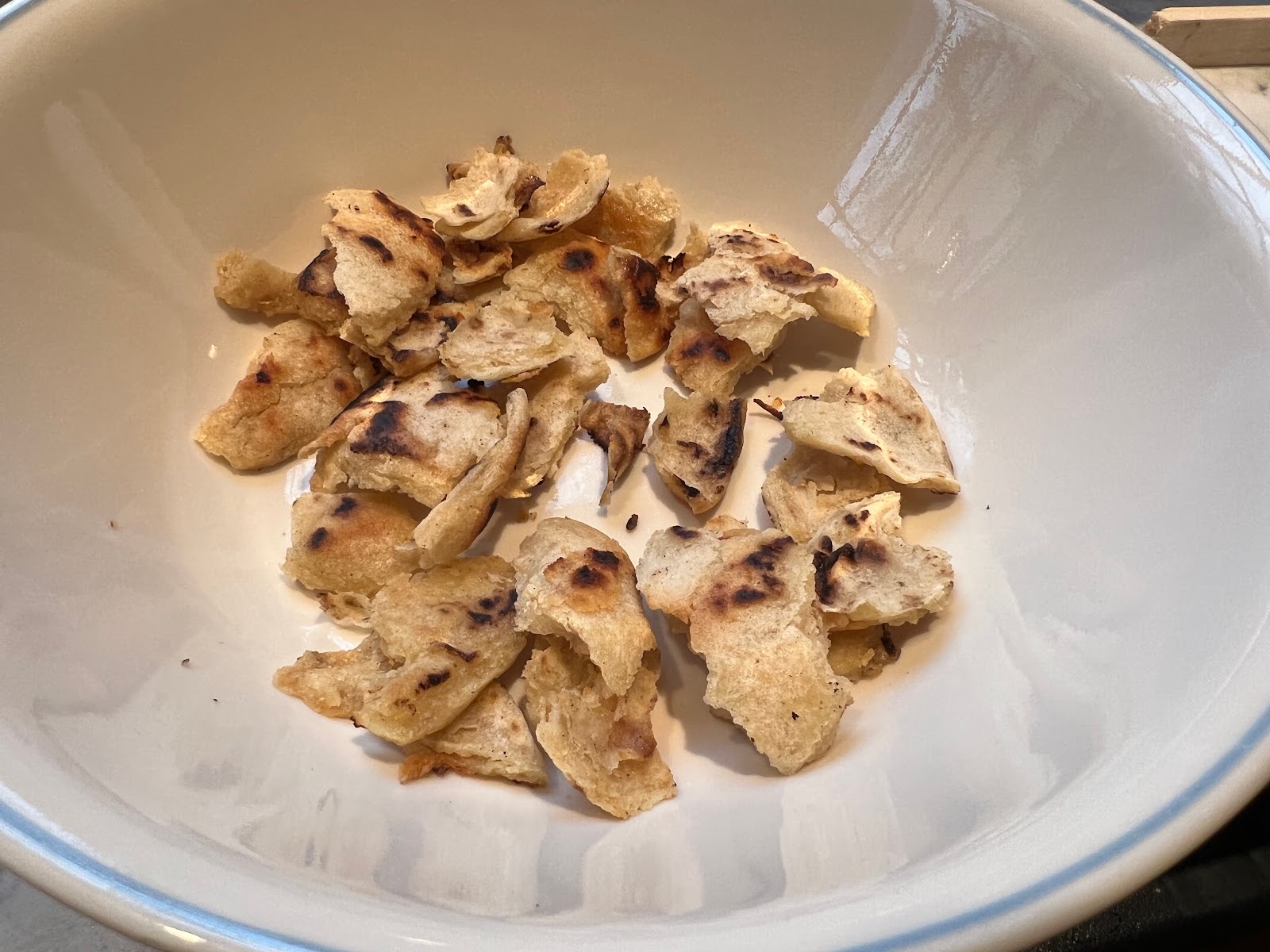
Perfecting and Applying Pan-Toasted Tortilla Shreds
One more thing! I finger-pulled shreds off a solid block of leftover wild boar, then added them to a warm lightly oil-coated fry pan, and pushed it down with a bacon press (https://www.amazon.com/gp/product/B077PJDPP3). I wanted some caramelization/crunch on the meat without drying it out (boar dries easily), hence the low temp and the press.

You need to visualize the particulars of how you want the result to be, then craftily plot your way there, always opting for the laziest, most cheating route.


Day Three: Hashy Collapse

My previous two hashes were about simple moves executed with great consideration, as I worked to use up the dwindling block of desiccating braised wild boar in my fridge.

Today, I hadn't had a bite until 4 PM, so I was famished. Lacking discipline to make any effort, this was slipshod hash. Still pretty good (an 8 out of 10 on my surprisingly non-ditzy system for rating foods, i.e. "elicits vocal expression of pleasure").

Roast potatoes are all gone and I didn't have the patience to boil rice. I had two handfuls of unsauced supermarket gnocchi in the fridge, so I boiled them up with some frozen mixed vegetables. Meanwhile tossed onions in a frying pan, like yesterday, but sloppily-cut and paying less attention to timing and temperature. I hand-pulled strands of wild boar meat again, but less thoughtfully. Trusting instinct, I used a bit more of the leftover Brazilian beans, counting on them to add some of the subtle flavor I wasn't conjuring with the other ingredients.

I weighed down the sizzling meat mixture again with my cast iron bacon press, dumped gnocchi and vegs into serving bowl, added the meat/onion, stirred, and devoured in about twelve seconds flat.

Wednesday, April 27, 2022

LEFFtover Latest

Fridge LEFFtover contents:
2 thick Guatemalan tortillas
1 roast chicken thigh
1/2 cup Dominican pinto beans
TJ's Moroccan harissa
What do you make?

Note: yeah, that's a drizzle of olive oil beneath the harissa smear

Thursday, January 6, 2022

LEFFtovers: Perfecting and Applying Pan-Toasted Tortilla Shreds

A trio of recent LEFFtover treatments, all building on the same tortilla move:

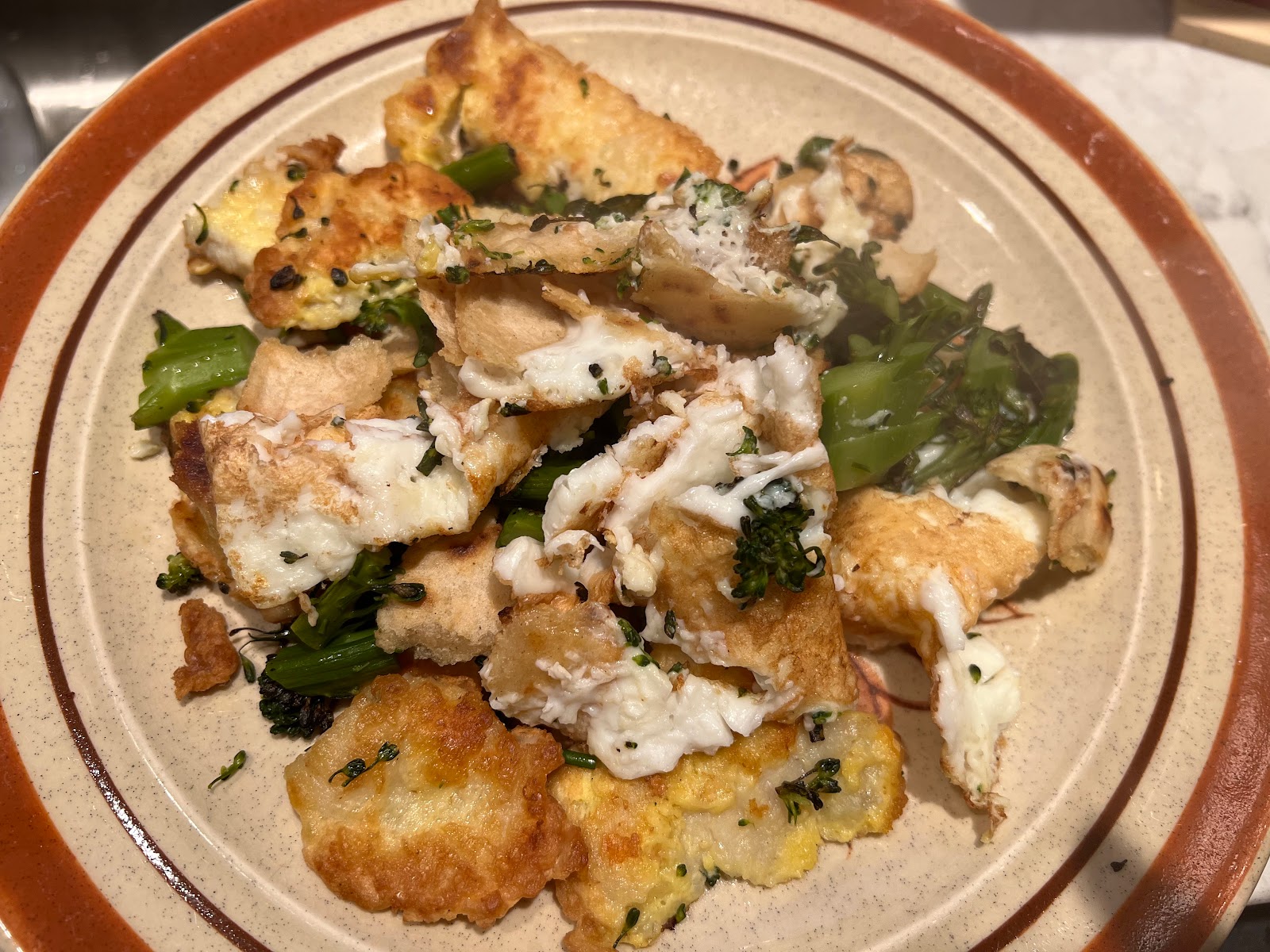
Chunky Central American-Korean Breakfast Hash
  • Egg white omelet.
  • Pan-toasted torn shreds of thick leftover Guatemalan tortillas.
  • Morsels of leftover Korean whitefish pancake.
  • Leftover broccolini.
I should have started by pan-toasting black mustard seeds, South Indian style. My bad.


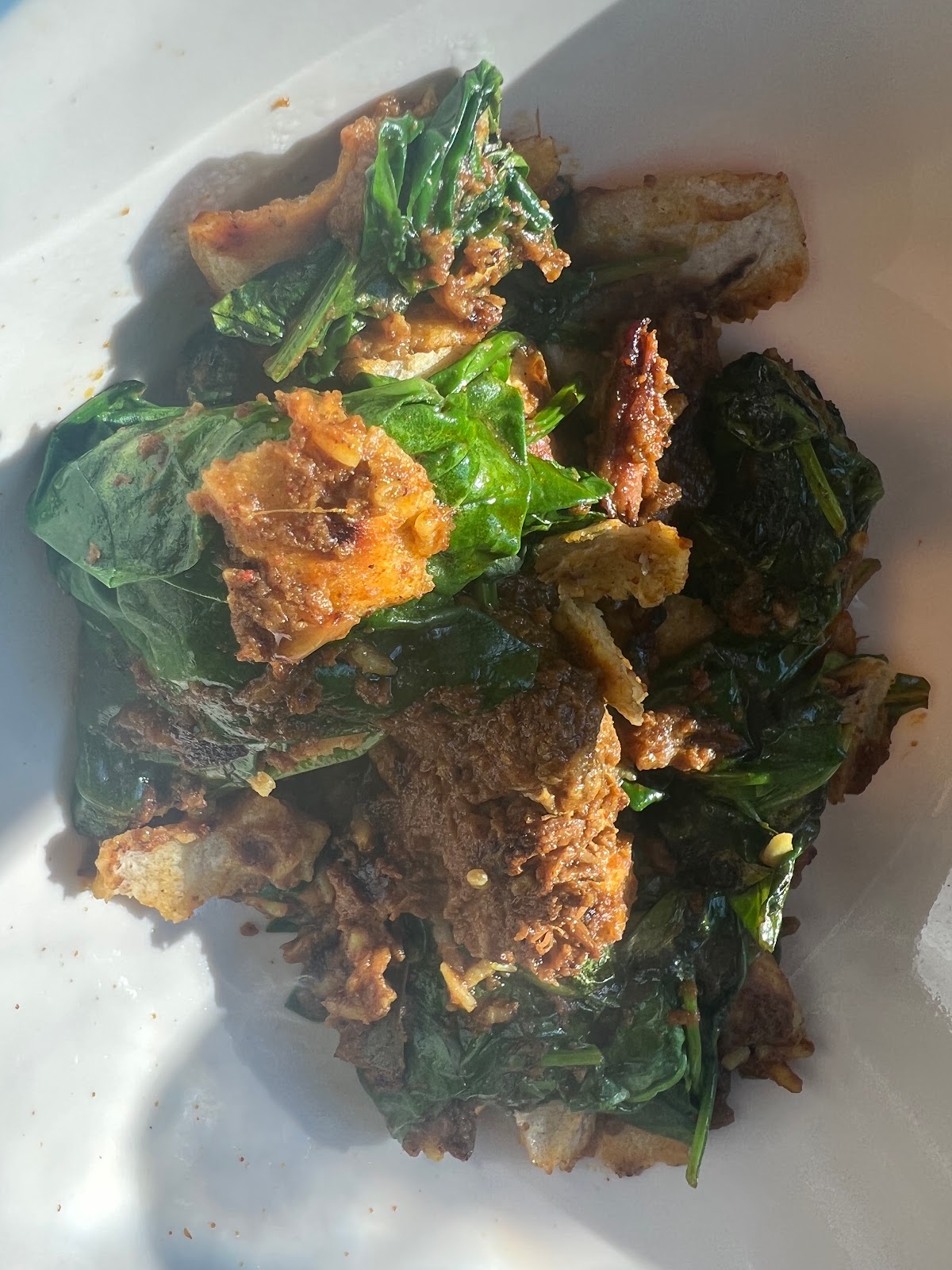
LEFFtover Goat Curry
  • Leftover Goat Curry
  • Leftover tortillas, torn and pan toasted
  • Baby spinach

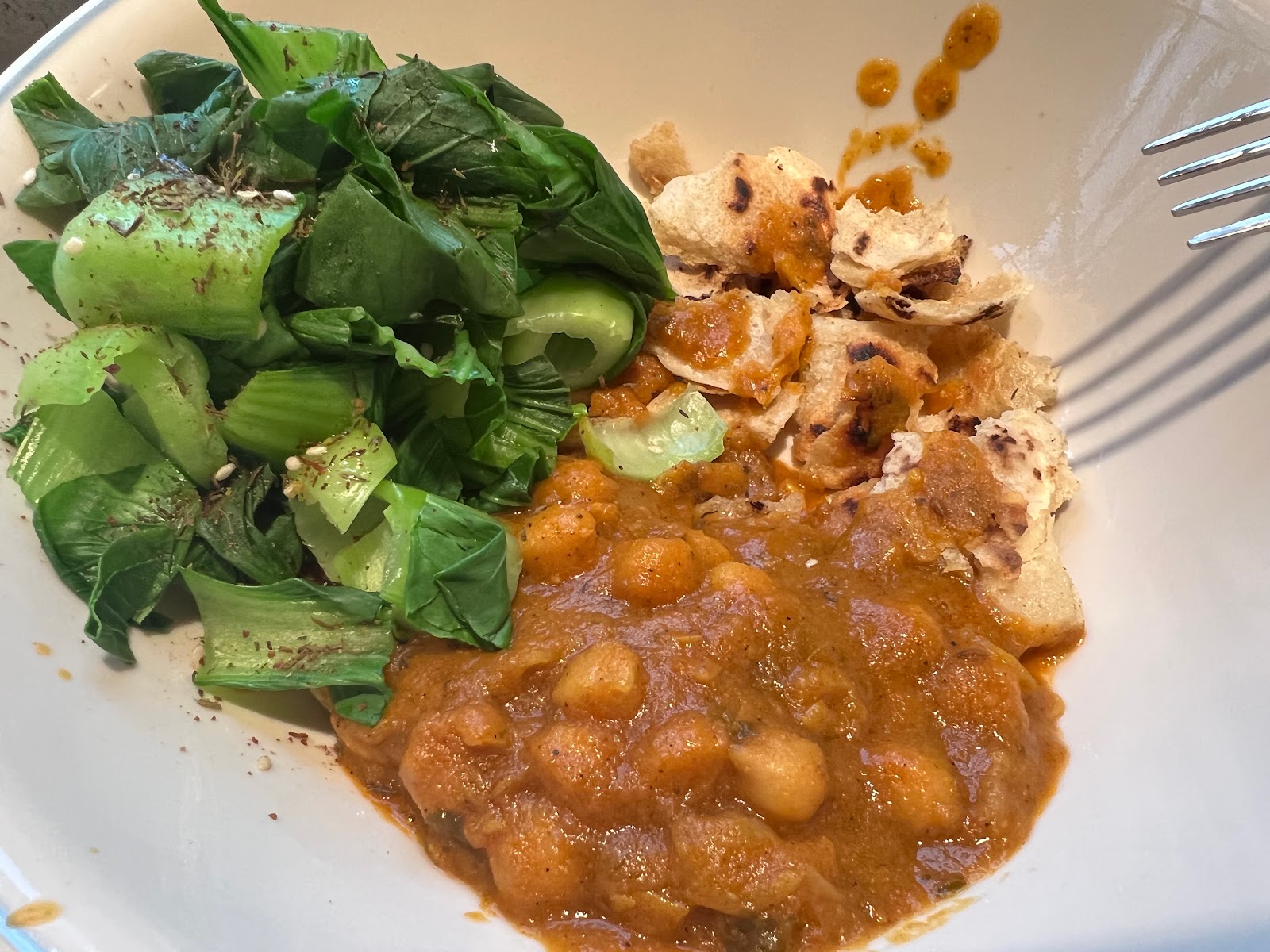
Punjabi Chole with Guatemalan Makki di Roti*
  • Leftover Punjabi stewed chickpeas
  • Leftover tortillas, torn and pan toasted
  • Coarsely-chopped baby bok choy drizzled with olive oil and zataar
* In case you missed the droll witticism, Punjabis actually make corn bread (makki di roti, most often served with sarson da saag, or soupy greens).


Making Of


Several things coming together here:

1. Frying is the dirty route to crunchiness
I thought I liked fried foods, but I mostly just like crunch. Some may get off on the overpowering oil flavor and heaviness of frying (and while I'll acknowledge that elite soul food chefs wield copious lard for results lighter than light itself, good luck finding cooking like that). I've always considered the oiliness to be something to tolerate if you want crunch. Which is insane, health-wise.

I perennially have loads of leftover thick Guatemalan tortillas in my fridge, because Guatemalans descended a few years ago and are everywhere and I love them. But their tortillas are so thick (ala Mexican gorditas) that I just can't finish a pile of them....along with the humungous mound of rice accompanying everything. Guatemela's just not super keto.

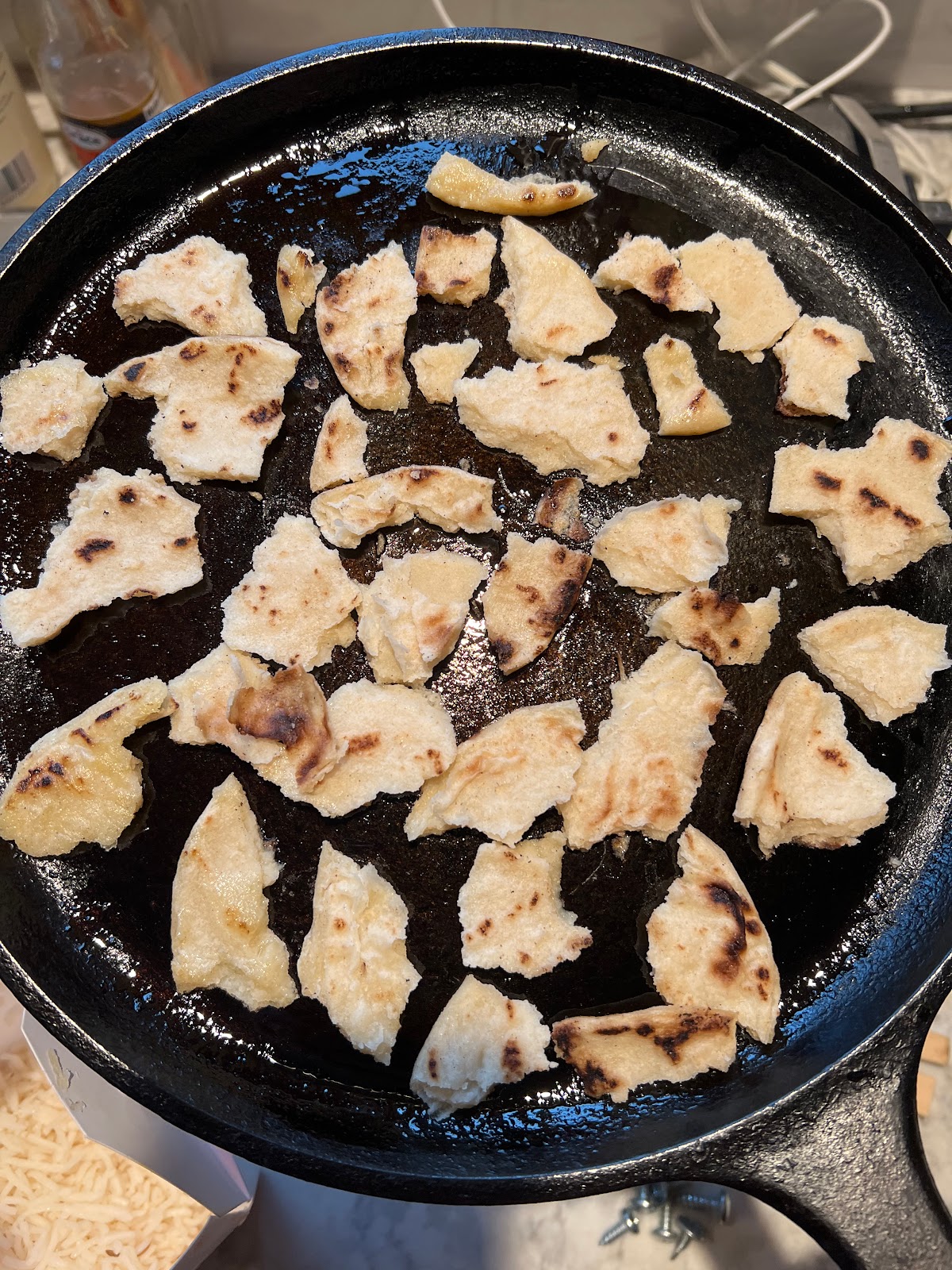
So in pursuit of giving them crunchy highlights, I've been working on alternative crunch production (ACP), finally settling on this formula: low heat, very lightly oiled cast iron (i.e. quick rub with an oily paper towel), and plenty of patience and care and timing. To create fast easy crunch, chuck your food into a vat of hot oil. But if you want nuance (bit of chew 'neath the crunch) and a >6 decade lifespan, you need to work harder.

2. My Carb Problem
Between the aforementioned Guatemalans and the Indians and the Dominicans and the East Asians, I ingest rice like a rural Chinese serf from a Pearl Buck novel. And most rice contains arsenic, which is cumulative in your system. So I'm trying to diversify carbs.

My go-to standby would be bread, but since I'm already way into panini, I don't have open bread slots. And potatoes take time to cook. So corny Guatemalan rounds seem more and more attractive. But I don't crave spongey, stale, leftover tortillas. I want something more appealing. Something a bit crunchy. But without the frying. So, yeah. This is where I'm headed with that.

3. Stew + Rice = Nice...but Tedious
I'm getting righteously tired of stewy stuff on rice. If I had more time to make mashed potatoes, I'd head straight there. But this is faster and lazier. I do need to buy some kasha, now that winter's here. And, of course, there's always pasta, but I can't imagine kasha or rigatoni would serve toothsomely in these contexts. So viva Guatemala! 

4. Fatah and Fatah
The "Yemen" section of my smart phone app, "Eat Everywhere" ("Your personal eating assistant in any restaurant at home or abroad") describes their much beloved Fatah:
Yemenis go crazy for both bread and butter, and fatah is the ultimate expression of both together. It's easy to remember the name - the more you eat it, the fatah you'll get. These buttery, bready croutons are moistened with broth and cooked with meat or vegetables until totally soggy. Really, it's a way of reusing stale bread (Yemenis go through a ton of the stuff).
Fatah is cousins with the better-known (hereabouts) Lebanese fattoush, which I've been told predate French salad croutons by like sixteen thousand years. So this toasting-torn-leftover-bread trick is done all over the Middle East, and northern South Asia. Also: Mexico. While this may not be precisely the move a Mexican grandma would make (i.e. chilaquiles), abuelita would surely nod her head approvingly.

Sunday, June 6, 2021

LEFFTOVERS: Korean Ecuadoran Salvadoran Breakfast Sampler

Nothing particularly creative here, but the combo was interesting. All were patiently heated in a very lightly oiled nonstick skillet (I did the omelet in a second pass).

Let's spin the clock:

12:00: Leftover riguas, which are the nth Salvadoran iteration of corn, with a modest vein of beany mash. This item is surprisingly widely available - in any supermarket with a decent Latino/Hispanic (here's the diff) refrigerated section for, say, cheeses and such. It's pretty commercial-tasting, but makes a fun variety carb to add to a leftover meal and break up monotony.

2:00: Leftover kimbap from the wonderful Doorebak (aka "Hi, Cook Catering") in the Closter cluster. I was always taught that when kimbap (vaguely sushi-looking rolls, can be stuffed with anything but raw fish, which would make it actual sushi) loses its of blush of freshness, you pan sautee it.

6:00: Egg white omelet with leftover broccolini (I do not eat protein-less meals, and you shouldn't, either).

9:00: The Ecuadoran ají (hot sauce) that shows up in my cooking or on my plate more often than not.

11:00: Korean jun ("pancakes"), again from Doorebak (aka "Hi, Cook Catering"), made with, as close as I was able to determine, penguin meat (see previous link).

Tuesday, May 25, 2021

LEFFtovers: Pork Chop Curry Penne


This consists of:

A leftover pork chop (sliced)

A leftover serving of spicy Indian vegetable curry

Some really good penne.


Before cooking, as I went about my day, I backburnered a process of visualization, envisioning not how I, as a cook, would approach it, but how I, as an eater, wanted it to come off. I never push with the cooking, I always pull from the eating. The best route, I've found, is to reverse engineer a clearly envisioned result. Work it out carefully in your imagination, like a puzzle, then execute.

The pork chunks, being leftover, were bound to be slightly dry. So I didn't want to "feature" them. They had to be buried in sauce. But I didn't want to give them the "meatball" treatment. I wanted the pork flavor to remain pure, and not be lost in the curry. I even wanted the caramelization from the rewarming to come through.

So I didn't rewarm the pork chunks in the curry, nor did I add curry over the reheated pork to heat in the same pan. I braised the pork chunks by themselves, removed them from the pan, then heated the curry, finally stirring it together with the pasta at the very end. Leftover flaws in the pork wouldnt be obvious, but it wouldn't be stewed, either. You knew you were eating pork chops, but they didn't particularly stick out.

Do I sound obsessive? Well, that's what it takes to produce quality. You have to care to a degree that would be off-putting if people knew.

Friday, April 30, 2021

LEFFtovers: Sushi & Waffles

Yesterday’s sushi, pan-fried, with waffles.

Tuesday, April 20, 2021

LEFFtovers: Oniony Ravioli

Fridge contents

6 Trader Joe's Beef Bolognese Ravioli
Half an onion
Straggly few fancy salad greens
Ecuadorian hot sauce
"What's with all the Ecuadorian hot sauce?" you might understandably wonder. There's an Ecuadoran rotissierie joint near me I hit once per week, and always ask for extra sauce. So there are always some small containers in my fridge. Ecuadoran hot sauce is creamy, like Peruvian ají, but more vegetal. It combines well, and I'm always looking for excuses to use it up.
I wanted to do this but had no tomatos.

So I roughly chopped the onion, and sautéd with lots of black pepper. Near the end, I added the greens atop, letting them wilt. Meanwhile I briefly re-boiled the ravioli to reheat them, drained the pot, splashed the hot sauce in the pot, then added the ravioli/onion/greens, stirring violently for a few seconds.

Sunday, April 11, 2021

LEFFtovers: Breakfast Hash

Please please touch to expand.

I sautéed onions, then added cut-up chunks of leftover gyro meat and cut-up French fry chunks, and served over an egg white omelet.

Small touches count (understatement of the century):
  • I did not salt the onions because the gyro is salty. And I under-salted the egg.
  • Those tomatoes were small, so I could have served them whole. But when I envisioned myself eating them, I realized I'd be happier if they were quartered. Cooks can go very far by pampering their predilections.
  • I had a vision in my head of really crunchy/chewy gyro meat, almost like Issan jerky. I also wanted to fully crisp up those fat steak fries, which were mushy from overnighting in the fridge. So I timed it appropriately (the more I make everything like toast - i.e. subjected to micro-concern via vast attentive patience - the more delicious my food turns out).

Friday, April 9, 2021

LEFFtovers: Scallop Thing

Particularly intricate LEFFtover treatment.


Raw materials in fridge:

Less than a full serving of Guatemalan take-out seafood soup
Small amount of leftover soba noodles
Small amount of basmati rice
Sautéed asparagus
Tiny takeout container of Ecuadoran hot sauce
Four raw scallops

Heat seafood soup. When bubbling, stir in soba noodles AND rice. Kill heat.

Sautee scallops with garlic in olive oil, cook 2-3 mins per side.

Upon flipping scallops, add asparagus to pan to reheat. Quarter the scallops after cooking.

Add noodle/rice mixture to a bowl. Top with asparagus. Top with scallops. Top with garlic. Dab each scallop segment with hot sauce. Walla.

Monday, March 15, 2021

The Life Cycle of Moroccan Lefftovers

I've had more experience with leftovers than you have. The only other statement I can make confidently about me and you is that I've eaten in more restaurants than you have. And the two are not unrelated.

When I was working as a food writer, my fridge was always full of greasy little bags. I was the "Mikey" of the food writing world - the guy they gave impossible, crushing, stupid assignments to. Newsday had me survey restaurants under the 7 train in Queens, and create an overview of all the best Puerto Rican restaurants in NYC. Time Out NY had me track down the best examples in the five boroughs of two dozen cuisines. My first book attempted to find 150 splendid "virgin" restaurants no one had previously written about (I cheated and threw in a few evergreens where conventional wisdom needed adjustment).

When you're fact checking 150 restaurants - or raking through the boroughs for Puerto Rican food - you're not eating every bite. Usually it's a single bite or two, and you bring home the rest. Circumstances forced me to became an accomplished and creative leftover reheater long before I learned to cook. In fact, my cooking could be viewed as an extension of my reheating.

The following shows the life cycle of a few copious foods I had in my fridge for a week. File it under Lefftovers.


Those are two containers of stewed vegetables on the left, three containers of mesmerizingly fluffy and massaged couscous on the right, and a potently concentrated container of short ribs in gravy.
Just for kicks, a kitchen background tour:
  • 1: Big version of my bagel plates
  • 2: Flour for a cracker-making project
  • 3: Semolina (for cracker-making project)
  • 4: Podiatric metatarsal pads
  • 5: Tomatoes "on the vine"
  • 6: Domaine Désiré Petit - Arbois-Pupillin
  • 7: Trader Joe's white grits.
  • 8: Dried flowers to give the place a perky touch
  • 9: Magic mushroom folk sculpture from a hilltop village in Oaxaca
  • 10: Rubbing alcohol
  • 11: Trader Joe's Chili Onion Crunch (my brain's on a permanent loop of believing I've run out. This is like my 73rd jar).
  • 12: Newsylum "Counting the Days" IPA, from historic Newtown CT by John Watson, the former homebrewer I wrote about here (search the page for "beer")
  • 13: Evil Twin "Harlan's Even More Jesus" beer
  • 14: Evil Twin "Even More Jesus" beer
  • 15: Black Diamond Cider "Porter's Pommeau"
  • 16: Trader Joe's "Taste of Vermont" maple syrup assortment
  • 17: Dried fenugreek for cracker-making project
  • 18: Zozirushi "fuzzy logic" rice cooker (has more computer power than Apollo 11. Me and Bob(TM) at one point considered using it to serve Chowhound. Currently inoperable, I'm stumped as to how to proceed).
  • 19: The Tailor of Panama by John le Carré
  • 20: Autographed copy of "Sizzle and Drizzle" by Nancy Birtwhistle
  • 21: Instant Pot. Bought five years ago, never used.
  • 22: Mortar and pestle
  • 23: Rolling pin for the cracker-making project
  • 24: Sample bottles of bourbon from a tasting 6 years ago.
  • 25: Maggi Seasoning ("improves the taste"). Note that this has been moved off my kitchen table since March, 2019.
  • 26: Big bag of spices from Penzey's for the cracker-making project
  • 27: Kayanoya Original Dashi Stock Powder
  • 28: Harry & David Pepper/Onion Relish
  • 29: Harry & David Contry Cranberry Relish
  • 30: Quite possibly the last surviving box of original-recipe Cope's Dried Sweet Corn on the planet
  • 31: Empty bottle of Chimay Anniversary Ale
  • 32: Maker's Mark (no, I'm NOT an alcoholic. Alcoholics don't have this stuff lying around. They drink it all up.)
  • 33: Vast pile of Chinese pu-erh tea
  • 34: Lots of cereal boxes, because I'm a grown-up and can have as much cereal as I want
Here it is in its full plated succulence:

There is a story about how I came to possess this blessed Moroccan wonderment. But I will not share that story today.

So here's the bite-for-bite:


Day two was a clone of Day one. Meat was finished.

Day three, I still had a little couscous and a bunch of vegetables. I broiled some salmon and topped the bowl with chunks of it. One of my nutrition axioms is that there must always be protein:

Day four, I realized I'd fail to properly dredge the vegetable containers, so heavier chunks were disproportionally left over. I served them over soba noodles:

...and topped it with leftover broiled salmon reheated with some onions I sautéd, and sprinkled with chili flakes:

Day five, breakfast. All I had was a precious small container of meat gravy (not vegetable broth). I heated it in a pan with leftover soba noodles, murasaka sweet potato, and chopped pea shoots, then served over an egg white omelet jazzed up with Trader Joe's Italian soffritto seasoning:


Thanks to the legendary Phil Simpson of PMS Graphics for assistance with the kitchen tour.

Thursday, February 25, 2021

LEFFtovers: Pork Rib Hash


The key to hash is counterintuitive: don't futz much with the components. You'd imagine lots of chopping, scraping, combining, tossing, and flipping. But that just results in a granular mash, not a hash. For hash, do very little. In fact, touch it as little as you can. Also: always work from leftovers. This is meta-cooking, not cooking.

Here's what I did:

Roughly chop onion, drop in olive oil/salt/pepper and leave it alone until brown on bottom.

Once brown, flip and lightly mix in leftover latino deli pork rib meat that's been roughly torn off the bone with fingers (hands beat knives for hash). Reduce heat to low medium. Some rice and a couple of black beans were clinging to the ribs, and were happily thrown in.

Remove skins from leftover baked small Murasaki sweet potatoes (from Trader Joe's), smash flat with a palm in a plate, then transfer with spatula to smother onion/rib mixture.

I know it sounds really layery (and looks like that at first), but have faith.

Cook for a couple minutes, then flip 1/4 of the pan at a time, mostly to keep the bottom stuff from burning. As you do so, ingredients will unavoidably combine.

Once flipped, cook another minute or two (cusp burning is not only ok but optimal), transfer to plate (more unavoidable combining), simply piling it on. Don't get arty. Trust the process.

Serve with hot sauce alongside or squirted atop.

Note: no stirring happened at all. Just one flip of onions and one flip of all ingredients and that's it. So how did it hash up? If it seems like magic, just consider what would have happened if you were trying NOT TO.

Yup! Hash!

Another note: maybe 1 TBS oil, period. The meat's greasy enough. Sure, if I added a half stick of butter it'd have had that cheap straight-to-the-amygdala brain zonk quality (the gourmand's roofie), but I don't pull cheap tricks, I work for my deliciousness. Plus I try to eat healthy at home.

Room for improvement: in close-up photo, you can see that the meat hasn't browned into frizzy crunch. My timing still needs work. Maybe I should have added meat when I first started the onions (or even earlier, cooked low and slow for a while on dry nonstick). And maybe roughed up the meat a bit more with my fingers. More fat would get me there more easily, but, like I said, I work for my deliciousness.

Tuesday, December 15, 2020

LEFFtovers: The Murky Distinction between OCD and Giving a Crap


Egg white omelet with sliced grape tomatoes. Sautéed baby asparagus. Reheated garlic knot.

This was one of the easiest "9"s (re: my surprisingly non-ditzy system for rating foods from one to ten) ever evoked. And, as any chef will tell you, it's devilishly hard to deliver impressive results with unadorned simple fixings (much less LEFFtovers).

Let's focus on the reheating of that garlic knot.

We use awfully sappy language to account for the conjuring of quality. With food, the cliché is to say it's "cooked with love", evoking Valentine cards and wooly sweater cat lady hugs. Let's expunge the corny language and examine how I crushed the garlic knot reheat.

I thought about how I'd go about this, off and on, all morning. Finally, I had a clear picture in my head. And once a clear picture has appeared - which means all obstructions have been worked out - there's an insatiable drive to proceed. So I strode into my kitchen with the studly brio of a pole vaulter stepping up to the medalist's podium.

Here was the plan. I'd pop it in a toaster oven, with a square of foil perched precariously atop to protect it from burning, but leaving the sides fully exposed so they'd heat thoroughly. I also needed the heat to dry it out after 24 hours spent sliming in its oily juices in the fridge. The moment the knot looked non-slimy (and not a moment later, because it would need more oven time and I didn't want it to dry out; I needed to preserve the chewy/fluffy/crusty), I'd snatch away the foil, turn down the heat a bit, and watch like a hawk for the moment when the knot browned into exactly the Object of My Deepest Desires (the harnessing of minute care with visceral desire stokes deep creative powers). As with my bagel toasting manifesto, I'd watch like a scientist observes a crucial experiment. Mere seconds matter.

I'd prioritized my two main concerns: heat and moisture, and in a very particular manner. Cooking teachers don't frame it this way, but I bear in mind that I'm always working on a continuum, rather than toward some finish line. The garlic knot shouldn't be cold, nor nuclear hot. I didn't want it slimy, but I didn't want to dry it out.

Cooking is a matter of midpoints, not endpoints. There's no endpoint in cooking, only a "click" of the camera - i.e. plating/serving at a certain point in an unending procession of possibilities. It's like writing - one could keep editing forever, but the supposed final version is just the capture of a certain arbitrary moment. "Process", not "arrival points". Always!

If you're absorbed in nano-moments, you can choose between billions of them, each conveying a different slant of deliciousness. There is vanishingly scant middle ground between under and over, or between slimy and dry, but if you're slicing finely enough (i.e. paying extremely close attention), you have myriad choices in choosing a particular slice to capture. The choosing is an exercise of playful caprice amid deadly seriousness - an amalgamation few people can manage, which explains why food (even from highly-trained chefs) is so seldom delicious.

I've just devoted 500 words to reheating a garlic knot...after spending my entire morning thinking through the process. To most people, this would seem stark raving bonkers. I could, however, justify it by calling it an expression of love. Hey, that garlic knot was for my beloved. Nothing's too good for my darling Linda. Or Vanessa. Or whomever. Swap in a random name, and you're good to go. Suddenly, the caring seems more beautiful than bonkers. Love justifies the caring.

At least it did until a generation ago. Yesterday's "love" is today's "OCD", and I'm not being cute; it's true. "OCD" is now applied, willy-nilly, to any instance of deep caring. Einstein working on Relativity? Beethoven composing in a diaper? Ugh. OCD, man. Take a chill pill. Find yourself some life/work balance.

OCD is a mental health problem where care is lavished where it doesn't matter. Cooking and other matters of actual utility and/or creativity do matter, always. "Obsessing" over your work - whether you're a choreographer, a barrista, or a mechanic - is what elevates us from livestock. It's sacred.

Martin Luther King skewed it as more of an ego appeal, but conveyed the basic gist:
“If a man is called to be a street sweeper, he should sweep streets even as a Michaelangelo painted, or Beethoven composed music or Shakespeare wrote poetry. He should sweep streets so well that all the hosts of heaven and earth will pause to say, 'Here lived a great street sweeper who did his job well.”
Obsessing over your stuff is a lesser mission. Obsessing over Linda or Vanessa used to be beautiful, though it lately seems "unbalanced". But obsessing about counting every single Toyota you ever pass makes you OCD. No bueno.

Lavishing your deepest attention on your garlic knot - or whatever else you're productively working on - is the opposite of OCD, which is the trivialization of one's limited time on Earth. It's true that a garlic knot - which pops in your mouth and is gone moments later - sits on the very brink of triviality. But the garlic knot in the photo, above, was as good as it looked. Two hours later, I'm still aglow. That's proof that it wasn't trivial; that it deserved my attention; that this was no kooky waste of Earth time, but more of a legit holy mission (even if it's not as "serious" seeming a pursuit as selling your car or endlessly mentally replaying the hurtful thing your old boss said).

People with OCD needn't change their drives; just channel those drives to something productive. As with depression, OCD's a dead end where, as perspective constricts and freezes, wheels spin impotently. A depressive spins creative wheels, over-building pointless internal towers of brooding discontent. An obsessive-compulsive spins activity wheels, pointlessly over-processing some constricted slice of the world.

Those who build useful towers or execute useful actions - who power their wheels with verve, transforming solid traction into bona fide landspeed - are using those faculties in their intended manner.


I'm describing, fwiw, karma yoga. Anyone great at anything - whether they realize it or not - is a karma yogi.

See also "Explaining Steve Jobs", "Unhinged" and "Cousin Libby's Yellow Rice".

Friday, July 31, 2020

Chicken Pasta With Angry Onions


Rotisserie chicken (hand-picked and chopped)
Roughly chopped onion
Sliced garlic
Parmesano
Trader Joe's gigli pasta
I added some leftover chopped broccolini after shooting the picture (a guy's got to nutrify)


This is more complicated than it seems.

My previously posted salmon pasta used very gently-cooked onions. In fact, I wrote a whole followup about the proper mindset for gently cooking onions.

This time, I flipped that (in case you haven't noticed, I'm a one-trick-pony. Flipping = reframing, and that's what I do. I've been flipping profitably ever since I stumbled upon the move in college while pondering the odd artifact - an iron - my mom had packed for me).

This time I cooked the onions harshly. I was a real bastard. Medium high heat, hardly any stirring, lots of sizzle. I let them brown nearly to burntness, and there was nothing gentle about it. I wanted them a little dry and a little crunchy and plenty sharp and angry.

The garlic, by contrast, was pampered low and slow, bringing out the sweetness. I used more grated parm than usual, figuring it would bridge the harsh onions to the mellow garlic. It worked.

I added the chopped chicken to the onion/garlic pan, raising heat and stirring madly for just long enough to warm it up. Then I stirred the mixture madly into the pasta along with parm and more olive oil (the latter injects a fresher flavor when it's added at the end, without heating much).

The result was just a bit dry (which is why the photo seems slightly flat). I'd forgotten to add pasta water for finishing sheen (and salt). The struggle continues.


Making of:

Monday, June 22, 2020

Salmon Pasta

I've made several dozen versions of this basic dish over the past few months. Cooking's all about iteration. Forget the recipe, forget technique, forget ingredient quality. Those vaunted X factors are dwarfed by the magical power of iteration; fine-tuning your moves (and, even more importantly, your micro-moves). The easy informality of it all, combined with absolutely full attention and deep caring, is the trick.

My guiding principle is to be as lazy as I can get away with. Not because I'm lazy, but because I want to focus, and if I'm navigating a fraught obstacle course where every single task is a demanding stressor, my attention gets diluted and I find myself acting more like a harried project manager than a deeply attentive artisan. I know where to invest my care. That's one thing the iterations show you (of course, you need to carefully analyze your results, or else the iterations won't improve on each other).

The caring part has to be way more extreme than you'd ever imagine. That's why you're lazy; to clear space for excessive caring. Not a cinematic display of furrowed brow where you tell yourself stories about your own diligence. Don't pose, but really do it. Lose yourself in it. Cook like you're saving a life.
See the religious tract I once posted about the devotional level necessary for producing a properly toasted and buttered bagel.
Ok, here goes.

Have some leftover salmon that was broiled first flesh side up and then skin side up until the skin nearly burnt. The skin won't remain crispy in the fridge, but you'll be rejuvenating it.

Heat water in a pot (use minimal water so it becomes starchy and thick and useful for adding later to make final results glisten).

Roughly chop a small onion and sauté in minimal oil. Cook it (seasoned with salt/pepper) about two notches cooler and twice as long as you ordinarily would. "Gentle" is your mantra. Stir infrequently (laziness!).

When you start the pasta, add thinly-sliced garlic to the onions (if the pan's actively sizzling, you'll brown or burn the garlic, so be sure the heat's tame before you add).

Roughly chop salmon and place atop the onion/garlic mixture. You don't want to use a ton of salmon. One full handful, roughly chopped, is sufficient per person. Don't do the ugly American move of deeming your protein the equivalent of a steak dinner. Be poor tonight.

Cut the salmon skin into small strips with paring knife, and add to sauté pan, keeping it separate from the other items.

Slice some tomatoes (I used Camparis) and place above the salmon which sits atop the onion/garlic. You don't want to cook the tomatoes to mushiness.

Drain pasta, saving water.

Hastily sauté a handful of spinach per serving in a little too much olive oil in the pasta pot (excess oil will help compose the sauce).

Critical checks before proceeding:
Salmon skin must be dry and crisp - almost starting to curl up.
Onions and garlic must be soft and golden.
Tomatoes must be relaxed but not gooey.
Spinach must be limp but still deeply green.

Remove salmon skin from pan, and keep handy on a plate.

Mix salmon, onions, and garlic.

The following should take about 30 seconds:

Add cooked pasta to pot with spinach, hoist the pot with one hand and stir aggressively and disrespectfully with the other hand, using a wooden or bamboo spoon or spatula.

Add a dab of cooking water.

Add salmon/onions/garlic/tomato (don't stop stirring!).

Add a dab of cooking water.

Stir in some seasoning (I used leftover Ecuadorian creamy hot sauce from a previous day's takeout, but sky's the limit: chili flakes, za'atar, any fresh herbs, etc.).

Add a dab of cooking water.

Add some grated Parmesan (not too much; this needs to be subliminal; cheese is great with salmon, but you don't want to flaunt the broken taboo).

Keep stirring violently until it looks like something you'd be eager to eat.

Transfer to plate.
If you're using lengthy pasta (linguini, spaghetti, etc), use tongs and give the mound a twist as you plate it. Carefully study 2'29" in this classic short video for spaghetti limone, where Frank Prisinzano makes that move look way too easy.
Arrange salmon skin atop.

Walla.


Read this followup posting more closely explaining about the onions.

Friday, May 29, 2020

Unnameable Breakfast

I don't even know what to call this. It's a breakfast bowl that built itself via unconscious direction.

I entered my kitchen.

I poured some yogurt into a bowl.

I added blueberries and banana slices.

I plopped in a couple tablespoons of chunky/crunchy raw almond butter.

I stirred lightly - to swirl, not mix.

I toasted, intentionally nearly burnt, some leftover fluffy whole wheat pita, ripped it into tatters, and threw them on top.

Good.

Blog Archive