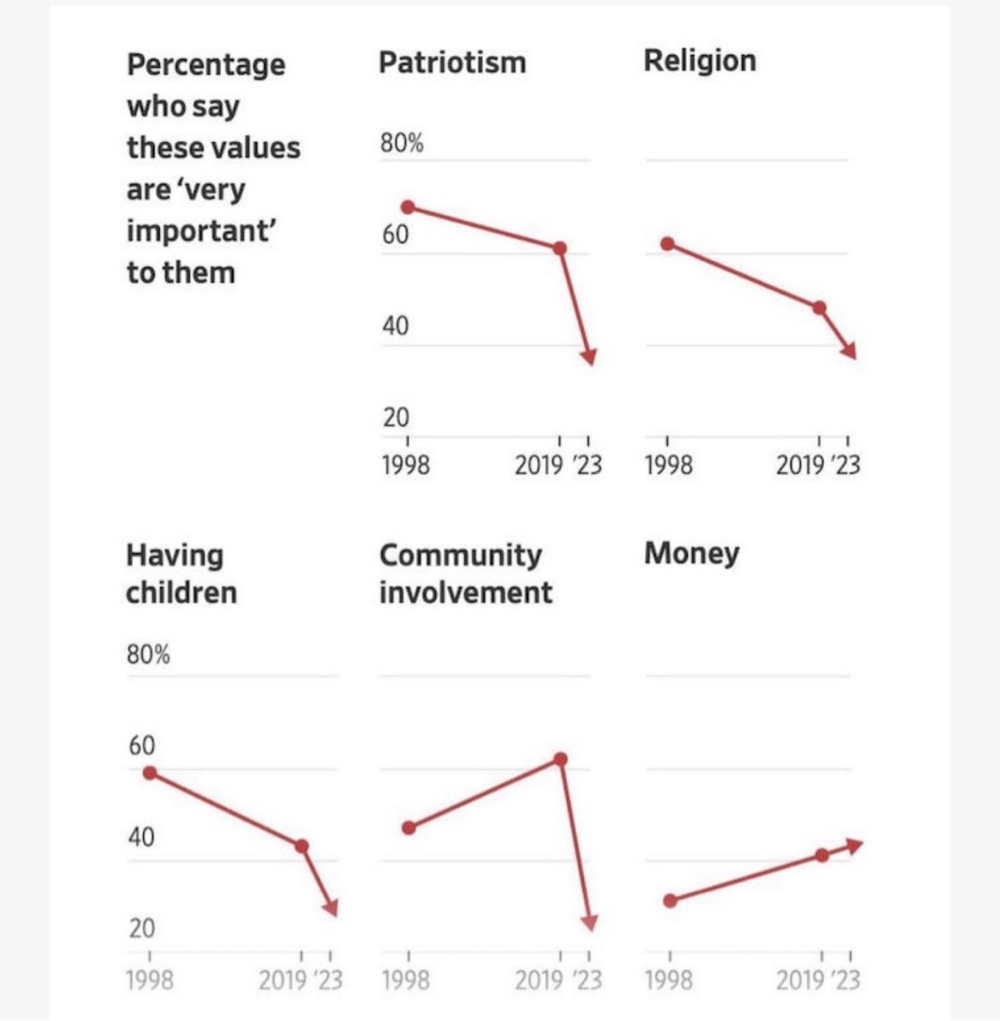
From Wall Street Journal:
Showing posts with label post-covid narcissism. Show all posts
Thursday, January 1, 2026
Post-Covid Narcissism
The data is beginnning to support my observation (see all postings tagged "Post-Covid Narcissism" in reverse chronological order) of a profound and enduring increase in narcissism since quarantine.
From Wall Street Journal:
Tuesday, December 30, 2025
Reciprocity
Way back in 1992, I hooked up saxophonist Ralph Lalama for a week long gig in Spain, where we both performed at the Seville Expo with a Catalan big band. We got along well, and a couple of weeks after we returned to New York, I bumped into him at a jam session he was running in the East Village. "Hey, Ralph!" I chirped. He glanced at me cooly, nodding imperceptibly before turning away.
One of Ralph's buddies explained things to me. "Ralph, you see, fancies himself an elder statesman in the jazz scene, so he figures that who he greets and how he greets them confers a certain anointment and validation. He wasn't sure you'd earned a full level of public respect from him."
"But," I replied, "I wasn't looking to be anointed. I was just saying hi." Ralph's friend shrugged helplessly. This is how it parses to Ralph. It had nothing to do with what I was looking for. I was hardly in this movie. This is the Ralph movie.
A week later, I bumped into Ralph in a Chinese restaurant. "Hey, Jim!" he chirped. I glanced at him cooly, nodding imperceptibly before turning away. I didn't run into him again for thirty years, whereupon he was still furious about the slight. He wouldn't look at me or talk to me, the ogre who'd dissed him. I never expected him to make the connection of his behavior in his sphere of influence to my behavior in mine, but I certainly never expected any of this to rock his world.
After a long period of unilateralism, I've started leaning into this behavior. I remain non-reactive, and always try to help where I can. I don't act spitefully or hold vendettas, and don't sneer or raise my voice. But I’ve begun to follow the playbook I'm handed. As with Ralph, I mirror. Not with venom or malice. Certainly no extra "oomph" to prove the point. I let people set the rules of engagement, and I amiably follow along. I reciprocate.
Since COVID quarantine, people feel less obligated to reply to one other. They don't answer messages if they're busy, or distracted, or didn't fully understand or approve of what was said. They'll let it go if they don't detect an immediate deliverable. And sometimes they don't reply just because.
I was eager to try this out for myself. It seemed like it might be liberating! So I did an experiment with a couple of longtime friends who'd grown less and less engaging, and declined to reply to each of them just once.
I never heard from either of them ever again.
I stoically followed the Golden Rule for my long unilateral period. But I eventually realized that it doesn't work if there's only one person doing it. As I wrote in The “Golden Rule” is Loftily Unattainable (I'd suggest reading the whole thing; it's short):
When the Bible suggested doing to others as you would have them do to you, it turns out this wasn't a helpful reminder. I always figured it was like "Sit up straight" or "Eat more vegetables"—a sappy homily people sometimes need reinforced, despite its blatant obviousness.
No. I see now that it was flabbergasting existential judo—a Copernican flip of perspective. And it was received as a lofty principle which, like other forms of godliness, could only be aspired to, and never put into actual practice.
Labels:
anecdote,
human behavior,
music,
post-covid narcissism
Sunday, November 23, 2025
Generational Healing
History is crammed full of societies suffering traumas and swiftly healing. They're back on their feet in no time, seen through a long lens.
I've written extensively about the psychological ravages of Covid quarantine. For example:
It's not healing, either. A generation has been spoiled. And their children, raised by a spoiled generation, will be spoiled as well. And their children will be somewhat spoiled, third-hand. But, of course, in a few generations, we'll have more or less repaired. Toxic ripples will remain, but much of humanity's spice comes from residual rippling, for better and for worse.
So this generational span will seem, to posterity, like nothing at all. We were back on our feet in no time!
I used to be appalled by reforestation practices. Driving past large stands of trees planted stupidly in grids, I'd complain that these were no forests. They were more akin to farms.
It took me a long time to realize that the second generation of trees would seem more natural. And from the third on, it would be nothing but forest, through and through.
I've written extensively about the psychological ravages of Covid quarantine. For example:
If someone is explaining astronomy to you and gets stuck remembering a term, and you fill in “gravitational lensing”, there is 0% probability they will stop their spiel, look freshly at you, and declare “Oh! You know astronomy!”These lingering quarantine effects are seldom noticed because they involve a ratcheting up of narcissism, and it's difficult for narcissists to distinguish gradations of narcissism (they'd need to pay empathic attention to other people's internal life—the very thing they have trouble with).
Pre-Covid, it was more like 60%.
They will continue their explanation - their performance - without hesitation. You have nothing to do with it. It’s like you’re not even there.
It's not healing, either. A generation has been spoiled. And their children, raised by a spoiled generation, will be spoiled as well. And their children will be somewhat spoiled, third-hand. But, of course, in a few generations, we'll have more or less repaired. Toxic ripples will remain, but much of humanity's spice comes from residual rippling, for better and for worse.
So this generational span will seem, to posterity, like nothing at all. We were back on our feet in no time!
I used to be appalled by reforestation practices. Driving past large stands of trees planted stupidly in grids, I'd complain that these were no forests. They were more akin to farms.
It took me a long time to realize that the second generation of trees would seem more natural. And from the third on, it would be nothing but forest, through and through.
Tuesday, November 4, 2025
Noticing
A friend speaks nine languages with great ease and perfect accent. It comes easily to him, and he has also played very fluent jazz trumpet since he was a teenager, though he's from a place with little tradition of it. That, too, is a learned language.
His explanation is that he's a genius. But I see the actuality of it: he has a gift for imitation, allowing him to effortlessly sound Italian or Brazilian or French, and the same gift helps him ape the sound of a jazz trumpet player. He doesn't have anything interesting to say in those languages—or on his horn. But he seamlessly recreates the superficial sound. A neat trick!
I explained this to an acquaintance, who asked a perfectly reasonable question: "How do you know all this?" Had I read a lot of psychology books? Had I extensively "examined" this guy? Did I have a shred of factual evidence for my assessment? He wasn't quite accusing me of glib bullshitting, but he certainly wasn't taking my explanation at face value. He knew the guy, too, and he hadn't reached these conclusions.
My first impulse was to doubt myself. But I do feel certain about this, and at age 62 I have a great many data points from times where I turned out to have been provably right. This has raised my confidence, though confidence was a very long time coming. When younger, *I* was the guy asking *myself* "But how did you know this?"
I'm loathe to call it "intuition", because it's a much more educated assessment. But, no, I'm not a shrink, and I did not put him through a battery of personality tests and cranial MRIs. So how do I account for it?
I actually pay attention to things outside my own head.
People think they already do this, but watching strangers walking around, it's obvious that they're completely zonked out, enslaved to their internal monologues. "Be here now" is too much to ask in a world where "Look around for half a second" is an impossibly tough ask. It's really that bad. I first noticed this as a child, and 50 years later I'm still finding that I've underestimated the problem (lingering effects of COVID quarantine have made it far worse). Opinions spew so freely that real knowledge and insight read as opinions with extra attitude (explaining why facts these days often lose in a clash with mere opinion).
At some point I started paying attention to the world outside my roiling mental narrative. Also: thinking about what I've seen, using bandwidth freed up by not ceaselessly obsessing (everything sucks; I need more money and power and sex; that awful thing my eighth grade teacher said; the president's a racist, etc).
Between my attention-paying and my thinking about stuff beyond gripey bullshit, things get figured out. Not per sassy opinion, nor magical intuition. Just a normal brain doing what it does when processes aren't hijacked by endless loops of peevish dissatisfaction.
I "know", in other words, because, having decided that four million mental go-rounds of my litany of dissatisfactions and resentments were sufficient, I turned my attention elsewhere. And began noticing stuff. That's all it takes.
Sunday, February 2, 2025
Solidarity Masks
A literary event last week at Boston's First Parish Church:
Don’t forget your solidarity mask!
During COVID, when rage-spittled conservatives refused to wear masks because they decided it was nothing but liberal gesturing and sanctimony, I considered them dangerous lunatics. Now with the epidemiological part removed, the gestural trope remains, and one might conclude that conservatives were right all along.
They certainly were not. But this line of thought illustrates how gestural madness and extremism propel people into the opposite camp. Both sides are fueled by a noxious combination of 1. tribalism and 2. recoil from Those Horrible Assholes. We are no longer approaching an Israeli/Palestinian-type situation. We're there.
I look Right and I see gestural stupidity and extremism. I look Left and I see gestural stupidity and extremism. So I choose the rational center. In Portugal.
"BUT JIM, AN INVITATION TO OPTIONALLY WEAR MASKS HARDLY TICKS THE METER IN A WEEK WHERE MAGA IS DEVOURING THE INSTITUTIONS OF THE UNITED STATES GOVERNMENT!"
Correct! But many in the crowds cheering on these extreme actions from the Right were driven to MAGA by disdain for extremism on the Left (few Americans have the self-restraint to gravitate moderately to center; their disgust impels more hyperbolic recoil).
And I invite you to go back and listen to Bernie Saunders speeches circa 2015, where he promised - with populist fire - sweeping, tectonic changes to institutions, while crowds roared appreciatively. Extremists only pretend to hate tyranny. What they really hate is the other side's tyrant.
Tuesday, May 21, 2024
Lasagna and Nonlinear Plausibility
I've finished the paper I reported working on with the help of ChatGPT. Here's a download link to the PDF. It stemmed from a real world experience, which I'll describe now.
I walked into a neighborhood cafe, delighted to see chicken lasagna as a daily special. But I was informed the dish had sold out, so I submitted my consolation order and took a seat to wait.
A customer who'd entered after me was disturbed, fussing loudly with the waiter over some trifle. I had no choice but to track his meal progress via the palpable electric charge of the terrified waiter whenever he aproached to serve the guy. And, momentarily, he brought a lovely dish of lasagna. The customer seemed delighted. As well he should have been.
"They needed to mollify him," I mused to myself. "If I'd made such a fuss, I'd have scored the reserve lasagna, myself!" My rumination on the old saw about squeaky wheels getting oil was interrupted by the arrival of my consolation dish of not lasagna.
Eventually I finished and stood up to pay at the counter. Glancing around the room, every customer was eating lasagna. Every last one of them. And, no, they weren't all John Malkovitch.
I was greeted by neighborhood acquaintances at a remote table - both, naturally, awash in lasagna. We exchanged pleasantries, and I explained my predicament. They stared at me blankly. No comment. Was I being ornery? Who knows. I paid my bill, amiably asking the owner why literally every diner was eating nonexistent lasagna.
"They all reserved ahead of time," he replied. "It's a popular special, and today it sold out within 37 minutes of opening!" He told me to watch the restaurant's Instagram page (though this did not seem at all like an Insta crowd) so I could reserve specials, myself. This made perfect sense, so I smilingly paid and left.
I went home and searched for their Instagram page. It hadn't been updated in months. And there was no mechanism to reserve even if specials were announced. Which they are not.
This is all very strange, but no stranger than my baseline everyday experience. Weird stuff happens
Life makes far more sense if you don't pay close attention. Most people remain occupied with the fake drama swirling around in their minds, leaving them blissfully unhinged from the actual. I decided at some point to pay attention and try to understand things, which sent me irrevocably into an uncharted detour suitable only for those who really seriously need to Know.
But even more than the lasagna, I was mystified by the dream-like reaction of my stupified neighbors. Glassy de-activated taciturnity is a pretty unusual response (though somewhat more common since COVID quarantine, with people still viewing each other with vague disinterest, like animated doodles or mild hallucinations).
Evidence was mounting for a paranoid conclusion. A crowd enjoying lasagna explicitly denied me. Lasagna-scarfing neighbors declining to address the 800 pound gorilla in the room, i.e. The Lasagna.
The comedy skit writes itself. I was amused. But while life can be surreal, I'm the furthest thing from paranoid, lacking the required notion of centrality. Also, I'm pretty rational. And that last part spurred an epiphany. An unsettling one, leaving me entirely "at sea".
In astronomically absurd moments, astronomically unlikely explanations are rational. It feels deeply disorienting that there are circumstances where loony, kooky, even paranoid conclusions would become more plausible. It would be irrational to hand wave them away. I felt the paradox in the pit of my stomach. I was on to something.
Here's how I would normally see the situation: People going through weird shit may become irrational from the sheer confusion and stress, which "messes their heads up." There's a cartoon logic to that - "so much crazy stuff happened that he finally went crazy!" But when conditions are strange enough, demented reckonings are rational, and rational ones become absurd ("maybe I had a spot of dust on my contact lens, making everyone's food look like lasagna"). The crossover point where implausibility flips into plausability, and vice versa, is an event horizon. It's sudden, i.e. nonlinear (it's also subjective, but that's ok; science incorporates subjectivity these days).
I suspect this to be a fresh insight. And as I developed it, I realized it's recursive (which makes it really interesting); it's difficult (impossible?) to empirically refute (which makes it stronger); and it may be useful in several scientific fields, especially math (here's another PDF link).
Fascinatingly, this lasagna experience was not a particularly good illustration of the insight it inspired. The level of aberration was not so high. I was being whimsical, which was suficient to get me musing. But I'd never tack this anecdote onto any scientific discussion of the insight, because it's a lousy fit!
In the long history of formal theory springing from empirical observation, I'd imagine this was the case more often than not. Because when circumstances are so clear and direct that they directly compel an insight, that insight would been noticed long prior and "baked in" to common sense. No scientist had to burn her hand on a match to establish that "heat" is a process in our world. We grokked that from the get-go!
So in addition to the distillation and formalization to turn an observation into a theory (I'm not there yet!), it may usually be necessary to think one's way through some skewed indirection. My ChatGPT collaborator (who, as always, I've instructed to bluntly disagree with me) agrees on this.
Note: I'd previously pledged to never eat another lasagna after the stupendous one I enjoyed in the kitchen of Momma Grimaldi. I'd "retired" the dish. However, none of the lasagna around here is even vaguely lasagna-like, so I feel that I'm respecting the spirit, if not the letter, of my pledge.
Monday, March 25, 2024
I Get It, Gary
I've retired my Chowhound narrative.
I've decided to never again recount the tale of Chowhound - nine years of unrecompensed labor and stress working a half-dozen full-time jobs in parallel, desperately defending against vandals, psychopaths, and guerilla marketers while contriving to handle mounting server bills and inadequate software, and then, at the very last moment, selling the damned thing and going to work for a deranged sadist (I recounted a lot of it for this Slog in a harrowing, hilarious, surreal series starting here).
Here's how it usually goes: I start recalling how I'd fallen into the project as a lark ("A Three Hour Tour! A Three Hour Tour!"), and listeners configure their features into an expression suitable for hearing about Jim's Kookie Experience. Then we reach the point where a million users stream into the site, and a low murmur begins to build:
"Uh, no, hahaha. Not at all, actually," I dissuade the listeners in mid-titillation. "Actually, there was no revenue model. We were just offering a public service. I didn't make a dime the whole time."
Faces fall in coin-us interruptus. So then why, Jim, are we hearing this?
I try to explain my reasons for working myself to death in a horrendously stressful ordeal. And it's not that they have trouble parsing my decision-making - that they see the dilemma and wonder why I chose Door B. No, the entire notion is inscrutable. Why would anyone knock themselves out so utterly if it didn't directly benefit them? What are we missing here?
This is an era of "work/life balance." Way back when, shmucks like Beethoven and Shakespeare fussed endlessly with subtleties when they might have made a fine living just expediently tossing stuff out there. But that was then, and now is now, and doing more than necessary - when it's not rewarding you (moneymoneymoneymoney) - seems irrational. Obsessive. Unhinged.
I explain that I'd created a great thing. A dream. A utopia. All those people were eating really well. Unsung geniuses who'd otherwise have been lost amid the drek were spotlit, some becoming bona fide superstars. The proprietor of Di Fara Pizzeria - a bitter old man in 1996, planning to shutter for lack of business - was elevated into a revered culinary god. And, for the first time ever, the annointers weren't a class of snobby, imperious Mrs. Howell-ish food columnists, but weirdos and misfits like me who eschew trendiness and worship actual quality. I'd created a magical machine to achieve the result I most wanted to see in the world: discovering and spotlighting quality; aggregating the savvy; and creating incentive for conscientious geniuses to open great places. And it had actually worked! How could I just shut it down?
At this point, they see me as getting worked up into some egotistical boast, so there's drippy nodding. Yeah, yeah. Whatever, dude. How fantastic for you. Can we start wrapping this up?
My story continues: Grinding and grinding, fading and fading, until reduced to a desiccated husk, whereupon I resolved, finally, to close the damned thing, but, crazily, wound up selling it at the eleventh hour.
MONEYMONEYMONEYMONEYMONEYMONEYMONEYMONEYMONEYMONEYMONEYMONEYMONEYMONEYMONEYMONEYMONEYMONEYMONEYMONEYMONEYMONEYMONEYMONEYMONEYMONEYMONEYMONEYMONEYMONEYMONEYMONEYMONEYMONEYMONEYMONEYMONEYMONEYMONEYMONEYMONEYMONEYMONEYMONEYMONEYMONEYMONEYMONEYMONEYMONEYMONEYMONEYMONEYMONEYMONEYMONEYMONEYMONEYMONEYMONEYMONEYMONEYMONEYMONEYMONEYMONEYMONEYMONEYMONEYMONEYMONEYMONEYMONEYMONEYMONEYMONEYMONEYMONEYMONEYMONEYMONEYMONEYMONEYMONEYMONEYMONEYMONEYMONEYMONEYMONEYMONEYMONEYMONEYMONEYMONEYMONEYMONEYMONEYMONEYMONEYMONEYMONEYMONEYMONEYMONEYMONEYMONEYMONEY
Well, y'know, that's not really the point here. I mean, no amount of money was worth it, and this amount certainly didn't come close. I was just lucky to avoid a total loss leaving me broken and penniless on the tarmac.
Wait, not MONEYMONEYMONEYMONEY?
I got paid some. Nothing super-impressive for a decade of herculean labor creating a respected national media source out of nothing.
And....cut.
Last time, I told the tale to an old musician friend I hadn't seen in 30 years, and who'd missed all this. When I uttered "nothing super-impressive", the strangest emotion flashed across his face. I realized, to my horror, that he was relieved.
Oh, thank god.
Really? After this grueling tale, after all I'd been through, and being someone you genuinely like and respect, who you would presumably root for, you feel delighted schadenfreude that I didn't make zillions? Really? That's your takeaway? Your emotional through-line?
It doesn't always produce schadenfreude, thank god, but no one has ever managed to sustain emotional connection throughout the story. The lurching arc disorients them (imagine what it did to me!), leaving them unsure when to jump between jealousy (masked by fake enthusiasm) and pity (masked by fake sympathy). And without a final price tag, it's like porn without the money shot. Because what else matters? No one bothers to connect their observation that I look super old with the grueling story I just told. That requires a paying of attention, and some degree of empathy.
I enjoyed writing up the epic tale for this Slog, where I'm not subject to real-time reaction. I can assume readers are pulling for me while they read. I'm still an optimist! But I'll never again tell it live. My friend's schadenfreude is like a gear spinning in the back of my gut. No one else gets to plant gears in my gut. My gut is closed for business!
My observations keep telling me people are getting worse. More lost in their heads; more narcissistic; certainly less generally alert and intelligent. I've had a lifelong sensation of downturn. But I'm starting to think the change has been internal. Me, not them.
Less lost in my head, less narcissistic, I'm paying better attention and seeing more clearly. Things were always this way, but I, too, had long been too narcissistically lost in my head to notice. There was a time when I'd have assumed support and sympathy. The utterance of some rote platitude ("Oh, no!" or "Oh, great!") would have propped up my suspension of conversational disbelief. But, then, toiling to fathom truth, I overshot. I know exactly what's up. And it's not complicated.
What's going on is that: 1. none of this is happening to them, and 2. my story doesn't follow a familiar contour compelling stock reactions at obvious moments, so 3. they don't know what to do with their faces to signal the right sort of empathy, and 4. MONEYMONEYMONEY, and 5. I've come to fully understand 1, 2, 3 and 4.
#5 is the biggie. The other stuff just is what it is. And what it's probably always been (though I still think quarantine made it worse). As I keep repeating, we're all far too narcissistic to recognize how extremely narcissistic everyone is. Greetings from sunny Portugal, by the way.
Anyhoo, when old friends and musicians ask what I've been up to, I'll tell them I've been operating a trombone babysitting service in Cincinnati how about you?
A blabbermouth since birth, with each passing year I become more and more of a "strong silent type". I never saw coming my transformation into Gary Cooper.
I get it, Gary.
I've decided to never again recount the tale of Chowhound - nine years of unrecompensed labor and stress working a half-dozen full-time jobs in parallel, desperately defending against vandals, psychopaths, and guerilla marketers while contriving to handle mounting server bills and inadequate software, and then, at the very last moment, selling the damned thing and going to work for a deranged sadist (I recounted a lot of it for this Slog in a harrowing, hilarious, surreal series starting here).
Here's how it usually goes: I start recalling how I'd fallen into the project as a lark ("A Three Hour Tour! A Three Hour Tour!"), and listeners configure their features into an expression suitable for hearing about Jim's Kookie Experience. Then we reach the point where a million users stream into the site, and a low murmur begins to build:
MONEYMONEYMONEYMONEYMONEYMONEYMONEYMONEYMONEYSort of like the murmuring Vikings in Monty Python's "Spam" sketch.
"Uh, no, hahaha. Not at all, actually," I dissuade the listeners in mid-titillation. "Actually, there was no revenue model. We were just offering a public service. I didn't make a dime the whole time."
Faces fall in coin-us interruptus. So then why, Jim, are we hearing this?
I try to explain my reasons for working myself to death in a horrendously stressful ordeal. And it's not that they have trouble parsing my decision-making - that they see the dilemma and wonder why I chose Door B. No, the entire notion is inscrutable. Why would anyone knock themselves out so utterly if it didn't directly benefit them? What are we missing here?
This is an era of "work/life balance." Way back when, shmucks like Beethoven and Shakespeare fussed endlessly with subtleties when they might have made a fine living just expediently tossing stuff out there. But that was then, and now is now, and doing more than necessary - when it's not rewarding you (moneymoneymoneymoney) - seems irrational. Obsessive. Unhinged.
I explain that I'd created a great thing. A dream. A utopia. All those people were eating really well. Unsung geniuses who'd otherwise have been lost amid the drek were spotlit, some becoming bona fide superstars. The proprietor of Di Fara Pizzeria - a bitter old man in 1996, planning to shutter for lack of business - was elevated into a revered culinary god. And, for the first time ever, the annointers weren't a class of snobby, imperious Mrs. Howell-ish food columnists, but weirdos and misfits like me who eschew trendiness and worship actual quality. I'd created a magical machine to achieve the result I most wanted to see in the world: discovering and spotlighting quality; aggregating the savvy; and creating incentive for conscientious geniuses to open great places. And it had actually worked! How could I just shut it down?
At this point, they see me as getting worked up into some egotistical boast, so there's drippy nodding. Yeah, yeah. Whatever, dude. How fantastic for you. Can we start wrapping this up?
My story continues: Grinding and grinding, fading and fading, until reduced to a desiccated husk, whereupon I resolved, finally, to close the damned thing, but, crazily, wound up selling it at the eleventh hour.
MONEYMONEYMONEYMONEYMONEYMONEYMONEYMONEYMONEYMONEYMONEYMONEYMONEYMONEYMONEYMONEYMONEYMONEYMONEYMONEYMONEYMONEYMONEYMONEYMONEYMONEYMONEYMONEYMONEYMONEYMONEYMONEYMONEYMONEYMONEYMONEYMONEYMONEYMONEYMONEYMONEYMONEYMONEYMONEYMONEYMONEYMONEYMONEYMONEYMONEYMONEYMONEYMONEYMONEYMONEYMONEYMONEYMONEYMONEYMONEYMONEYMONEYMONEYMONEYMONEYMONEYMONEYMONEYMONEYMONEYMONEYMONEYMONEYMONEYMONEYMONEYMONEYMONEYMONEYMONEYMONEYMONEYMONEYMONEYMONEYMONEYMONEYMONEYMONEYMONEYMONEYMONEYMONEYMONEYMONEYMONEYMONEYMONEYMONEYMONEYMONEYMONEYMONEYMONEYMONEYMONEYMONEYMONEY
Well, y'know, that's not really the point here. I mean, no amount of money was worth it, and this amount certainly didn't come close. I was just lucky to avoid a total loss leaving me broken and penniless on the tarmac.
Wait, not MONEYMONEYMONEYMONEY?
I got paid some. Nothing super-impressive for a decade of herculean labor creating a respected national media source out of nothing.
And....cut.
Last time, I told the tale to an old musician friend I hadn't seen in 30 years, and who'd missed all this. When I uttered "nothing super-impressive", the strangest emotion flashed across his face. I realized, to my horror, that he was relieved.
Oh, thank god.
Really? After this grueling tale, after all I'd been through, and being someone you genuinely like and respect, who you would presumably root for, you feel delighted schadenfreude that I didn't make zillions? Really? That's your takeaway? Your emotional through-line?
It doesn't always produce schadenfreude, thank god, but no one has ever managed to sustain emotional connection throughout the story. The lurching arc disorients them (imagine what it did to me!), leaving them unsure when to jump between jealousy (masked by fake enthusiasm) and pity (masked by fake sympathy). And without a final price tag, it's like porn without the money shot. Because what else matters? No one bothers to connect their observation that I look super old with the grueling story I just told. That requires a paying of attention, and some degree of empathy.
I enjoyed writing up the epic tale for this Slog, where I'm not subject to real-time reaction. I can assume readers are pulling for me while they read. I'm still an optimist! But I'll never again tell it live. My friend's schadenfreude is like a gear spinning in the back of my gut. No one else gets to plant gears in my gut. My gut is closed for business!
My observations keep telling me people are getting worse. More lost in their heads; more narcissistic; certainly less generally alert and intelligent. I've had a lifelong sensation of downturn. But I'm starting to think the change has been internal. Me, not them.
Less lost in my head, less narcissistic, I'm paying better attention and seeing more clearly. Things were always this way, but I, too, had long been too narcissistically lost in my head to notice. There was a time when I'd have assumed support and sympathy. The utterance of some rote platitude ("Oh, no!" or "Oh, great!") would have propped up my suspension of conversational disbelief. But, then, toiling to fathom truth, I overshot. I know exactly what's up. And it's not complicated.
What's going on is that: 1. none of this is happening to them, and 2. my story doesn't follow a familiar contour compelling stock reactions at obvious moments, so 3. they don't know what to do with their faces to signal the right sort of empathy, and 4. MONEYMONEYMONEY, and 5. I've come to fully understand 1, 2, 3 and 4.
#5 is the biggie. The other stuff just is what it is. And what it's probably always been (though I still think quarantine made it worse). As I keep repeating, we're all far too narcissistic to recognize how extremely narcissistic everyone is. Greetings from sunny Portugal, by the way.
Anyhoo, when old friends and musicians ask what I've been up to, I'll tell them I've been operating a trombone babysitting service in Cincinnati how about you?
A blabbermouth since birth, with each passing year I become more and more of a "strong silent type". I never saw coming my transformation into Gary Cooper.
I get it, Gary.
Monday, March 4, 2024
The Savage Dystopia of Vapid Conversation
Tying together previously unconnected observations and finding a common basis for post-Covid dementia, social media inanity, and so-called "cancel culture"....
Spotted today on the Book of Faces: A real conversation starter!
This sort of thing preceded social media. A theme is raised, and people take turns "sharing" stories more or less relating to that theme. Humans love doing this because it invites us to freely unload the contents of our brain without requiring thought or consideration. "'Cookies,' you say? Well, let me tell you about the time my cousin Wayne ate so many that he vomited!"
We don't care about Wayne, even a little bit. But we dare not stop them while they're unloading. This is as close to a "performance" as non-creative people ever get. It's their time to shine. Hush now, and try to laugh supportively.
Our minds are fringy hairballs of half-baked thoughts and memories. So it's cognitively soothing to extract something nominally relevant from that hopeless clutter. Like a hoarder who's been asked for a green sponge, the glee is high.
You can't get people to help, or to show up, or even to do, like, anything, really. This is the sole remaining way in which contemporary human beings can dependably be persuaded to contribute. It's come down to this:
I think it was George Carlin who did a bit about the desperate talk radio host coaxing listeners to call in by inviting opinions about nun-strangling. So, yeah, the gambit of conversation-starting has been around for a while. In fact, it paid for the apartment in which I currently type.
But it's now all there is. Mindless "sharing" is no longer something we mostly do while roasting marshmallows around glowing campfires. Social media invites us to chime in randomly, uninterestingly, unhelpfully, inanely, 24/7. And we're so used to this that hardly anyone can respond directly and substantitively to another person's statement even in the course of everyday conversation. At very best, people may lightly scan your speech or writing for a keyword triggering them to "share" broadly on that general theme. "'Cookies,' you say?"
Paying attention to another person is hard. And forming a salient response requires way more effort than anyone is interested in applying. People aren't worth all that. So, per the way of things, the muscle atrophies. Many are so dulled (by comfort, complacency, and quarantine) that they couldn't listen closely or respond relevantly even if they wanted to. It's strictly hypothetical, though, because who'd want to?
Nearly everyone in the rich world, especially post-lockdown, is roaringly narcissistic. But I've been wrong to pin this stuff entirely on narcissism.A few weeks ago, I offered this example of the problem:
But it's not all narcissism. It’s also the viral practice of chiming in on a loose theme rather than responding to whatever was just said. "Sharing", not conversing (“sharing” has become an Orwellian term for “broadcasting,” just as “humbled” is now how we flaunt). This is not to claim human discussion was ever super on-point. But it used to be, sometimes. Now it's never. It's too much damned work to pay attention, much less respond relevantly. We've decided that people just aren't worth it. And we're too self-absorbed to notice that any of this is happening.
So that's unpleasant. But there's more. The same phenomenon sows chaos...and worse. Let's alter that meme a little:
I can assure you, having run a huge online forum, that this won't be a discussion about music. It will be a discussion about a whole other topic.
"I'm offended!" is just another way to rotely grab hold of a keyword and unload mental clutter. Another tape to pop in. The person urging others to chime in doesn't get to restrain what, exactly, gets unloaded (you cannot imagine the grief Chowhound's moderators took while trying to curtail discussion of motorboat repair, bowling, and global politics in a food forum). Unloaders do not appreciate being thwarted in mid-spurt.
It's entirely predictable that people point their hoses at the inviter as zestfully as the invitation. Rather than vapidly sharing on the theme, they’ll vapidly share about the choice of keyword. Our hoses are stupendously agnostic. They just spray and spray and spray!
So if I were foolish enough to type out the word "nigger", hardly anyone would take context into account. Nary an iota of consideration would be paid to who I am, where I'm coming from, what I meant, or how I've lived my life. Such factors are utterly irrelevant. Rather, a keyword compels an unconstrained outflow of mental contents - in this case maybe not such nice contents - because that's what words are for now. And, of course, whoever typed that word is a racist racist who must crawl up and die. Because that's the take.
Spotted today on the Book of Faces: A real conversation starter!
This sort of thing preceded social media. A theme is raised, and people take turns "sharing" stories more or less relating to that theme. Humans love doing this because it invites us to freely unload the contents of our brain without requiring thought or consideration. "'Cookies,' you say? Well, let me tell you about the time my cousin Wayne ate so many that he vomited!"
We don't care about Wayne, even a little bit. But we dare not stop them while they're unloading. This is as close to a "performance" as non-creative people ever get. It's their time to shine. Hush now, and try to laugh supportively.
Our minds are fringy hairballs of half-baked thoughts and memories. So it's cognitively soothing to extract something nominally relevant from that hopeless clutter. Like a hoarder who's been asked for a green sponge, the glee is high.
You can't get people to help, or to show up, or even to do, like, anything, really. This is the sole remaining way in which contemporary human beings can dependably be persuaded to contribute. It's come down to this:
I think it was George Carlin who did a bit about the desperate talk radio host coaxing listeners to call in by inviting opinions about nun-strangling. So, yeah, the gambit of conversation-starting has been around for a while. In fact, it paid for the apartment in which I currently type.
But it's now all there is. Mindless "sharing" is no longer something we mostly do while roasting marshmallows around glowing campfires. Social media invites us to chime in randomly, uninterestingly, unhelpfully, inanely, 24/7. And we're so used to this that hardly anyone can respond directly and substantitively to another person's statement even in the course of everyday conversation. At very best, people may lightly scan your speech or writing for a keyword triggering them to "share" broadly on that general theme. "'Cookies,' you say?"
Paying attention to another person is hard. And forming a salient response requires way more effort than anyone is interested in applying. People aren't worth all that. So, per the way of things, the muscle atrophies. Many are so dulled (by comfort, complacency, and quarantine) that they couldn't listen closely or respond relevantly even if they wanted to. It's strictly hypothetical, though, because who'd want to?
Nearly everyone in the rich world, especially post-lockdown, is roaringly narcissistic. But I've been wrong to pin this stuff entirely on narcissism.A few weeks ago, I offered this example of the problem:
If someone is explaining astronomy to you and gets stuck remembering a term, and you fill in “gravitational lensing”, there is 0% probability they will stop their spiel, look freshly at you, and declare “Oh! You know astronomy!”To be sure, that's not non-narcissistic! You can't view other people as full-fledged beings while using their faces as targets for splattering your pent-up mental contents. My frequent observation - that we’re all far too narcissistic to recognize how extremely narcissistic everyone is - applies. Our obliviousness to the clear truth that no one ever actually talks to us stems from 1. our delusion of centrality ("everyone is always paying attention to me!"), plus the hilarious fact that 2. we're paying as little attention as they are. We have mental contents of our own to unload, which we're busily preparing while they babble. 'Cookies,' you say?
Pre-Covid, it was more like 60%.
They will continue their explanation - their performance - without hesitation. You have nothing to do with it. It’s like you’re not even there. This is the framing: My thoughtstream is paramount. My assumptions are sacrosanct. Actual evidence is inconsequential; flimsy and unreal.
But it's not all narcissism. It’s also the viral practice of chiming in on a loose theme rather than responding to whatever was just said. "Sharing", not conversing (“sharing” has become an Orwellian term for “broadcasting,” just as “humbled” is now how we flaunt). This is not to claim human discussion was ever super on-point. But it used to be, sometimes. Now it's never. It's too much damned work to pay attention, much less respond relevantly. We've decided that people just aren't worth it. And we're too self-absorbed to notice that any of this is happening.
So that's unpleasant. But there's more. The same phenomenon sows chaos...and worse. Let's alter that meme a little:
I can assure you, having run a huge online forum, that this won't be a discussion about music. It will be a discussion about a whole other topic.
"I'm offended!" is just another way to rotely grab hold of a keyword and unload mental clutter. Another tape to pop in. The person urging others to chime in doesn't get to restrain what, exactly, gets unloaded (you cannot imagine the grief Chowhound's moderators took while trying to curtail discussion of motorboat repair, bowling, and global politics in a food forum). Unloaders do not appreciate being thwarted in mid-spurt.
It's entirely predictable that people point their hoses at the inviter as zestfully as the invitation. Rather than vapidly sharing on the theme, they’ll vapidly share about the choice of keyword. Our hoses are stupendously agnostic. They just spray and spray and spray!
So if I were foolish enough to type out the word "nigger", hardly anyone would take context into account. Nary an iota of consideration would be paid to who I am, where I'm coming from, what I meant, or how I've lived my life. Such factors are utterly irrelevant. Rather, a keyword compels an unconstrained outflow of mental contents - in this case maybe not such nice contents - because that's what words are for now. And, of course, whoever typed that word is a racist racist who must crawl up and die. Because that's the take.
Tuesday, February 20, 2024
NAIHISIINHYSIIBIKEAIAYKNAI
Proposing a new acronym:
For half of you, it triggered "arrogant asshole" vibes. Such readers have likely already clicked off the page. So I'll address the remainder, for whom this triggered "fucking people!" vibes. One is habitually on one side or the other of this Great Divide.
I left it super open-ended because it happens everywhere now; in all realms. "The Death of Expertise" - the observation that ignorance presumes to triumph over erudition via empty cocky snark - is just one tendril of a larger problem. And it's absolutely everywhere now.
Hyper-accelerated by the massive narcissism stoked during COVID lockdown, it started well before. My first experience came in the late 90s, when I ordered two cannoli, no powdered sugar. The clerk nodded attentively, and brought back two cannoli with powdered sugar.
Hey, she heard me. What else could possibly matter? She's the Central Character, while I'm way out here amid a cartoonish blur of Customers. Of Humanity. You know; the periphery.
Since then, it's gotten so much worse. People often tell me who they think I am and what they think I've done, and what my intentions were. Figuring they're just being cheeky and provocatively conversational, I warmly grin and correct them. And their faces freeze. No. That's not what they thought. Often they'll argue back, restating their assumption. Because what else could possibly matter beyond their thinking?
At this point, we need an acronym. Hence "NAIHISIINHYSIIBIKEAIAYKLNAI".
NAIHISIINHYSIIBIKEAIAYKLNAIThis is short for "No, actually, it's how I said it is, not how you said it is, because I know everything about it and you know literally nothing about it." In my head, it's said in a calm, firm monotone, though you likely heard an incensed huff.
For half of you, it triggered "arrogant asshole" vibes. Such readers have likely already clicked off the page. So I'll address the remainder, for whom this triggered "fucking people!" vibes. One is habitually on one side or the other of this Great Divide.
I left it super open-ended because it happens everywhere now; in all realms. "The Death of Expertise" - the observation that ignorance presumes to triumph over erudition via empty cocky snark - is just one tendril of a larger problem. And it's absolutely everywhere now.
Hyper-accelerated by the massive narcissism stoked during COVID lockdown, it started well before. My first experience came in the late 90s, when I ordered two cannoli, no powdered sugar. The clerk nodded attentively, and brought back two cannoli with powdered sugar.
"I said 'no powdered sugar'."Of course, anyone can mis-hear or screw up. That's no problem. Or maybe I mumbled. But how odd to imagine your hearing/remembering supersedes my speech!
"No, you didn't."
"I'm pretty sure I know what I said, because I said it!"Brief minor confusion. Darting eyes. The clerk hadn't considered my end. She's not, after all, like, a psychiatrist or whatever. "Who knows," she replied. "But I heard you."
Insolent shrug
"So you think I was deliberately messing with you? Or is it that I've lost control of my mouth?"
Hey, she heard me. What else could possibly matter? She's the Central Character, while I'm way out here amid a cartoonish blur of Customers. Of Humanity. You know; the periphery.
Since then, it's gotten so much worse. People often tell me who they think I am and what they think I've done, and what my intentions were. Figuring they're just being cheeky and provocatively conversational, I warmly grin and correct them. And their faces freeze. No. That's not what they thought. Often they'll argue back, restating their assumption. Because what else could possibly matter beyond their thinking?
At this point, we need an acronym. Hence "NAIHISIINHYSIIBIKEAIAYKLNAI".
Sunday, September 24, 2023
Post-Covid Psychopathology
I've been trying for some time now to try to get to the crux of post-Covid psychopathology (see postings labeled "Post-Covid narcissism", and browse in reverse-chronological order to follow the developing insight). I think I've finally boiled it down to its essence:
A friend replied "Do you think things were trending in that direction before Covid, and then super-ultra-accelerated?"
After thanking him for his insight on acceleration (the fact that I hear no one else talking about this stuff makes me hesitant to characterize it as some huge broad thing) I replied:
We’re way too narcissistic to recognize how extremely narcissistic everyone is.
If someone is explaining astronomy to you and gets stuck remembering a term, and you fill in “gravitational lensing”, there is 0% probability they will stop their spiel, look freshly at you, and declare “Oh! You know astronomy!”They will continue their explanation - their performance - without hesitation. You have nothing to do with it. It’s like you’re not even there. This is the framing: My thoughtstream is paramount. My assumptions are sacrosanct. Actual evidence is inconsequential; flimsy and unreal.
Pre-Covid, it was more like 60%.
A friend replied "Do you think things were trending in that direction before Covid, and then super-ultra-accelerated?"
After thanking him for his insight on acceleration (the fact that I hear no one else talking about this stuff makes me hesitant to characterize it as some huge broad thing) I replied:
Yes. One word: narcissism."I'm talking now. My thoughtstream is paramount." Even parodized here for mockery, it strikes us as nearly reasonable, no? That's new! And in a few years, we may be unable to imagine any alternative. It won't seem the least bit loony for people to be entirely performative and utterly nonresponsive. And even that might be optimistic. As I type this paragraph, I hear the readership in my head ask "But what do you mean?"
Lock narcissists up in isolation for a couple years and this is what you get. Not only can't they custom-tailor their speech to your unique reality, they'd never imagine any imperative to do so. "I'm talking now. My thoughtstream is paramount."
We’re way too narcissistic to recognize how extremely narcissistic everyone is.
Wednesday, August 24, 2022
Grievance is Golden
I amuse myself by trying to observe post-Covid psychological skews. Most existed pre-Covid, as well, but have mushroomed into far greater prevalence. Here are previous postings tagged "Post-covid narcissism".
A few years ago, I bumped into a friend and his lavishly neurotic wife.
I'd offered some observation she happened not to agree with, and she gave me a full chewing out, tying my latest Wrong Thinking into my bundle of previous transgressions. Having found me resolutely "guilty" at trial-by-mouth, she grasped the very idea of me - the proposition of my project as a living entity - and firmly stubbed it out on the rough concrete floor like a cigarette beneath her heel. I had been viciously put to death via the unusually cruel punishment of mouthy pique.
Once the tirade died down, and I'd offered my sardonic "bravo", she explained that her mother had died the previous month (vulnerable for a moment!) and that she's simply not able to handle any shit - ANY SHIT - at all, and (it reignites!) here I come, with my shit, yet again, always my shit, my god-damned shit, and....
Before the fit could fully re-percolate, I cut her off.
Very quietly and calmly, I informed her that my mom had died the previous month, as well.
No. No. Bad. No.
There is no redemption. This is a redemption-free world. Never count on redemption. The evidence that I could be in comparable pain without lashing out was not just dismissed; it further inflamed her. I'd committed the most loathsome offense: I undercut her grievance.
Oh, good lord, you must never do that.
Her husband somehow pulled her away, like a pitbull from a burglar. Thank goodness the leash held, or I might have had chunks scraped off my face. How could I be so callously insensitive as to pull some judo move about how my mother died with SOMEONE WHOSE MOTHER DIED???
Allow me to sum up the framing:
Coming around to my point, I used to see this periodically from people who, in a previous generation, might have been termed "emotionally disturbed." Later, such folks became mainstreamed, and eventually perhaps even admired for their spleeny excess. But, post-Covid, I see this behavior almost daily. Horrid behavior pugnaciously justified (explicitly or implicitly - you can easily smell it even if they don't verbally announce it) by "I have problems!" What was once a euphemism (for being a little cuckoo for cocoa puffs) has become an entitlement.
It's notable that "I have problems" people would never ever ever ever ever ever ever ever ever ever ever ever ever ever ever ever ever consider - much less inquire about - your problems. If they cared one bit about your problems - or even recognized you as a full-out fellow life form - they wouldn't behave this way. That would be an entirely different world. A world where other people have actual problems might compel some consideration and self-restraint. And that is, quite evidently, not the world we're presently in.
Everyone with flamboyant problems is the only person with problems. Everyone in flamboyant pain is the only person in pain. And they won't hesitate to create problems and generate pain for others because not having to worry about, or respect, or even fully register other people is the entitlement of having problems and being in pain. That's the perq! In the inimitable words of the great Rod Blagojevich, “I've got this thing, and it's golden!”
That Blagojevich quote encapsulated our era. I've got this thing, and it's golden. Make the "thing" any sort of grievance, and...well, it's golden!
A few years ago, I bumped into a friend and his lavishly neurotic wife.
I'd offered some observation she happened not to agree with, and she gave me a full chewing out, tying my latest Wrong Thinking into my bundle of previous transgressions. Having found me resolutely "guilty" at trial-by-mouth, she grasped the very idea of me - the proposition of my project as a living entity - and firmly stubbed it out on the rough concrete floor like a cigarette beneath her heel. I had been viciously put to death via the unusually cruel punishment of mouthy pique.
Once the tirade died down, and I'd offered my sardonic "bravo", she explained that her mother had died the previous month (vulnerable for a moment!) and that she's simply not able to handle any shit - ANY SHIT - at all, and (it reignites!) here I come, with my shit, yet again, always my shit, my god-damned shit, and....
Before the fit could fully re-percolate, I cut her off.
Very quietly and calmly, I informed her that my mom had died the previous month, as well.
No. No. Bad. No.
There is no redemption. This is a redemption-free world. Never count on redemption. The evidence that I could be in comparable pain without lashing out was not just dismissed; it further inflamed her. I'd committed the most loathsome offense: I undercut her grievance.
Oh, good lord, you must never do that.
Her husband somehow pulled her away, like a pitbull from a burglar. Thank goodness the leash held, or I might have had chunks scraped off my face. How could I be so callously insensitive as to pull some judo move about how my mother died with SOMEONE WHOSE MOTHER DIED???
Allow me to sum up the framing:
My pain is the worst pain. My pain is the only pain. I don't want to hear about your pain. You CHALLENGE me by citing your pain. How DARE you cite your pain, when you can plainly see I'm in pain! You are rudely INTERRUPTING THE FUCKING PERFORMANCE!!!!!!People flamboyantly displaying pain and victimhood are putting on a show, and it's their show - their time to shine! - not yours. You are audience. You are a non-player character. Stay in your lane!
Coming around to my point, I used to see this periodically from people who, in a previous generation, might have been termed "emotionally disturbed." Later, such folks became mainstreamed, and eventually perhaps even admired for their spleeny excess. But, post-Covid, I see this behavior almost daily. Horrid behavior pugnaciously justified (explicitly or implicitly - you can easily smell it even if they don't verbally announce it) by "I have problems!" What was once a euphemism (for being a little cuckoo for cocoa puffs) has become an entitlement.
It's notable that "I have problems" people would never ever ever ever ever ever ever ever ever ever ever ever ever ever ever ever ever consider - much less inquire about - your problems. If they cared one bit about your problems - or even recognized you as a full-out fellow life form - they wouldn't behave this way. That would be an entirely different world. A world where other people have actual problems might compel some consideration and self-restraint. And that is, quite evidently, not the world we're presently in.
Everyone with flamboyant problems is the only person with problems. Everyone in flamboyant pain is the only person in pain. And they won't hesitate to create problems and generate pain for others because not having to worry about, or respect, or even fully register other people is the entitlement of having problems and being in pain. That's the perq! In the inimitable words of the great Rod Blagojevich, “I've got this thing, and it's golden!”
That Blagojevich quote encapsulated our era. I've got this thing, and it's golden. Make the "thing" any sort of grievance, and...well, it's golden!
Postscript: I think what I'm describing here is actual narcisissm ("I register your point of view, but mine totally supercedes") rather than egocentricity ("I can't even see your point of view"), per the distinction I've been musing.
Tuesday, August 16, 2022
Knowing Me WAY Better Than I Know Myself
I amuse myself by trying to observe post-Covid psychological skews. Most existed pre-Covid, as well, but have mushroomed into far greater prevalence. Here are previous postings tagged "Post-covid narcissism".
This has happened to me three times this week, and a bunch of times since Covid shutdown (aka "The Veil of Ultimate Narcissism"):
A friend contributes:
This has happened to me three times this week, and a bunch of times since Covid shutdown (aka "The Veil of Ultimate Narcissism"):
People don’t listen carefully, so they misinterpret what you're asking or explaining.A simpler (and thoroughly maddening) version of this appeared sometimes pre-Covid:
You go back and forth several times trying to clarify, but they persist in their original conclusion.
Eventually, they grow angry at you for occupying their time. They've painstakingly answered you a number of times. They completely understood your question/explanation, but you're just refusing to accept the answer they keep needing to repeat to you.
"Wait, you're misunderstanding me."HOW DO YOU KNOW? HOW WOULD YOU POSSIBLY BE IN A POSITION TO GAUGE THIS? Sigh. Drives me cuckoo for cocoa-puffs. I seriously grok hermits.
"No, I'm not!"
A friend contributes:
It’s partly a failure to listen carefully, and partly a refusal to consider the possibility of anything not fitting preconceived /existing views.But overarching all is the assumption of primacy. If you imagine that you outrank me in the ability to gauge what I’m trying to say - if your second-hand hearing supersedes my first-hand speaking - that means I am a mere cartoon for you.
Saturday, July 30, 2022
Don't You Dare Use Your Insight to Relieve My Unnecessary Pain!
Last week, I posted "Post-Covid Narcissism: The Unnecessary Extra Effort of Custom-Tailoring". The title was quite a mouthful, so I have a nice clear example to offer...after a quick recap.
Last week, in Jim Leff's Slog....
A few months ago I received an email from a musician abroad. He'd attended one of my jazz seminars in the early 90s, and told me that my teaching had played a key role in inspiring him to become a full-time guitarist. Thanks for the wonderful insights, Jim!
I congratulated him on his success - he'd shown me a slew of recordings with his smiling mug on the cover - and somehow the discussion turned to the sacrifices he'd made on the way. He'd been through brutal poverty! Once, at his low point, he came home and found that he'd been evicted, with all his gear thrown out in the street! Though we were talking via email, his trembling horror over the memory was apparent. He'd been through the gates of hell!
I figured I'd try to relieve his post-traumatic suffering by offering an alternate framing. Y'know, some of that much-admired insight!
Last week, in Jim Leff's Slog....
It's a "new normal". We must earn everything anew every time. There is no credit, no slack, no benefit of doubt or money in the bank. It's all "What have you done for me lately?" Our roiling belchy stomachs are the source of all truth, so we mostly just announce at people, rather than interact in a truly personalized way.
....
Narcissists don't customize. They don't/can't take into account who you are and what you know and what you're like. They don’t temper their thoughts, statements, or actions in consideration of your particulars.
....
Most of us, most of the time, are blankly uttering the canned lines we customarily say; dreamily expelling pronouncements from the gastric flares within our seat of truth.
....
This may seem like a bitterly dark observation, but, no, it's actually liberating. It means you're off the hook! Congratulations! To survive this, you must remember that it's always "about them" with narcissists.
A few months ago I received an email from a musician abroad. He'd attended one of my jazz seminars in the early 90s, and told me that my teaching had played a key role in inspiring him to become a full-time guitarist. Thanks for the wonderful insights, Jim!
I congratulated him on his success - he'd shown me a slew of recordings with his smiling mug on the cover - and somehow the discussion turned to the sacrifices he'd made on the way. He'd been through brutal poverty! Once, at his low point, he came home and found that he'd been evicted, with all his gear thrown out in the street! Though we were talking via email, his trembling horror over the memory was apparent. He'd been through the gates of hell!
I figured I'd try to relieve his post-traumatic suffering by offering an alternate framing. Y'know, some of that much-admired insight!
"For 99% of human beings who've ever lived, and a substantial number even today, the very notion of having "gear" would have been unthinkable. Only rich, privileged people owned "gear", and they'd have dearly loved some, even out in the street. In fact, they wouldn't have understood what "out in the street" even meant. As opposed to what? Your palace? Where else would they keep their hypothetical gear?"Here was his response (not literal - he doesn't speak in American cadences - but it's a pretty fair translation) and final words to me:
"Ok, Boomer."
Saturday, July 23, 2022
Post-Covid Narcissism: The Unnecessary Extra Effort of Custom-Tailoring
I amuse myself by trying to observe post-Covid psychological skews. Most existed pre-Covid, as well, but have mushroomed into far greater prevalence (Here is a previous such observation).I urged a friend to check out a TV series called "Patriot" (here’s why).
This friend has known me for 30 years. She has a rich sense of who I am and what I enjoy, and of my reliability when it comes to recommending specific things for specific people. A lot of my tips have become her most-cherished things.
"I'm not really into high-testosterone entertainment."
"Why would you think it's that?"
"The title."
"So your gut reaction to the show title supersedes all your experience with me and my recommendations?"
Short answer: yup, she absolutely prioritizes her gut reaction above the massive evidence of a 30 year personal relationship.
My family has been way ahead of this curve. Quick story! It's like 2000 and we're all in Memphis for a wedding. Having finished a rehearsal thing, we're standing around a parking lot discussing dinner options. I pipe up: "I know a place, not too far!" A cousin replies, haughty and dubious, "Is it good?"This happens a lot. It's a "new normal". We must earn everything anew every time. There is no credit, no slack, no benefit of doubt or money in the bank. It's all "What have you done for me lately?" Our roiling belchy stomachs are the source of all truth, so we mostly just announce at people, rather than interact in a truly personalized way.
Narcissists don't customize. They don't/can't take into account who you are and what you know and what you're like. They don’t temper their thoughts, statements, or actions in consideration of your particulars. For that, a cognitive sub-routine would have to be cranked up, requiring much greater effort than simply saying/doing whatever reflexively pops up. And that effort is scarcely worth it, because, you know, people, am-I-right? People aren't worth it. Effort with people is strictly for plebes, and we’re a society of coddled aristocrats.
Most of us, most of the time, are blankly uttering the canned lines we customarily say; dreamily expelling pronouncements from the gastric flares within our seat of truth.
Why don't we notice how bad the narcissism’s gotten? As I've previously noted, it's because we're too narcissistic to notice how narcissistic everyone's become.
This may seem like a bitterly dark observation, but, no, it's actually liberating. It means you're off the hook! Congratulations! To survive this (believe me, I’m your guy for the low-down on surviving narcissists), you must remember that it's always "about them" with narcissists. And narcissism in America has become pretty much universal.
So if you make an effort to be helpful and useful and generally sum-positive for people you encounter, you can blithely let the chips fall, because you’ll seldom register as a full-fledged presence existing outside their own headspace. Their action and reaction, in other words, have nothing to do with your reality.
I don’t normally traffic in New Age treacle, but consider agreement #2.
You might imagine that falling in love would be the antithesis of this narcissistic dehumanization. But no. It most often represents the apotheosis.
Monday, May 9, 2022
Two Post-COVID Social Anomalies
Two post-COVID social anomalies:
1. Everyone Thinks We Can Read Their Mind
In the middle of a discussion of house prices, a friend suddenly declared "Three Monks!" and peered at me expectantly. Not playfully. No rakishly cocked eyebrow. He wasn't inviting me to solve a puzzle. This wasn't a Jeopardy moment, he expected me to parse his declaration and keep going.
Confused, I asked him to explain.
Last week, someone began to update a friend of mine about someone named "Raquel". My friend asked who this Raquel person is.
2. Knowing Who You Are Doesn't Elevate the Relationship
Say there's a clerk you see regularly, but who treats you brusquely, like a random customer. You figure she doesn't remember you. One day, you approach, start to identify yourself, and she interrupts.
She knows who you are. You don't need to say your name.
But there's no eye contact, no human engagement. She remains every bit as brusque and impersonal as if you were a random stranger. You've gone from being a random NPC (non-player character) to being an NPC with a name.
This never happened to me before COVID. Once people knew my name, there would be some minimal level of human interaction. "Hey, Karla." "Oh, hi, Jim." No more. Now I’m expected to silently approach and accept my takeout order or prescription or paperwork, exactly like before, but without self-identifying. Like an 18th century Russian serf grimly awaiting his weekly potato.
In the middle of a discussion of house prices, a friend suddenly declared "Three Monks!" and peered at me expectantly. Not playfully. No rakishly cocked eyebrow. He wasn't inviting me to solve a puzzle. This wasn't a Jeopardy moment, he expected me to parse his declaration and keep going.
Confused, I asked him to explain.
"That's the beer!"This happens a lot. Almost constantly. Here’s how I believe it plays out: “The random thing which just fired in my cortex must be meaningful for you, because my thought-stream is paramount. After all, that's where all of this is happening.”
"The beer...uh, well, I've heard of Three Monks beer. But how does that pertain to house prices?"
"Remember how last month I was trying to think of that beer I liked?"
"No."
"Well, that's the name! Three Monks!"
Last week, someone began to update a friend of mine about someone named "Raquel". My friend asked who this Raquel person is.
"You know, Raquel! Bobby's wife!"It's all happening in my mindspace. You exist in my mindspace. How can you not be intimately familiar with the flow of thoughts through my mindspace, or with the other objects existing in my mindspace?
"Who's Bobby?"
"My neighbor!"
"I've never met Bobby or Raquel."
"How is that possible?"
"There are literally billions of people I've never met. Also, I've never even been to your house."
"But I thought you knew everyone!"
Say there's a clerk you see regularly, but who treats you brusquely, like a random customer. You figure she doesn't remember you. One day, you approach, start to identify yourself, and she interrupts.
She knows who you are. You don't need to say your name.
But there's no eye contact, no human engagement. She remains every bit as brusque and impersonal as if you were a random stranger. You've gone from being a random NPC (non-player character) to being an NPC with a name.
This never happened to me before COVID. Once people knew my name, there would be some minimal level of human interaction. "Hey, Karla." "Oh, hi, Jim." No more. Now I’m expected to silently approach and accept my takeout order or prescription or paperwork, exactly like before, but without self-identifying. Like an 18th century Russian serf grimly awaiting his weekly potato.
Subscribe to:
Posts (Atom)


