I've been a huge fan of New Orleans pianist/singer James Booker since childhood. Booker, a perennially under-acclaimed honky-tonk genius, died in 1983 but his name still sparks gleams in the eyes of musicians and others in-the-know. James Booker is just The Guy. He's as good as it gets, and even those from that scene who've risen to fame and fortune (Dr. John, Harry Connick, etc) will freely admit it.
He's becoming a little less obscure thanks to the new film "Bayou Maharajah: The troubled genius of James Booker". I've heard it's un-frickin-believably terrific (musician friends tell me it's one of the greatest music films ever), but it's near the end of its festival circuit, and will likely never get a full release. I'll be sure and let you know when the DVD comes out.
I'd suggest you buy his CDs, buy the transcriptions of his miraculous piano work, and await the DVD. But don't take my word for it. Check this out, if you can even stand hearing music so honest, funky, gorgeous, and brilliant:
Monday, November 4, 2013


Sunday, November 3, 2013
The Beauty of Water, of Whiteness, and of Silence
Just as spices and herbs were originally used to mask the off tastes of decaying foodstuffs, anything that flavors water has its origins as a masking agent. Most of what we enjoy about cuisine has its origin not in delighting the palate but in hiding rot.
It's only recently that un-doctored water has been widely safe to drink, and many of us retain an aversion to its seemingly lackluster flavor, much as people habituated to chile pepper find un-spicy chow horridly bland. Accustomed to masks, we are recoiled by purity!
If you're not drinking water, you are drinking something designed to mask water, not improve it. Call to mind, say, Pepsi, Yoo Hoo, or supermarket orange juice. Can you even think of water while drinking such things? I challenge you to sip a soft drink while visualizing a pristine mountain spring. You can't. The water which makes up the vast majority of the content is unrecognizable. It's thoroughly masked. We've gotten good at it!
The same is true even with delicious drinks. A terrific strawberry milkshake, a fine pint of beer, or a fancy glass of wine are still just premium-quality water-maskers.
But here's the thing. Having tasted 1929 Chateau Lafite, and many of the very greatest sakes, wines, beers, Chinese teas and spirits of the past century, I can report that those diverse experiences all triggered a similar observation: they all struck me as improvements on water. They uplifted its essential purity rather then masked it. All I've thought about while drinking those masterpieces was....water. I reveled in water. It's a miraculous feat! While anyone can mask water, improving on it is a seemingly impossible task because water is perfection.
Similarly, nearly all artists mask the blankness of white, rather than improve upon its perfection. And nearly all musicians mask silence rather than improve upon its perfection. The masks may be beautiful, brilliant, and inspiring. But it's important to understand the stagecraft - the intentions behind the things you're appreciating. Nearly everything humans do involves cleverly masking perfection.
The beauty of water, whiteness, and silence is perfect and unsurpassable. So improving the unsurpassable is quite an accomplishment. It's a magic trick pulled off only very rarely.
If you're about to play or compose music, try holding back until you have a note to offer that can improve upon the perfection of silence (if you haven't yet fallen deeply in love with silence, you have no business making music). If you're about to paint, try holding back until you have a brushstroke to offer that can improve upon the perfection of the white canvass. And if you're creating some sort of drink, try holding back until you can improve upon the perfection of water. With this perspective, you can't fail.
It's only after realizing that everything's perfect, as-is, that one is in a position to make a contribution that contributes.
Mamma Grimaldi's lasagna was an example of this reported in real time.
It's only recently that un-doctored water has been widely safe to drink, and many of us retain an aversion to its seemingly lackluster flavor, much as people habituated to chile pepper find un-spicy chow horridly bland. Accustomed to masks, we are recoiled by purity!
If you're not drinking water, you are drinking something designed to mask water, not improve it. Call to mind, say, Pepsi, Yoo Hoo, or supermarket orange juice. Can you even think of water while drinking such things? I challenge you to sip a soft drink while visualizing a pristine mountain spring. You can't. The water which makes up the vast majority of the content is unrecognizable. It's thoroughly masked. We've gotten good at it!
The same is true even with delicious drinks. A terrific strawberry milkshake, a fine pint of beer, or a fancy glass of wine are still just premium-quality water-maskers.
But here's the thing. Having tasted 1929 Chateau Lafite, and many of the very greatest sakes, wines, beers, Chinese teas and spirits of the past century, I can report that those diverse experiences all triggered a similar observation: they all struck me as improvements on water. They uplifted its essential purity rather then masked it. All I've thought about while drinking those masterpieces was....water. I reveled in water. It's a miraculous feat! While anyone can mask water, improving on it is a seemingly impossible task because water is perfection.
Similarly, nearly all artists mask the blankness of white, rather than improve upon its perfection. And nearly all musicians mask silence rather than improve upon its perfection. The masks may be beautiful, brilliant, and inspiring. But it's important to understand the stagecraft - the intentions behind the things you're appreciating. Nearly everything humans do involves cleverly masking perfection.
The beauty of water, whiteness, and silence is perfect and unsurpassable. So improving the unsurpassable is quite an accomplishment. It's a magic trick pulled off only very rarely.
If you're about to play or compose music, try holding back until you have a note to offer that can improve upon the perfection of silence (if you haven't yet fallen deeply in love with silence, you have no business making music). If you're about to paint, try holding back until you have a brushstroke to offer that can improve upon the perfection of the white canvass. And if you're creating some sort of drink, try holding back until you can improve upon the perfection of water. With this perspective, you can't fail.
It's only after realizing that everything's perfect, as-is, that one is in a position to make a contribution that contributes.
Mamma Grimaldi's lasagna was an example of this reported in real time.
Saturday, November 2, 2013
New Label: Right Whispering
One of the perqs of being a moderate is that I can pretty much relate to what both sides are trying to say. And I've found that I'm sometimes able to convey what the Right is feeling to people on the Left - which is something people on the Right seem incapable of doing, themselves (of course, the reverse is true, as well).
I've launched a new "label" (see a list of all labels along the left side of the page, just beneath "Popular Entries") called "Right Whispering".
Here are all entries with the new label.
I've launched a new "label" (see a list of all labels along the left side of the page, just beneath "Popular Entries") called "Right Whispering".
Here are all entries with the new label.
Secrets
Hello, John, how are you?
I am fine Sally, and you?
Very well, thank you. Beautiful day, isn't it?
Yes, it is a beautiful day. Good bye, Sally!
Goodbye, John!
Whether you're a beginning language student or a native speaker, cliched dialogs are mindless bits of conversational fluff requiring little thought. The cadences of such conversations are delivered on auto-pilot, and this can be problematic if one party needs the other to pay close attention. The most dangerous example is "Keep this to yourself".
The next time you need to pause a discussion to ask someone to keep something confidential, pay close attention to their response. They'll hastily and effusively assure you of their complete and absolute discretion the moment they catch your drift - before you've actually explained what needs to be kept secret and why.
They won't hear any such explanation, because they'll have flipped into "keeping a secret mode", which isn't about secret-keeping, per se. Rather, it's about effusively assuring the other person via the usual yadda-yadda so that the conversation can continue. That's all it is: moving the dialog along. Beautiful day, isn't it, Sally? Yes, it is a beautiful day, John.
These snatches of canned conversation take place in a semi-trance state. It's a little bit like how when two people speak at the same time, and one invites the other to go ahead, he will often begin with "I was just gonna say...." That verbiage is devoid of information, and the person who says it isn't fully conscious at the moment. It's about rhythm, pace and continuity. Flow. They're revving themselves back up to conversational speed after the interruption, and doing so with a snippet of unconscious patterned dialog they've heard others use. Nothing's actually being said, even though someone's vocalizing.
"Keeping a secret" mode is, similarly, a canned conversational placeholder delivered in a light trance. What's essentially being said is non-informational; it's all gesture and posture, as if to say "Of course I'll keep this secret! You know me; I never say anything to anyone about anything! My default setting is to shut my mouth and assume complete silence as I go through my day to day life! You can trust me!"
Nonsense. We share things we're told all the time. It's what human beings do. If close, solicitous attention isn't paid to what, specifically, must be kept quiet, then it's just empty assurance. If you've ever met a special forces soldier or an Apple exec - or anyone else who really, truly needs to keep secrets - you'll observe that there's effort involved. Such people have put thought into what can and can't be said, and discipline is exercised. Keeping secrets is hard work. It's not nothing. But given that we've habitually reduced the request for secrecy to sleepy patterned behavior, it's extremely difficult to establish a bona fide secret.
Indeed, secrets are broadcasted all the time. And it's not that people are compulsively loose-lipped. It's just that it's nearly impossible to get them to focus on (much less execute) a commitment to keep quiet. Tranced-out, patterned gesturing represents the very opposite of the keen attention required to establish real discretion. It's a serious problem.
Some time back, a lawyer friend was trying to drum up investment for an enterprise we were working on together. I asked him to fill in one of his contacts about our project, but only after swearing the guy to secrecy. He got back to me to say that the investor wanted me to know he really liked the idea, and that he had a friend who was also interested in investing.
I blinked for a moment. Wait a minute. How did that friend even hear about what we were doing? The lawyer stammered something about how the guy hadn't blabbed or anything; that he'd just briefly filled in his friend. But wasn't that precisely what he'd promised not to do?
The lawyer (who should have known better) had allowed the confidentiality assurance to be canned and unconscious. It hadn't sunk in. It's not that the investor was being duplicitous. He hadn't, after all, made the slightest effort to cover up the broken promise. It's that no conscious promise was made; just a fluffy bit of yadda-yadda (I refused to get involved with the guy; not because he was dishonest, but because I couldn't trust him to steadily respect his commitments.)
This is why many people in such circumstances ask people to sign non-disclosure agreements, threatening legal action if secrets are blabbed. Such documents are laughably unenforceable; all they are is a means for getting a person to focus - really focus - on exactly what's being asked of them, and what they're promising. But, predictably, even the signing of these things has sunk into unconscious habitual behavior. There are no easy routes cutting through this hindrance!
Human beings appear to be uncontrollably blabber-mouthed, dishonest, and duplicitous. But much of that behavior stems from foggy-headedness rather than villainy. Per Leff's Fourth Law, 95% of apparent maliciousness is actually incompetence.
I am fine Sally, and you?
Very well, thank you. Beautiful day, isn't it?
Yes, it is a beautiful day. Good bye, Sally!
Goodbye, John!
Whether you're a beginning language student or a native speaker, cliched dialogs are mindless bits of conversational fluff requiring little thought. The cadences of such conversations are delivered on auto-pilot, and this can be problematic if one party needs the other to pay close attention. The most dangerous example is "Keep this to yourself".
The next time you need to pause a discussion to ask someone to keep something confidential, pay close attention to their response. They'll hastily and effusively assure you of their complete and absolute discretion the moment they catch your drift - before you've actually explained what needs to be kept secret and why.
They won't hear any such explanation, because they'll have flipped into "keeping a secret mode", which isn't about secret-keeping, per se. Rather, it's about effusively assuring the other person via the usual yadda-yadda so that the conversation can continue. That's all it is: moving the dialog along. Beautiful day, isn't it, Sally? Yes, it is a beautiful day, John.
These snatches of canned conversation take place in a semi-trance state. It's a little bit like how when two people speak at the same time, and one invites the other to go ahead, he will often begin with "I was just gonna say...." That verbiage is devoid of information, and the person who says it isn't fully conscious at the moment. It's about rhythm, pace and continuity. Flow. They're revving themselves back up to conversational speed after the interruption, and doing so with a snippet of unconscious patterned dialog they've heard others use. Nothing's actually being said, even though someone's vocalizing.
"Keeping a secret" mode is, similarly, a canned conversational placeholder delivered in a light trance. What's essentially being said is non-informational; it's all gesture and posture, as if to say "Of course I'll keep this secret! You know me; I never say anything to anyone about anything! My default setting is to shut my mouth and assume complete silence as I go through my day to day life! You can trust me!"
Nonsense. We share things we're told all the time. It's what human beings do. If close, solicitous attention isn't paid to what, specifically, must be kept quiet, then it's just empty assurance. If you've ever met a special forces soldier or an Apple exec - or anyone else who really, truly needs to keep secrets - you'll observe that there's effort involved. Such people have put thought into what can and can't be said, and discipline is exercised. Keeping secrets is hard work. It's not nothing. But given that we've habitually reduced the request for secrecy to sleepy patterned behavior, it's extremely difficult to establish a bona fide secret.
Indeed, secrets are broadcasted all the time. And it's not that people are compulsively loose-lipped. It's just that it's nearly impossible to get them to focus on (much less execute) a commitment to keep quiet. Tranced-out, patterned gesturing represents the very opposite of the keen attention required to establish real discretion. It's a serious problem.
Some time back, a lawyer friend was trying to drum up investment for an enterprise we were working on together. I asked him to fill in one of his contacts about our project, but only after swearing the guy to secrecy. He got back to me to say that the investor wanted me to know he really liked the idea, and that he had a friend who was also interested in investing.
I blinked for a moment. Wait a minute. How did that friend even hear about what we were doing? The lawyer stammered something about how the guy hadn't blabbed or anything; that he'd just briefly filled in his friend. But wasn't that precisely what he'd promised not to do?
The lawyer (who should have known better) had allowed the confidentiality assurance to be canned and unconscious. It hadn't sunk in. It's not that the investor was being duplicitous. He hadn't, after all, made the slightest effort to cover up the broken promise. It's that no conscious promise was made; just a fluffy bit of yadda-yadda (I refused to get involved with the guy; not because he was dishonest, but because I couldn't trust him to steadily respect his commitments.)
This is why many people in such circumstances ask people to sign non-disclosure agreements, threatening legal action if secrets are blabbed. Such documents are laughably unenforceable; all they are is a means for getting a person to focus - really focus - on exactly what's being asked of them, and what they're promising. But, predictably, even the signing of these things has sunk into unconscious habitual behavior. There are no easy routes cutting through this hindrance!
Human beings appear to be uncontrollably blabber-mouthed, dishonest, and duplicitous. But much of that behavior stems from foggy-headedness rather than villainy. Per Leff's Fourth Law, 95% of apparent maliciousness is actually incompetence.
Thursday, October 31, 2013
Peaks
The following is a graph of all-time traffic statistics to this Slog (courtesy of Blogger, our host):

The big crazy peak was the eerie, highly impersonal moment last month when my "How I Outgrew Libertarianism" article exploded in a brief mayhem of confirmation bias and snark. The smaller peak was the Newtown shooting, when I tried to work out my feelings here, not realizing I'd be publishing the first-ever online reference to the killer's mom, casting me into the midst of the sensationalism. Good times. Of course, I lived through a different sort of traffic peak from 1997 to 2005, and that wasn't much fun, either.
I've occasionally played prominent music gigs with famous people. The experiences were rarely satisfying, but they made my family and friends deeply happy (in much the same way, come to think of it, as my weight loss does). By contrast, if I report spending a deeply satisfying evening playing in an obscure black bar near the airport, eyes glaze. I can seriously impress anyone in their late 20's by telling them I played the crazed jungle bone solos on the cartoon "Rocko's Modern Life"...but that gig meant nothing to me.*
Peaks of mass attention are only pleasant for extreme narcissists. Real people get the heebie-jeebies, at best. Yet most of us think you'd have to be completely bonkers to eschew the spotlight, ala Salinger. If one isn't angling to do the thing one does in front of the largest possible crowd, one seems not to be doing anything at all. A well-meaning friend who faithfully reads the Slog asked me the other day whether I've been doing any writing lately. God bless America!
Looking at that graph, I recall happily giving life to ideas that would have otherwise forever vaguely flitted around in my head. I remember reveling in the freedom to broach difficult and obscure concepts without worrying about losing readers, and the joy of not having to persuade square editors to publish my work. Most of all: the blessed relief from the professional obligation to untangle and pre-chew every concept for effortless swallowing. And, speaking of swallowing, I've discussed food here with a frequency proportional to the topic's actual (non-predominant) priority in my life.
And, emerging from it all is a result that makes me blink in disbelief: I seem to have unwittingly assembled an accessible, highly-interconnected model of my (for better or worse) unique way of viewing things - a Web of my mind disguised as a blog. Sometimes I read myself here to understand who I am and how I think. For so many years I had no idea.
As I view the modest traffic curve, I intuit that among the few hundred steady readers some have been with me from the beginning, since long before Chowhound, and perhaps even dating back to my NY Press days. We've survived the Chowhound deluge and here we are, dry and safe, and still together.
That's what I feel when I look at the graph. Then I notice those two peaks, and I cringe.
* - Trombonist Garnett Brown has the converse problem: I've heard that his all-time favorite recorded solo is on the "Deep Throat" soundtrack, and, of course, absolutely nobody cares.

The big crazy peak was the eerie, highly impersonal moment last month when my "How I Outgrew Libertarianism" article exploded in a brief mayhem of confirmation bias and snark. The smaller peak was the Newtown shooting, when I tried to work out my feelings here, not realizing I'd be publishing the first-ever online reference to the killer's mom, casting me into the midst of the sensationalism. Good times. Of course, I lived through a different sort of traffic peak from 1997 to 2005, and that wasn't much fun, either.
I've occasionally played prominent music gigs with famous people. The experiences were rarely satisfying, but they made my family and friends deeply happy (in much the same way, come to think of it, as my weight loss does). By contrast, if I report spending a deeply satisfying evening playing in an obscure black bar near the airport, eyes glaze. I can seriously impress anyone in their late 20's by telling them I played the crazed jungle bone solos on the cartoon "Rocko's Modern Life"...but that gig meant nothing to me.*
Peaks of mass attention are only pleasant for extreme narcissists. Real people get the heebie-jeebies, at best. Yet most of us think you'd have to be completely bonkers to eschew the spotlight, ala Salinger. If one isn't angling to do the thing one does in front of the largest possible crowd, one seems not to be doing anything at all. A well-meaning friend who faithfully reads the Slog asked me the other day whether I've been doing any writing lately. God bless America!
Looking at that graph, I recall happily giving life to ideas that would have otherwise forever vaguely flitted around in my head. I remember reveling in the freedom to broach difficult and obscure concepts without worrying about losing readers, and the joy of not having to persuade square editors to publish my work. Most of all: the blessed relief from the professional obligation to untangle and pre-chew every concept for effortless swallowing. And, speaking of swallowing, I've discussed food here with a frequency proportional to the topic's actual (non-predominant) priority in my life.
And, emerging from it all is a result that makes me blink in disbelief: I seem to have unwittingly assembled an accessible, highly-interconnected model of my (for better or worse) unique way of viewing things - a Web of my mind disguised as a blog. Sometimes I read myself here to understand who I am and how I think. For so many years I had no idea.
As I view the modest traffic curve, I intuit that among the few hundred steady readers some have been with me from the beginning, since long before Chowhound, and perhaps even dating back to my NY Press days. We've survived the Chowhound deluge and here we are, dry and safe, and still together.
That's what I feel when I look at the graph. Then I notice those two peaks, and I cringe.
* - Trombonist Garnett Brown has the converse problem: I've heard that his all-time favorite recorded solo is on the "Deep Throat" soundtrack, and, of course, absolutely nobody cares.
Wednesday, October 30, 2013
Technical Difficulties
Technical difficulties caused yesterday's entry ("Surprising Behavior Breaks Things") to be cut off, and then removed, and then restored as an older draft, and only just right now brought to its final intended form.
Ironically, I was trying to edit and publish via a different method. Which broke things.
If you read it previously, you might want to give it another look.
Ironically, I was trying to edit and publish via a different method. Which broke things.
If you read it previously, you might want to give it another look.
Tuesday, October 29, 2013
Surprising Behavior Breaks Things
An exploration of Groucho Marx, computer hackers, beta testers, Banksy, and Kali the Goddess of Death
Most channels of action in this world are established with the expectation that they'll be used in certain prescribed ways. Builders anticipate the potential range of actions, and they build to accommodate them. They also try to anticipate "edge cases" - the surprising and unconventional behavior of a small portion of the public. Of course, no one can anticipate all edge cases. Surprisingness, by its nature, is hard to anticipate.
If you do surprising things, you will tend to break things, because things are not made to withstand (much less accommodate) surprising behavior. If you rename your computer's innermost system kernel file to "I Love You", your computer will probably behave erratically. If you attach scramjet engines to your Dodge Dart and accelerate it to 5000 mph, the airbag system is likely to cause more harm than good. And so on.
Most people are not creative, so stuff doesn't break for them as often. Things generally work in a diverse society because most people are surprisingly unsurprising, and so most behavior is anticipatable...by engineers, lawmakers, and other architects and managers.
Being creative, breaking stuff comes naturally to me, and that's made me a very good beta tester. It's the task of a beta tester to push a given piece of technology past its breaking point so builders can make their work as impervious as possible to edge-case usage. Beta testing has been a cherished hobby of mine for many years; it's the only legitimate arena these days for the inquisitive, explorative type of person who proudly identified ourselves as "hackers" before the term became laden with shame.
[A hacker, in the original sense of the word, is someone who finds surprising ways to use technology never anticipated by its builders. Yes, this includes abusive actions such as vandalizing home pages, stealing credit card numbers, and disseminating viruses, but that's just the inevitable asshole side of a broad realm. At its heart, hacking is very similar to "tinkering"; it's about pushing beyond limits and intentions, a pursuit that's innately immoral only for those who equate morality with blind, trudging conformity.]
But while the clever misuse of systems represents a joyful expression of freedom and creativity (I must again link to Banksy as the current champion of that sort of thing), a distinction must be made between that and the random and heedless misuse of systems.
There is risk in making yourself an edge case. Parking lots, for example, are designed for slow driving. Those who navigate them at high speed will tend to have drivers crash into them, because anticipating really fast cars while backing out of parking spaces requires more violent neck-craning than most people apply. Again, surprising behavior breaks things. So it's important to consider the stakes.
But, either way, some level of breakage is always involved. So, from the perspective of those bound by blind, trudging conformity, creativity is indistinguishable from destructiveness. That's why creative people are feared. To Margaret Dumont (the stout, stuck-up lady who was forever trying to throw fabulous fancy parties and sing regal cantatas in the Marx Brothers movies) Groucho and his brothers were evil destructive forces, barging in with their wisecracks and their disrespectful behavior and ruining everything. And it's key to remember that the world is pretty much entirely composed of Margaret Dumonts.
I'm a big fan of Mayor Bloomberg, but I wasn't surprised in the least by his reaction to Bansky's recent New York escapades:
The Dumontian resistance to surprise is what gave rise to the Hindu goddess Kali being known as the goddess of destruction (remember those depraved cultists in "Indiana Jones and the Temple of Doom"?). Like the hackers, she gets a bad rap. What she actually is is the goddess of creativity. But to those who tenaciously cling to status quo, her bottomless thirst for change and the immense energy she wields in empowering the world's ceaseless churning represent all that is destructive, dangerous, and deathly. She's the very root of all our fears because, being infinitely surprising, over time she breaks absolutely everything.
Most channels of action in this world are established with the expectation that they'll be used in certain prescribed ways. Builders anticipate the potential range of actions, and they build to accommodate them. They also try to anticipate "edge cases" - the surprising and unconventional behavior of a small portion of the public. Of course, no one can anticipate all edge cases. Surprisingness, by its nature, is hard to anticipate.
If you do surprising things, you will tend to break things, because things are not made to withstand (much less accommodate) surprising behavior. If you rename your computer's innermost system kernel file to "I Love You", your computer will probably behave erratically. If you attach scramjet engines to your Dodge Dart and accelerate it to 5000 mph, the airbag system is likely to cause more harm than good. And so on.
Most people are not creative, so stuff doesn't break for them as often. Things generally work in a diverse society because most people are surprisingly unsurprising, and so most behavior is anticipatable...by engineers, lawmakers, and other architects and managers.
Being creative, breaking stuff comes naturally to me, and that's made me a very good beta tester. It's the task of a beta tester to push a given piece of technology past its breaking point so builders can make their work as impervious as possible to edge-case usage. Beta testing has been a cherished hobby of mine for many years; it's the only legitimate arena these days for the inquisitive, explorative type of person who proudly identified ourselves as "hackers" before the term became laden with shame.
[A hacker, in the original sense of the word, is someone who finds surprising ways to use technology never anticipated by its builders. Yes, this includes abusive actions such as vandalizing home pages, stealing credit card numbers, and disseminating viruses, but that's just the inevitable asshole side of a broad realm. At its heart, hacking is very similar to "tinkering"; it's about pushing beyond limits and intentions, a pursuit that's innately immoral only for those who equate morality with blind, trudging conformity.]
But while the clever misuse of systems represents a joyful expression of freedom and creativity (I must again link to Banksy as the current champion of that sort of thing), a distinction must be made between that and the random and heedless misuse of systems.
There is risk in making yourself an edge case. Parking lots, for example, are designed for slow driving. Those who navigate them at high speed will tend to have drivers crash into them, because anticipating really fast cars while backing out of parking spaces requires more violent neck-craning than most people apply. Again, surprising behavior breaks things. So it's important to consider the stakes.
But, either way, some level of breakage is always involved. So, from the perspective of those bound by blind, trudging conformity, creativity is indistinguishable from destructiveness. That's why creative people are feared. To Margaret Dumont (the stout, stuck-up lady who was forever trying to throw fabulous fancy parties and sing regal cantatas in the Marx Brothers movies) Groucho and his brothers were evil destructive forces, barging in with their wisecracks and their disrespectful behavior and ruining everything. And it's key to remember that the world is pretty much entirely composed of Margaret Dumonts.
I'm a big fan of Mayor Bloomberg, but I wasn't surprised in the least by his reaction to Bansky's recent New York escapades:
"There are some places for art and there are some places [not for] art. And running up to somebody's property or public property and defacing it is not my definition of art.... it’s a sign of decay and loss of controlThere it is! People prefer control over surprise, so it's the mission of those in charge to defend the former from the latter. Or at least try to, with the grim acknowledgement that entropy always wins in the end.
The Dumontian resistance to surprise is what gave rise to the Hindu goddess Kali being known as the goddess of destruction (remember those depraved cultists in "Indiana Jones and the Temple of Doom"?). Like the hackers, she gets a bad rap. What she actually is is the goddess of creativity. But to those who tenaciously cling to status quo, her bottomless thirst for change and the immense energy she wields in empowering the world's ceaseless churning represent all that is destructive, dangerous, and deathly. She's the very root of all our fears because, being infinitely surprising, over time she breaks absolutely everything.
Sunday, October 27, 2013
Banksy's Grumpy Truck
Banksy expresses in nine words an observation to which I've devoted thousands:

The truck's owner, no fool, has put the vehicle up for sale.
Previous Slog mentions of Banksy:
The Quandary of Unacclaimed Genius
Explaining Armstrong
The Shallow and Self-Defeating Illusion of Competition (same quote, making a different point)

The truck's owner, no fool, has put the vehicle up for sale.
Previous Slog mentions of Banksy:
The Quandary of Unacclaimed Genius
Explaining Armstrong
The Shallow and Self-Defeating Illusion of Competition (same quote, making a different point)
Snowden: Greater Threat to Whistle-Blowing than to the Government
Per this troubling news story, Snowden has some really heavy information. He insists it's encrypted and stored wisely, and that he'll reveal it only selectively and judiciously.
Even if Snowden's completely sincere and his actions are immaculate, he'll still have done great harm to the future of whistle-blowing by bringing to light - for those of us predisposed to applaud whistle-blowers - conflicting moral issues not previously clearly seen. Many of us hearken to the image of a moral individual taking a stand against an immoral institution. That image is baked into the American psyche as an indisputable good. Those Nazi soldiers "just following orders" were morally obligated to disobey those orders, no?
The problem is that different people have differing notions of morality, and if every institution required the consent and approval of each individual, nothing would ever function (consider our Congress). Whistle-blowing should be reserved for only extreme evil, corruption, and immorality, but that's difficult to gauge when one's dander is up (and someone's dander always is). It's only clear in retrospect.
Many of us - at least those who don't run large institutions - have maintained an innate sense that whistle-blowers are good, and should never be thwarted. But along with the baby comes torrents of bathwater. Should one minor, unproven individual have the power to blow up an institution? And, furthermore, do we want individuals - even those as principled and judicious as Snowden claims to be - taking upon themselves the full brunt of that institution's power?
These are questions I'd never previously asked myself. But now whistle-blowing seems a much more nuanced scenario. Edward Snowden, by pushing these boundaries, has raised such questions even among those inclined to sympathize. In so doing, he's enduringly harmed the cherished institution of whistle-blowing. This episode has been an enormous boon for those who seek to hinder that sort of thing for all the wrong reasons.
'"I carefully evaluated every single document I disclosed to ensure that each was legitimately in the public interest," he told the Guardian newspaper. "There are all sorts of documents that would have made a big impact that I didn’t turn over, because harming people isn’t my goal. Transparency is."'I'm sympathetic to the goal of transparency. But I'm not sure I want an Edward Snowden determining what's harmful. Nor do I want an Edward Snowden assuming responsibility for encrypting and storing these documents. In a feat of power jujitsu, the whistle-blower has taken on the responsibilities of the institution, and while I lack confidence in the wisdom and competence of institutions, I have exponentially less confidence in the wisdom and competence of a Snowden.
Even if Snowden's completely sincere and his actions are immaculate, he'll still have done great harm to the future of whistle-blowing by bringing to light - for those of us predisposed to applaud whistle-blowers - conflicting moral issues not previously clearly seen. Many of us hearken to the image of a moral individual taking a stand against an immoral institution. That image is baked into the American psyche as an indisputable good. Those Nazi soldiers "just following orders" were morally obligated to disobey those orders, no?
The problem is that different people have differing notions of morality, and if every institution required the consent and approval of each individual, nothing would ever function (consider our Congress). Whistle-blowing should be reserved for only extreme evil, corruption, and immorality, but that's difficult to gauge when one's dander is up (and someone's dander always is). It's only clear in retrospect.
Many of us - at least those who don't run large institutions - have maintained an innate sense that whistle-blowers are good, and should never be thwarted. But along with the baby comes torrents of bathwater. Should one minor, unproven individual have the power to blow up an institution? And, furthermore, do we want individuals - even those as principled and judicious as Snowden claims to be - taking upon themselves the full brunt of that institution's power?
These are questions I'd never previously asked myself. But now whistle-blowing seems a much more nuanced scenario. Edward Snowden, by pushing these boundaries, has raised such questions even among those inclined to sympathize. In so doing, he's enduringly harmed the cherished institution of whistle-blowing. This episode has been an enormous boon for those who seek to hinder that sort of thing for all the wrong reasons.
Monday, October 21, 2013
Vast Realms of Human Craziness
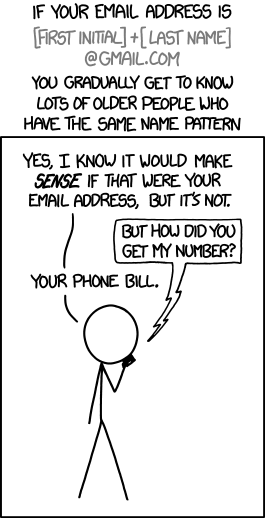
Sometimes XKCD comics can be a bit obscure, and this one made me ponder for a minute:

The point is that many people, believe it or not, assume they have a pre-assigned email address waiting for them at terrygoldberg@gmail.com or margaretsopolosky@yahoo.com. It's crazy just on the face of it, but misunderstanding technology is one thing, and assuming you're the special Bob Jefferson who gets that address is nuttier still. And yet many people, asked for their email address, really do just make one up. They enter on forms - or pass on to friends - addresses they've never actually signed up for, ala UncleLarry@gmail.com.
Breathe. Don't forget to breathe.
The comic left me perplexed yesterday, as I pondered it all, but it's even worse than that. For about the hundredth time, I just typed in a URL I'd found on a restaurant takeout menu and found that there's no such site. I'd always assumed this happened because someone made the mistake of publicizing the address before the site went live. But now I realize...it's the same phenomenon. They're just making it up.
The point is that many people, believe it or not, assume they have a pre-assigned email address waiting for them at terrygoldberg@gmail.com or margaretsopolosky@yahoo.com. It's crazy just on the face of it, but misunderstanding technology is one thing, and assuming you're the special Bob Jefferson who gets that address is nuttier still. And yet many people, asked for their email address, really do just make one up. They enter on forms - or pass on to friends - addresses they've never actually signed up for, ala UncleLarry@gmail.com.
Breathe. Don't forget to breathe.
The comic left me perplexed yesterday, as I pondered it all, but it's even worse than that. For about the hundredth time, I just typed in a URL I'd found on a restaurant takeout menu and found that there's no such site. I'd always assumed this happened because someone made the mistake of publicizing the address before the site went live. But now I realize...it's the same phenomenon. They're just making it up.
Subscribe to:
Posts (Atom)