Sunday, December 9, 2018

A Toasted Bagel Tutorial and Manifesto

This starts off about bagels, then blears without warning into something more broadly about toast. I was going to re-jigger it for consistency, but I really want to say both things, and it's my party, so I'll blear if I want to.


TOASTING
Every toaster has a hotter side, and the brown part of the bagel must face that side. You want the brown side thoroughly caramelized, its blisters well-crisped. The cut side is a more delicate matter. There is an extremely brief window where a wide diversity of toasty coloration and texture can exist. The outer rim has just begun to display a dark golden brown hue while virginal white wheaten patches still punctuate a fast-widening golden landscape. Wait another second, and the entire surface will be browned, dry, monotonous. Pull a second too early, and there'll be little crunch or resistance (#resistance).

To zero in on that vanishing moment requires high-level attention-paying. As I wrote last year:
I've made toasting a spiritual practice, honing my tolerances to milliseconds, aiming to extract the bread at its peak. That's working out quite well, but it's just a matter of vigilance and commitment - of wanting it (watching me peer expectantly into my toaster oven, you'd think I was slicing atoms).

BUTTERING
You must commence buttering immediately, and work swiftly. You can't pause for an instant, because the surface is rapidly cooling and drying - i.e. becoming less absorbent. Soon, your buttering knife will kick up micro-powder from the desiccated surface (if you hear that awful scraping sound, you're too late), and the powder will settle back down and absorb the butter. Greasy grit. Awful.

You must strive for very thin yet very thorough coverage. Know that there's a theoretical limit to buttering thoroughness. One can never completely cover the surface without using huge quantities of butter. So one must triage. Darker ridges are the highest priority. Being more caramelized, they're more flavorful, so non-butteriness will stick out more than with butterless gaps in milder, breadier portions.

There must be no pooling of butter. I understand the French aesthetic of bread-and-butter (i.e. tons of the latter), but a bagel - a homely, sturdy carb bomb - is no sophisticated Frenchie delight. A bagel is earthy, and whether you're a Hispanic Indian pounding out tortillas or a Japanese crunching through the rooty delights of kinpira, earthiness is something to connect with directly, and not to defile with reckless gussying-up.

Also: this is toast. Fresh bread can receive infinite butter while remaining bread, but toast absorbs, and no one wants to suck saturated pockets of liquid butter from their toast. Yuck.

This is more or less where it becomes about toast, generally. Hey, happy holidays, everyone! Be careful out there, and don't forget to tip your waiters! Ok, I'll let you get back to it...

The butter's nothing more than a necessary compromise to mitigate what would otherwise be unendurable blandness. So paint with your knife, rather than smear. Butter quickly, yet thinly, yet thoroughly, a devilishly tricky goal. In my fifth decade of effort, it still doesn't come easily. It requires inhuman commitment.


TIMING
If your first bite comes more than 10 seconds post-buttering, you've committed an atrocity. That hard-won diversified landscape of toasty texture is quickly stiffening into the inevitable end state of hard, dry unity; what industry types call "bagel rigor mortis". The clock's ticking, so you'd best be chewing.

If your ideal breakfast is to leisurely work on a crossword puzzle with periodic interruptions for a bite of toast and a slurp of coffee, for god's sake, find some other bready vehicle. Toast must be eaten not calmly, like a croissant, but eagerly, like xiaolongbao.


YOU'RE NOT RIGHT
I realize much of this contradicts widespread beloved life habits. But people acclimatize themselves to hideous culinary results all the time. The average American is perfectly fine with roaringly rancid nuts (e.g. 75% of the nuts in packaged foods like breakfast cereal or granola), and see no problem at all with "skunked" beer, where light's interacted with the hops through clear or green glass bottles to conjure up horribleness. We accept awful tastes out of habit, and toast is among the most grievous victims.

If you enjoy crap like Taco Bell, bless your heart. It won't taste any better if you're diligent, so scarf freely. Botched toast, however, is a crime, and a waste, because toast can be great.


SACRAMENTAL RELICS
Ok, cue the singing angels (and click, please, for full porn):


...and no, you can not have my bagel plates when I die. They will be shattered and buried, because I have looked long and hard but found no one worthy of the mantle.

Saturday, December 8, 2018

Being Bob Hope

Whatever you do (assuming you think you're pretty good at it): if a total stranger stumbled across your most recent three efforts, would he find them impressive?

If not, regardless of your excuse (e.g. if they were just dumb jobs you essentially phoned in, knowing that'd suffice; or if it was a bad day; or if the asshole who hired you didn't want quality; or if you had life issues distracting you from doing your best work) then you might want to reexamine your self-image as someone-good-at-what-you-do. You have very likely fallen victim to a widespread virus that makes people forget that they need to actually be good to assume they are good. Not just once, at a fondly-recalled peak, but all the time...including right now.

I saw Bob Hope sporadically on TV for thirty years - from the early 1970's until his death in 2003 - without once so much as cracking a smile at a word he ever said. I sat through accolades and standing ovations, preenings and posings, and he was never, ever funny. It's not that he was in a decline - i.e. trying his best but simply out-of-date. He made no apparent effort at being funny, nor did he seem to care in the least that he wasn't.

He didn't need to be. He'd grown beyond it. He was Bob frickin' Hope. And that, alarmingly, appeared to be sufficient. A reputation for quality paradoxically supplants any obligation for quality. So if you want to be That Guy Who's Good more than you want to actually be good, there's no reason not to stop cold at that finish line and gloat amid the perqs.
Most singers become singers because they want to be singers, not because they want to sing.

When I finally saw some of Hope's old movies, they, unsurprisingly, weren't funny, either.

Friday, December 7, 2018

Pro-Bono Dignity vs the Condescension of Compensation

I had two friends over my house, served them delicious drinks, and drove them to a great obscure place for dinner and back. When the check arrived for our meal, and we all pulled bills from our wallets, one refused the $10 change he had coming to him. "Keep it!" he told me. " All the driving and hosting...!"

I, alas, couldn't conceal my indignant reaction (which he absolutely did not deserve; one of my several character flaws is a complete lack of 'game face'). "Ten bucks doesn't cover all that, dude!" I replied. To his credit, he thought about it, nodded slightly, grabbed the ten, and stuffed it in his wallet.

A lot of my seeming "generosity" stems from the disgustingly conceited conviction that my effort is priceless. 'For free' makes it a gift, and there's dignity in that. Turn it into a job, and odds are that I'll recoil from the inevitable condescension.

I remarked to a friend during my Chowhound slog that if I were being paid to run the site, and it was anything less than an absolutely obscene wage, I'd have dropped the whole thing in a hot second. Stressful 15hr/day/7day/week unpaid work amid abject poverty was preferable to the prospect of condescension.
I've been condescended to a lot in my life, and have become over-sensitized. I used to consider this evidence of my own roaring ego, but eventually discovered that I don't enjoy deferential respect much, either.
Working for free is always the next best option.


At age 21, I was the world's angriest street busker. When someone threw a quarter into my trombone case, I wanted to throw it right back at them. It's not that I expected them all to toss fifty dollar bills. I didn't know what I'd expected! I just sure as hell valued myself at more than a lousy quarter. And, to this day, I still can't unravel the knot. I see how my perspective is justified and right, and also how it's awful and wrong, but can produce no higher-level Slog-ish insights beyond reporting a deep, deep impulse to simply play, period, and let it be a gift. To let it all be a gift. It sounds kookily quasi-messianic, I suppose, though - at least when I think about it - it feels like defeatism.

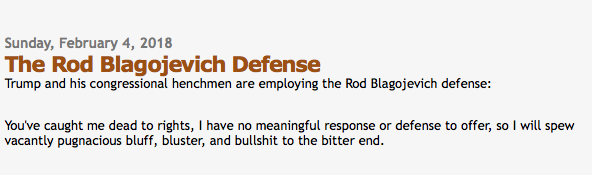
It Will Be Totally Rod Blagojevich

I have a prediction on the Trump/Russia thing. I already essentially put this on record back in February:
...but let me solidify it.

The president has no strategy post-Mueller. His lawyers might have concocted a strategy, but they knew their client would just blow it up with some stupid tweet, so they've simply kept him out of Mueller's hot seat and gathered intel on the investigation via slimeballs like Manafort. And his aides haven't the slightest idea what he actually did, so they have no way of anticipating any end game. After towing the brainless, loud-mouthed "No Collusion!!!" line for months, that's all they've got. It's the facade, the building, and foundation. There's no other structure.

So just as dear, dear Rod Blagojevich indignantly and furiously insisted on his innocence of blatantly obvious crimes right up until his fate was sealed and there was nothing else to say, we'll see that Trump’s got nothing (or, as Giuliani might put it, "bupkis"). We'll hear incredible tales backed up with incontrovertible evidence from Mueller (or whoever winds up sharing/leaking Mueller's report despite Trump's inevitable effort to muzzle it), and there will no rebuttal.

Needless to say, there will be fire and brimstone, rage tweeting, random incriminations and deflections, and there might even be a tail-wagging war with Iran to try to change the subject. His base will stand with him, and as long as they do, so will the Senate. Impeachment is inevitable, but conviction is a very tough hill to climb. So I'm not saying the story will be over.

But mark my words: it will be utter anticlimax. He'll be even guiltier of worse deeds than we imagined, and that...will be that.

Tuesday, December 4, 2018

An Epistemological Dialog on Awakening

Ralph: So, Ted, after doing all that meditation, are you enlightened?

Ted: What do you mean, Ralph?

Ralph: You know, Enlightenment! Nirvana! Spiritual realization!

Ted: So far as I understand, those terms all describe something inherently unknowable and undefinable. So you're asking whether some essentially random label applies. You may as well ask me whether I'm fzzzzzgppppp.

Ralph: Are you fzzzzzgppppp?

Ted: No idea. But whether I confirm or deny, if the question is unknowable, what difference does the answer make?

Ralph: But enlightenment isn't completely mysterious. It's the recognition that there's no separation. All is one, etc etc.

Ted: Well, if you know this, it means you're enlightened, no?

Ralph: I don't actually "know" it; I just know the gist.

Ted: It doesn't sound like something that could boil down to a gist. But, anyway, if someone recognized that he isn't separate, then he'd have to be nuts to then go ahead and affix a label like "enlightened" onto that non-existent separate self, right? Isn't that a complete contradiction?

Ralph: My head hurts.

Ted: I do view the world via a different perspective, but since perspective is inexpressible (we can describe objects but not framings), it's really not a useful question.

Ralph: So what's a more useful question?

Ted: "What have I forgotten?" You and I and all the rest of us are aware of the truth at some level, because it's the same truth for all of us. Even if we've mostly forgotten, it's still what we are, and can be related to - if only slightly.

Ralph: Ok: what have I forgotten?

Ted: That the stories of you, your life, and your world, are just stories. Everyone's pretending.

You surely recognize, for example, that you're the same child you always were, only now pretending to be an adult. Just like people caught up identifying with a movie plot or with being Yankees fans, you've convinced yourself it's all rock solid. Underneath, though, you know full well that you're playing. Pretending. You choose to forget in order to heighten the experience; an ongoing suspension of disbelief. Yet underpinning it all is a steady hum of awareness that's always been there and never wavered. That constant, unchanging hum is what you are. It's the part that chooses to do the pretending.

Even if you don't have it all worked out in your head, does this ring the least bit true for you?

Ralph: I guess I can kinda/sorta relate to what you're saying, a little.

Ted: Good! I'll take it! Let's say you 5% remember. That's pretty good!

Ralph: So are you saying you don't pretend? Or that you remember that you're pretending while you're pretending?

Ted: I pretend when I'm with other people, while 75% remembering. In other words, I pretend, but lightly. So I can easily snap out of the pretending.

The snapping-out is actually the hard part. I had to work hard just now to induce your 5% remembrance, and it's already fading. If I see you in Walgreens next week and ask whether you still remember, you might nod a hazy, tentative "yes", but you won't really remember. But if we meet and you looked at me expectantly, I'll nod my head with full bemused recognition...even if I'm in the middle of a screaming fight with the cashier, or picking up newly prescribed terminal cancer meds. I never completely forget. That's the difference. The only one.

Ralph: So how do I increase my remembering from 5%?

Ted: Remembering, like any faculty, can be developed. Again: meditation, etc. But I need to warn you that if you work at it for some time, and then slack off, you'll retain a false confidence. It's hard to distinguish between real remembering and the remembrance of remembering. You'll feel certain you still have "the gist" of it - a sort of mental snapshot - even though actual remembering is no longer available. The gist of remembering smoothly dissipates into the fog of forgetting. While remembering remembering, you can easily forget that you've forgotten.

Ralph: Kill me now.

Ted: I just did.


Further Reading:
Waking Up
Realized, Shmealized
Spirituality in 333 Words
Spirituality in 33 Words
Why God Lets Bad Things Happen
Soothing the Baby
All postings tagged "Spirituality"

Monday, December 3, 2018

Art

Art is any human creation devised to induce a reframing of perspective.


All postings labeled "definitions"

Sunday, December 2, 2018

A Business With No End

I have never before seen a newspaper story anything like "A Business With No End", published, somehow, last week by the NY Times.

Remember that weird FBI raid a while ago on Newsweek, which hooked into the cultish group that had bought the company and had immediately set about mass-firing the journalists?

Do you ever wonder about those Amazon marketplace sellers who price items several times higher than Amazon itself does?

Have you ever had the subconscious impression that clickbait is growing like kudzu - just as fast as you've learned to evade it - and that it may have become vastly vaster than your vastest imagination could imagine?

And have you noticed that the clickbait model of aggressive, empty, attention-clogging trash has adapted and propagated to every plane and realm? As the article asks,
What is the experience of clickbait other than realizing we have vastly overpaid, even if only with our attention? News, information and products are simply someone’s inventory.
Most scarily, had you ever imagined that the kudzu of multi-realm clickbait might leap from our monitors and begin taking over our actual world? Quoting the article again:
Still harder for me to grasp was the total interpenetration of e-commerce and physical space. Standing inside Stevens Books was like being on a stage set for Stevens Books, Stevens Book, Stevens Book Shop, and Stevensbook — all at the same time. It wasn’t that the bookstore wasn’t real, but rather that it felt reverse-engineered by an online business, or a series of them. Being a human who resides in physical space, my perceptual abilities were overwhelmed.
What if all the above are weirdly related? Well, they certainly seem to be. Check out the article. But I would discourage you from reading it in its entirety. It's a vertiginous microcosm of the vertiginous house of mirrors it futilely attempts to map.

I'm dumbstruck that the NY Times even published it. It lands absolutely nowhere, serving as a deftly researched/written performance piece more befitting of Werner Herzog or Lars Von Trier than the Grey Old Lady (I suppose they did it to swipe back at the folks who ran Newsweek into the ground; journalists grant themselves unusual indulgence in score-settling against those who attack their profession).

Read the first few paragraphs, and, each time you start feeling as if you're drowning, jag forward via agitated punchy scrollings until the narrative retracts itself from each of countless rabbit holes and cul-de-sacs. Do not read thoroughly/carefully. Do not attempt to follow all the way down, and for god's sake, do not Google. There madness lies.

A ten minute browse is sufficient, and well worth the effort. In the 70s and 80s, weighty "futurists" would tell us what the future would be like, their predictions inevitably laughably wrong. But there's something about this article - this article! - that leaves me certain I've been shown a sharp picture of Life on Earth circa 2025 (i.e. just before we all perish in the rising waters). It may - or may not - be the diabolical and unknowable scheme of a slippery Korean-American evangelical pastor/spider named David Jang and his shady company, IBT Media, and his shady bible college, Olivet University, in association with all matter in the visible universe.


Update: check out this comment on the article.

Dud Monolith?

I was listening to a podcast about the film "2001" where one of the guests (Dr. Drang, at 17:50) made an interesting point which sailed over the heads of the other guests:
"The monolith isn't magic - or "technology that's indistinguishable from magic". It is just a black solid 1 x 4 x 9. That's literally all there is to it. And the reason it accelerates their evolution is that by merely seeing this thing we would now call "man-made" - not a natural formation - is just enough to kick that one ape's mind into the idea that you can form the world to your desires; that you don't have to accept everything as it is. It's not trees and rocks and grass. This thing is clearly not a tree, or a rock, or grass. It is so unlike anything you've ever encountered that it triggers in your mind a new way of thinking about the possibilities...It's just literally a simple non-natural shape...and that would be enough."
So the first monolith - the one that appeared before our apey ancestors in prehistoric times - might have delivered zero juju. It may have been sufficient to come across an obviously unnatural object to catalyze the realization that we can build and control; that we needn't be unwitting flotsam in the daily life of the world; that our conscious intelligence lies beyond the frame. It's not genetic evolution so much as a contagious expansion of consciousness.

The monolith on the Moon was different. That one (like the one near Jupiter) was a tripwire, beaming home notification that the humans had reached a threshold. But the apes had done nothing especially clever; nothing to indicate a threshold having been reached.

I'll add this thought: if the first monolith had directly intervened to effect some critical change, why hadn't it done so the previous week, century, or millennium? Why had it chosen to appear then and there? It can only be that that one ape was primed to make the leap. It was time. And this particular leap requires only an expansion of awareness - a reframing. Reframing can never be externally imposed (nothing in the universe can alter your perspective for you*; this is the essence - and extent - of your free will), though it certainly can be externally inspired, e.g. by art. For example, by a jarringly smooth and beautifully polished monolith, or by an equally jarring and polished film.


Two Kubrick bonuses (click for legibility):


Saturday, December 1, 2018

When Mere Decency Seems Heroic

The following may read like a disrespectfully back-handed compliment (poorly-timed, to boot), but I feel compelled to make a larger point - one that I suspect George H.W. Bush himself would have eagerly agreed with.


What It Takes, the much-admired study of presidential politics, marvels at Bush's common touch (read the chapter for free here). As a WWII officer, he had personal relationships with the enlisted men under his command. He referred to his chauffeur by his name, rather than referring to him as "my chauffeur". He behaved like an ordinary guy, rather than like a stuck-up patrician prig, and for that we are to laud him.

And as president he disavowed the political rise of David Duke, an unrepentant Ku Klux Klan grand wizard. We are to deem this a monumental gesture of humanitarianism.

I get it. I myself once wrote that "character is measured by the rate at which one discards one's values as stakes rise," and George Bush had plenty of character (not to say he was a moral paragon, which he certainly wasn't). And it's undeniably true that character is in very short supply these days on all fronts...and has never been particularly common.

But it's nearly impossible to express how sad it makes me to be part of a species where character is so rare that we celebrate its possessors as heroes. Treating people like people and declining to condescend oughtn't be heroic. Disavowing Nazis oughtn't be heroic. Are we really to be moved and inspired by mere common decency?


Whenever someone dives into water or otherwise puts themselves at risk to rescue someone, newspapers deem them a hero. Inevitably, the hero objects that this is simply how everyone should act...and this "modesty" adds to their heroic legacy. We would do well to listen more closely to such "heroes", and take them at their word.

Same for celebrated people who refuse to take personal credit for epiphany, eureka, and inspiration, since this stuff - the really good stuff - inevitably arrives from who-knows-where. Why don't we take them more seriously when they try to explain this?


Fantastic Breadless Stuffing

Big discovery. This is the best stuffing I've ever had, it's super easy to make, and it doesn't use any bread (I will not use the "g" word). Low fat, to boot.

Any time I post a photo of a meager food portion, that's a good sign. It means I tore into it like a hunger-crazed wolverine before calming down sufficiently to think of shooting a picture.


Heat nonstick pan to medium, spreading olive oil thinly but thoroughly (e.g. with a paper towel). Sprinkle salt and more black pepper than you imagine you need in the pan.

Coarsely chop a medium onion and spread it out in the pan. Cook a minute or two.

Finely chop a few red Swiss chard stems (green works, though is less festive-looking), add to onions.

Skin and use a fork to hastily/coarsely mash a large leftover baked sweet potato (I prefer Murasakis, the purple-skinned Japanese ones, seasonally available at Trader Joe's). When onions and stems are soft, lay mashed sweet potato over vegetables. Add a small splash of water or apple cider (especially good: cider sediment and/or cider that's slightly spoiled) to pan surface (i.e. not directly onto vegetables) and immediately cover tightly (if liquid doesn't immediately sizzle, increase heat).

When liquid stops sizzling, stir violently with spatula, add another splash and cover again.

Season with cumin and chili pepper flakes. Stir again (optionally drizzling some olive oil atop before final stir), and monitor closely, removing from heat once onions are nicely brown. Timing is tricky. Sweet potatoes burn easily, so it's better to forgo fully-browned onions rather than risk burning the sweet potatoes.

Blog Archive